35. Moving Towards, but Also Away From, the Dutch East Indies, Feb 8 – 12, 1938

To recap, Helen was just recently in the Dutch East Indies for Chinese New Year (1938 = year of the Tiger), then took a tour through a brink-of-war Singapore, with its air raid drills and harbor full of battleships. And now, though she keeps her forward momentum, she is back in the Dutch East Indies.

To visualize the geography of this, I have created a map of all the places she stopped on the five month trip around the world (the loop-de-loop is her inland visit to the Taj Mahal). There are some zigs and zags, but no backtracking.
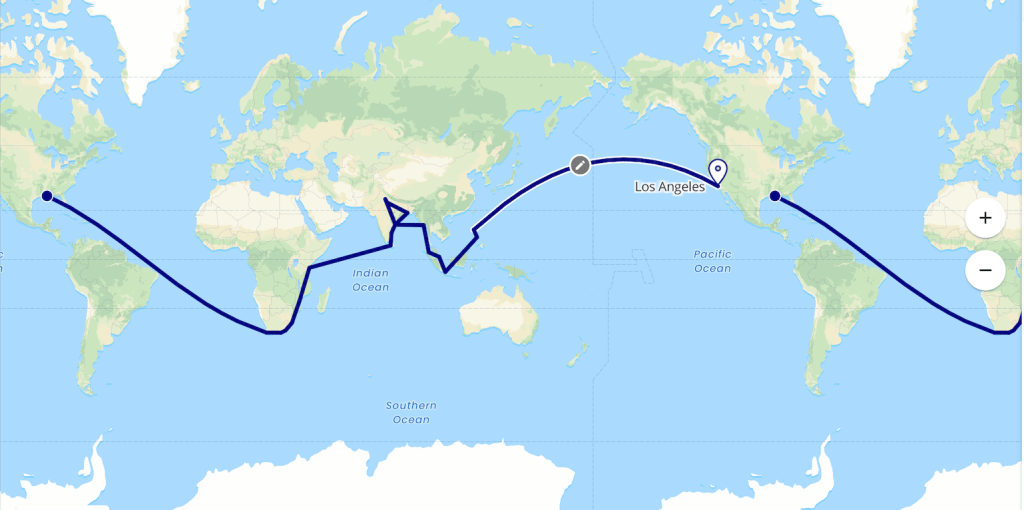
The M.S. Silverwillow started its voyage in New Orleans in 1937 and ended (at least Helen’s leg of it) five months later in Los Angeles, in 1938

A zoom-in on the map might not show the exact seafarers’ route (but never doubt that there could have been some Fitzcarraldo-esque boat-over-a-mountain stuff going on). Even if it weren’t a crow’s fly map made with a free app, you can still tell, geography-wise, how a boat might visit the Dutch East Indies (now Indonesia) twice, before and after a stop in Singapore.
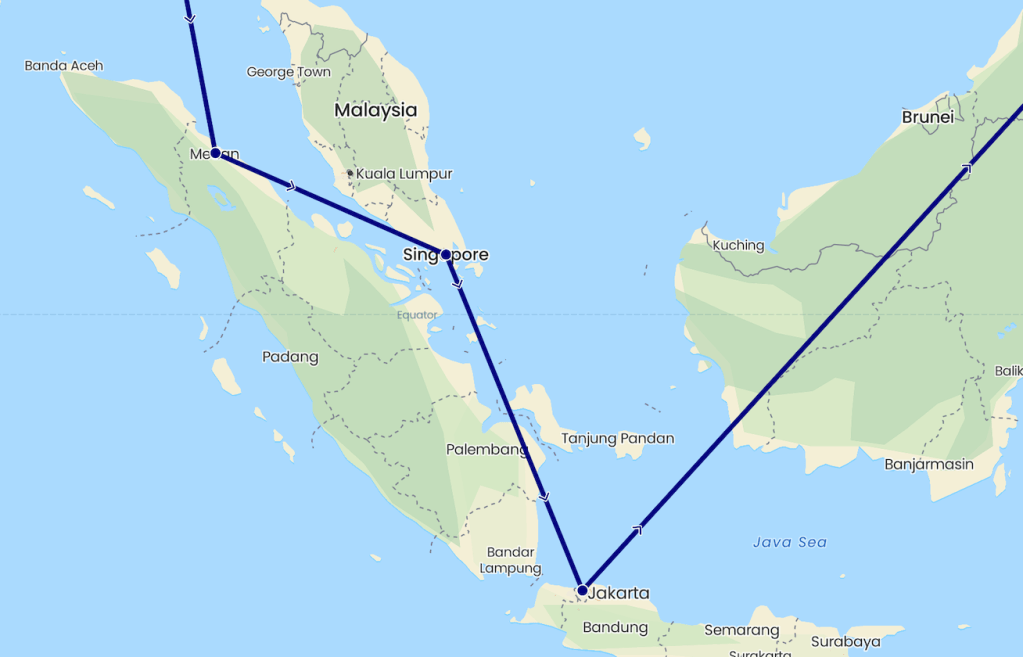
Helen’s exact route, via boat, through South East Asia, 1938.

Now that we (I) understand the trajectory, we snap back to a world simmering in war.

Day-to-Day Journal

Tue Feb 8 

Up with the anchors at 6:00 a.m. into the harbor of Tandjong—Priok past two rows of warships, 3 French, 2 Dutch. Still wind blowing, came too close to the Dutch Navy for comfort as we made two passes at the mooring buoy.

Silverteak came in just astern of us, did not go alongside as we expected.

Side note: The Silverteak survived World War II. The Silverwillow (the boat Helen was on) was used by the British navy, and was destroyed by U-Boats on October 30, 1942. Several men died.

To Batavia (8 mi.), a canal runs alongside the road from Batavia to the New Batavia Centrum (no Europeans live in the old city now (malaria)). 

Took pictures of the laundry being done in the canal.

Side note: I wish I had more pictures. There are barely a dozen of the whole trip, and most from the early time at sea. The canal might have looked like this.

Batavia was known as Cemetery of Europeans because of the rates of malaria.

Fine stores, we went in only one, having no more time. Thru Batavia museum, beautiful dignified building with white columns, filled with Javanese work: carving, silver, models of types of houses, costumes, implements, Batik, musical instruments, boats — a fascinating place to spend days. 

Outside were many Hindu and Buddhist Gods from Borobudur and elsewhere.

Side note: Most if not all of these artifacts survived WWII, but the local population did not fare as well. The Japanese occupied the Dutch East Indies in January 1942. They were welcomed at first at liberators, after hundreds of years of Dutch colonialism, but ultimately four million people died there during Japanese occupation due to forced labor and famine. The gory details can be found here.

Saw sacred cannon decked with flowers, incense burning. Pony carts like Sumatra, but with flat tops, called a delman - with ponies from Bali. Buffalo hides drying (use for fans, belts, lampshades, etc.) thru the country. Opium factory (control by Gov't.) next to medical college. 

Everywhere along the road coolies in big hats carrying baskets. Hundreds piled high with rambutans (fruit with red soft-spiny shell — hang in great clusters on the trees), mangostein, pomelo, banana, ucus (like small pale lemon, inside formed like a pomelo, has a tinge of banana flavor), also vegetables, tinware, all manner of household articles.

Side note: By ‘ucus’ I believe she meant ugli, which is an unfortunately named fruit. It is also known as uniq in some circles and Jamaican tangelo in others. So much learning.

Goodyear has a large factory, produce 6,000 bicycle tires, 600 truck tires per day. (Gov't. collects 1,000,000 in fees from the bicycles in Java). A large market-looking place with hundreds of people around it proves to be a pawnshop, one of sixteen Gov't. operated ones in Batavia. 

Side notes: The government had its hands in pawnshops, opium factories, and salt. Also, remember my hint in the last post about Helen being back in this part of the world decades later, and that it would be related to rubber? Here is another hint.

Acres of rice fields, tapioca (use root), rubber, sugar, miles of kapok trees, sago palms, pith used for making sago-like small tapioca beads, also ground for bread flour — leaves dried to make thatch roofs for houses, juice makes vinegar and a native alcoholic drink. 

Indigo plants about 3 ft. high have white blossom, plant soaked in water 15 days, crushed, extracting juice, water left to evaporate, indigo powder remains. Tamarind trees growing along road, from them a hot extract for flavoring salads. The palm with the red stem is sealing-wax palm. Betelnut tree a tall very straight-trunk palm with a tuft of leaves at the top, clusters of nuts like the date betel leaf, in which natives wrap the nut comes from a small shrub-like tree, is chewed like chewing gum.

Side note: Sago palm does just about everything, doesn’t it? Puddings, breads, roofs, boozes, and last but certainly not least… BOBA TEA. The also magical indigo powder is used to regrow thinning hair AND to cover grays. In India, she complained about the red betel nut chewing spit splats everywhere, if I recall. The betel nut was more like a cigarette in effect than chewing gum though.

In Buitenzorg the zoological museum, then the Botanical Garden (largest in the world) many thousands of trees I never saw before — trees with trunks like concrete walls, cannon ball tree (fruit the size and shape of c-ball), pandanus, from which Panama hats are made. 

Side note: The Panama hats she saw might have been called Tamsui hats, from Taiwan. They are the same looking. I don’t think the actual Panamanian Panama hats were made from pandanus, as it didn’t grow in Panama. Those (at the time at least) were usually made from the Carludovica palmata plant, indigenous to the region.

Lily ponds with enormous pads, pink lilies, lotus flower — monument to Mrs Raffles. 

Side note: Sir Thomas Stamford Bingley Raffles built The Lady Raffles Memorial for his wife. He was a Colonial governor in the Dutch East Indies in the 1800s. Helen mentioned a Raffles Hotel in Singapore. And I know I’ve heard of Raffles whilst traveling in that part of the world. It’s all the same guy, but the latter without the Thomas or the Bingley. Why is a British dude the governor of a Dutch colony? Google says because of a capture, for number of years, of Java by the British during the Napoleonic Wars. Then it went back to the Dutch. Maybe the monument was nice so they kept it.

Houses in Java are made of bamboo matting, for there is no good building wood here except teak, which is very expensive and a Government monopoly. Bamboo house lasts about 20 yr.

Side note: Teak was not indigenous to the region, but had been growing there since the 16th Century. Excellent building material (rugged stuff used for floors and boats and furniture) was available locally, but the colonial government hoarded it for their own use and profit, and locals got to build bamboo houses that last for 20 years. Cruelty and greed.

A new passenger on our return — youngish, male, married, from Sacramento. Daisy nabbed him. 

Side note: Daisy is ‘Miss Daisy Mount’, who Helen described as, “Sweet little old lady, dainty, birdlike, speech a bit breathless as tho people wouldn’t listen. Pioneer stock.” But here she is ‘nabbing’ a youngish married man. In a post several months ago, Helen said that Daisy, “had an acquaintance”, and she also was involved in some gossip, telling Helen there was “axe in the offing”.

I think I may have found her! Sarah Fisher ‘Daisy’ Mount was born in 1867 in the San Francisco Bay Area. In 1938, she would have been 71, so that tracks (Helen was 34, so 71 would be quite old). After docking in Los Angeles, Helen traveled north through California, visiting Daisy in SF on the way.

Helen also mentions that Daisy has ‘pioneer stock’ and pioneers were settling all around the Bay Area in the 1860s. And now here was Miss Mount seeing the world and nabbing young men. Go Daisy!

Miss Mount passed away in SF in 1945 at age 78.

Why we know so little about the few other civilian passengers on the boat is because Helen was focused (people-wise) almost exclusively on the men that worked on the boat.

Wealthy Chinese own much of the land in Batavia. 

Started sleeping out, hot and humid — coughed for hours in spite of Jim's toast at 10:30 — paced deck, slept in for a couple of hours.

Ashore in a boat with a port oar and a paddle in the stern. -10 Java cents each way. Quite something to see our passengers climb in and out.

Side note: Sleeping ‘out’ probably means that she is back in the hammock that she helped measure, cut, sew, and hang on her way from New Orleans to Cape Town.

And regarding people climbing in and out of the boat… I think she is poking fun at the more elderly of civilian passengers, who mostly have at least three decades on her.

Wed. Feb. 9: Dropped the pick in the early dawn at Cheribon. Tug with 7 lighters came alongside. Unloading gunnies from Calcutta, taking on a few tons of Sago flour. 

At 11:00 Capt. asked if we wanted to go ashore. H.Q. & I went with him. Stopped for a beer at Hotel Cheribon, Then 30 mi. south to Lingga-Djati, to Hotel Rustoord, beautiful drive. Rice fields and rice fields, men, women, and children working in them — every separate shoot planted by hand. Mt. Cheribon — 10,000 ft. volcano shrouded in clouds most of the day, extinct for 200 yr., became active last year. Sandwiches, milk, fruit for lunch (my first glass of milk since Capetown and this was boiled).

Side note: I cannot find anything about the Hotel Rustoord, but the word ‘rustoord’ means old people’s home in Dutch.

The Mt. Cheribon she mentions is indeed a Mt. near Cheribon, but it is actually named Mount Cereme (or Ciremai or Ciremay).

There is so much Dutch East Indies that we must cut this one in half… but stay tuned because next we have more war, but also some peace.
34. Fancy Fliers, Cossack Choirs, and Balmy Tigers, Singapore, Feb 3 – 7, 1938

The After-the-Trip Letter

Singapore...magic name...it can be anything you want it to be. Will you have pineapple and rubber plantations and factories, a new modern airport whose administration building is second to none in the world....

Side note: The fancy Kallang Airport was born in 1937 and Amelia Earhart had swooped by there shortly after its debut. Her fateful flight was just a month or so later.

Remember who also flew planes? Helen. Purportedly, Helen and Amelia lived in the same dorm room (not at the same time) at Columbia University’s Teacher’s College, where Helen received her Bachelor’s (1920-24) and Master’s (1931) in Physical Education. Amelia lived in the room in 1919-20 and Helen in 1931, says my sleuthing.

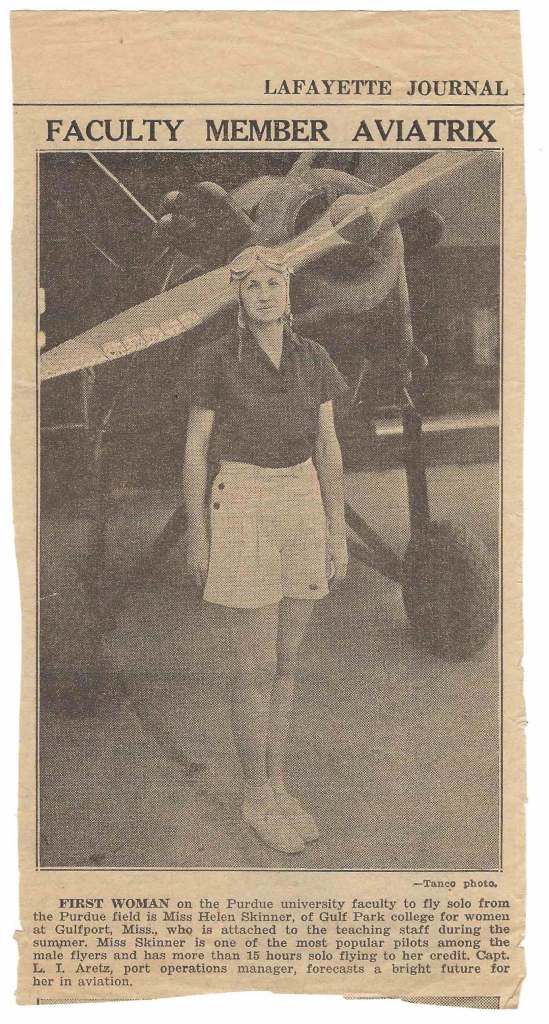
Another coincidence is that they both taught at Purdue, in the same year (1936), and they used the same airfield, but apparently never met. I’m pretty sure Helen only taught one summer semester at Purdue, but still. Here are some snippets from a newspaper story about Helen: “First woman on the Purdue faculty to fly solo from Purdue field … Miss Skinner is one of the most popular pilots among the male flyers … Capt. L. I. Aretz, port operations manager, forecasts a bright future for her in aviation.”

And guess who also knew Aretz, Miss Amelia. There’s a whole movie about it.

I talk about the fun parallels in a previous post.

Since I don’t have any pictures from Helen’s time in Singapore, here is the newspaper clipping about her from Purdue in 1936.

Helen, being cooler than most of us, The Lafayette Journal, 1936, Purdue U.

And now we transition back to Singapore and February of 1938….

...American movies cantor in "Ali Baba Goes to Town', to be specific...the Don Cossack Russian Choir was there, too....good ice-cream (for the first time since New Orleans)...a wish for a fortune to spend on Chinese silks and linens, magnificent hand work at iniquitously low prices....tea at the Raffles Hotel, and swimming at the Singapore Club and dinner afterward at the home of friends.....

Side note: Ali Baba Goes to Town (that link is the trailer and I suggest a look see) is a 1937 musical comedy with Tony Martin, featuring lily white Arabian Sultans and, not surprisingly, blackface. Hollywood certainly did its best at exporting American-branded racism to theaters around the world.

Sadly, two people were killed in a flying carpet incident during the making of the film.

The Don Cossack Russian Choir were exiled Cossacks who started a choir in an interment camp in Turkey. They performed over 10,000 times. By 1938, they’d been at it for 15 years. Here’s more of their music and it’s quite lovely.

...and a strange night of "blackout" during British manoeuvres, when every light in the city was out, and all night long we watched the fingers of fifteen searchlights make patterns across the sky, pointing at squadrons of planes as they flew high overhead, trying to evade the anti-aircraft batteries. War seemed very near, and the demonstration was too realistic for comfort.

Side note: The British colonial government’s Air Raids and Bombardments Precautions Sub-committee in Singapore had started doing test air raid blackouts in 1936. In 1941, Singapore was indeed hit by the Japanese and eventually fell to their army in 1942.

Like the Dutch East Indies, the Japanese left when they surrendered, but unlike the Dutch, the British came back and stuck around Singapore for a few more decades. Singapore would become fully independent in 1965 after a few years as one with Malaysia.

The Day-to-Day Journal 

Helen’s day to day journal from the same time period as the letter above adds context and quite of a Helen-style detail (costs, weights, conversions, measurements, timelines, routes, schedules, distances….). She has detail for everything EXCEPT the juicy stuff with Shag.

Here is most of it, with a sprinkle of commentary:

Thru. Feb. 3: 

Woke at 3:00 am. when the anchor went out, lights of Singapore all around. Up at 6:30 harbor full of British battleships. Pilot came on just before 7 a.m.

White ships on green water against pink clouds in a gray sky.

Money changers, vendors of all kinds on deck before breakfast.

To Chinese and Buddhist temples, thru Malay villages, Singapore Swimming Club, airport (mud flats filled in, one of most beautiful airports in the world, very modernistic) saw a few planes, but none in the air.

To a pineapple canning factory (Sin Heng & Co.) still celebrating Chinese New Year, it was not in operation. Cut and slice, wash, add sugar, cook, can, label, ship. Very clean, white tile tables.

Goodyear Rubber Co., 2 young men from Akron, Ohio — showed us around. Rubber sheets weighed, sorted, graded, repacked, pressed (bound with steel straps) into space not to exceed 5 cu. Ft.

Side note: Later in life, Helen would be involved in an industry that relied on rubber, and would be back in this part of the world, but you have to read on to find out more.

Dropped me at the ship, lunched, Shag's watch changed. Beastly hot. Steak dinner for 50 ¢ (Sing.) at Café de Luxe (with the case of Javanese carbine, silver, batik in the window). 

White ships on green water against pink clouds in a gray sky

Fri. Feb 4: 

To botanical gardens, fed the monkeys. Past the Eng. & Chinese homes in the best residential section.

Into the grounds of the Chinese whose "Tiger Balm" has made him enormously wealthy. The most unique gardens - pools and gardens, pagodas and houses and people in miniature, exquisitely done.

Stop at a rubber plantation, saw the latex oozing and the process involved before it goes to the shippers.

Into Jahore over the quite new causeway. Saw Sultan's Palace (his Scotch wife divorced him 2 mo. ago.) At the Mosque to hear the Muezzin's call to prayer. Watched the parades of the police, the soldiers. No women worship in a Mosque. Took some movies which I shall probably never see.

Side note: Singapore: exquisite gardens, oozing latex…

The Tiger Balm guy’s was known as The Tiger Balm King. And his gardens are called the Tiger Balm Gardens. His name means tiger, hence the product name. His story is most definitely worth a look see.

Sultan Ibrahim of Johor (not the Hollywood Sultan), would soon head to Europe to help with his gout and also, since he happened to be in the region, meet with Hitler and Mussolini. He also got briefly detained on suspicion of being a spy.

Shag and I took a rickshaw ride, then sat on the jetty until midnight. At 2 a.m. the generators were shut down, a great silence came over the ship. The city lights went out. Blackout for war maneuvers, Plane roared thru the sky pursued by searchlights. Eight fingers of light making patterns on the black page of night. Signal lights flashed — I caught on in time to get ._._. (end of message). Wandered all over the ship from one vantage point to another until 5:30 a.m.

Side note: I want a picture of those two cuties on a rickshaw!! I just asked an AI thing to create one and it would not. It could have looked like this and how perfect for their ongoing meetcute.

Sat. Feb. 5: 

Hot! Struggled up after 2 1/2 sleep, shave legs, get bathing bag from trunk which was behind the last box in the store room. Kept the gang waiting while I dressed.

Uptown with our driver to Adelphi Hotel, Mrs. Reed picked me up at 10:00 a.m. with her Dick (8) and David (4) and 2 girl children of a Methodist Missionary to the Singapore Swimming Club. A breeze, salt water just the right temp, felt marvelous. To the Reed home, no windows, open on all sides with shutters instead of glass. Closed only to keep out rain (rain 360 days a year), everything mildews, cloth, floors, cloisonne even. She lived 11 yr., he 16, in China. Both speak the language fluently, loved China. Three yrs. Dick has been twice around the world, at 8.

Side note: The Reeds might be with the YCWA or another athletic organization. I suspect Helen was job prospecting at some of these ports. She had not planned on getting distracted by a certain Mr. Shag.

Had a ma mee for lunch, a hybrid Chinese dish — noodles, chopped cooked egg, prawns, crab meat, nuts, raisins, soy sauce, very delicious. American cake, good coffee, Eskimo pie!, Pomolo, mangustein. 

Side note: Very adventurous with food, that Helen. Some people in the family (me) are not. I envy that.

Heavy rain as we reached town, took me to Tang's on Middle Valley Road, one-price Chinese store, beautiful things, but I'd spent too much money. She dropped me in High St., found H.D. in the café with Chief who had rescued her when she'd almost fainted (touch of the sun, no doubt). 

Back to the ship for 4 p.m. sailing, to find we'd sail at noon tomorrow. Our crew from Shanghai under the domination of the Bos'n, a petty racketeer (the Shanghai agent takes all the 1st mo. wages, the Bos'n $9 (Shanghai) a month, asst. Bos'n another tong. One group would not work for the other. Some wanted to go home, so in the end all went at 5 p.m., under police escort to jail.

Will be repatriated in a couple of days and sent back to Shanghai. Shag & I walked and talked until 11:30.

Side note: I cannot find anything on this corrupt Bos’n (ie Boatswain, ie guy in charge of boat things), but I did find this extra cool video of Singapore from 1938. It features just about everything she mentions above, except what the flip she talked about with Shag.

Sat. Sun. Feb 6: 

A new crew, Cantonese from Singapore, came to inspect the boat early this a.m.

To the ship for noon sailing. Under way at 2:30, very narrow entrance to the wharf, rammed against the jetty as we were towed out, small dent in ship's side. In the harbor the bos'n let the boom down on a sailor, cut off the ends of two fingers, gashed his face, chest - a gory sight. Put him off in the pilot boat not a very auspicious start.

Side note: My goodness if that happened in front of me my journal would be filled with screams in all caps, but no, for Helen it’s another list: 2 missing fingers, 1 gashed face, 1 gory chest. I’m envious again, as I can’t even watch someone administer a shot on the television without getting woozy.

Visited Shag until 9. Early turned in, very poohed. Heavy rain every day in Singapore, showers 2-4 p.m. often. Keeps air fresh, grass green, but not very healthy, disturbs metabolism, women go flabby very young.

Side note: Remember that Helen has a Master’s in Physical Education so she was no dope when it came to women’s health and fitness. But is this ‘young women go flabby in rainy places’ sounds fishy. So is she right? Yes, but it’s not just women. Everyone gets an equal chance at going flabby quite young in rainy humid places, says Scientific American.

And there we shall end for now.

Next up: War and Peace (literally and figuratively). Stay tuned for that! (And also eventually, why Helen was back in these parts decades later, and how it involved rubber.)

Shag and I took a rickshaw ride, then sat on the jetty until midnight. At 2 a.m. the generators were shut down, a great silence came over the ship. The city lights went out. Blackout for war maneuvers, Plane roared thru the sky pursued by searchlights.

33. Chinese New Year and the House of Orange, Dutch East Indies, Jan 31 – Feb 2, 1938

The After-the-Trip Letter

In the Islands of the Dutch East Indies we stopped at many ports, unloading rice from Burma, picking up spices, tapioca flour, tea, kapok, rubber. 

We drove inland at each stop as far as we had time to go.

There were mountains, volcanoes, miles of terraced rice fields, and an endless procession of coppery brown Malays going to market, carrying two baskets hung on a bar across the shoulders: pottery, sugar cane, durians, mangosteens, kapok pods...we couldn't carry the loads, but they've developed a peculiar jog to balance and distribute the weight, and as days pass it becomes hauntingly familiar to watch, until, for the visitor it becomes a part of the memory of the scene. Gay, colorful in face and dress, clean, cheerful, the Malays seem a happy people.

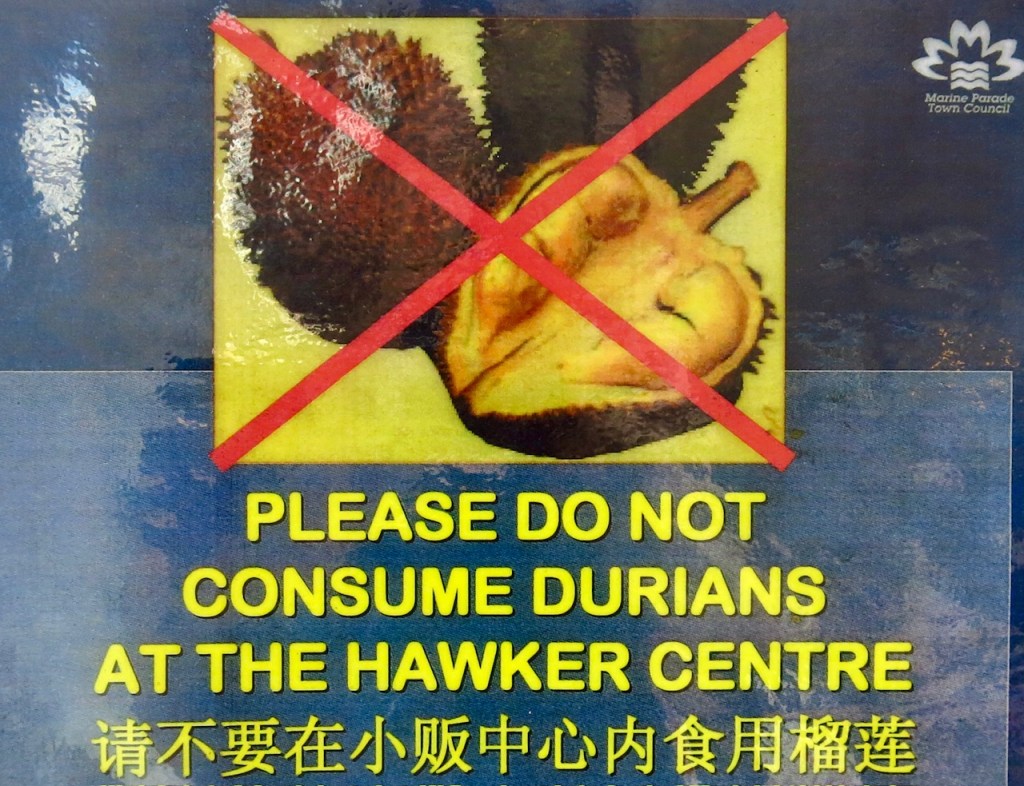
Side note: Durians! Below is a picture I took in Singapore, where they are banned for smelling bad.

A picture I took in Singapore where durians weren’t allowed in most (if not all) markets due to smells. Circa 2015.

The Day-to-Day Journal

Belawan-Deli — Brastagi - Indonesia 

Mon. Jan. 31:

Off the ship at 9:00 a.m. in a 7-passenger car thru Medan and up 4800' to cool mountains.

Gorgeous scenery - thousands of coconut palms, dates, bananas, tobacco barns of palm thatch, tobacco fields protected by thatch sheds, tea plantations - the white flower resembles a syringe, paddy fields, coffee. Hair-pin turns, good driver.

Side note: These are likely some of the lovely lush locations she looky-looed. Imagine exploring those sights though while driving in a 1930s vehicle on 1938 roads. A seven-passenger car back then did not look very agile and probably didn’t have the best shocks absorbers.

It is the Chinese new year, fire crackers every where, many Chinese in Belawan, Medan, dressed in holiday clothes, horse back riding, riding in the curved-top pony carts, on the streets. 

Thru the town of Brastagi with its market, pagoda, pony carts, trim lawns, to the Grand Hotel, Dutch, very plain exterior, set in rolling hills at the foot of a volcano (Sibajak), and looking off toward a Berkshire-like range in the distance.

Our "Dutch" lunch consisted of "omelet americanine", filet mignon and French fried potatoes. An "Am. Ex." round-the-world party here.

Cool in the mountains, beautiful drive down, steaming hot when we returned to the ship.

Learned that Princess Juliana had given birth to a girl.

Shag and I for a walk, then boat deck until 11.

Side note: 1938 was the year of the Tiger.

The new Dutch royal was Princess Beatrix, who went onto become queen, and who is still kicking. Due to the impending war, little Beatrix would soon flee the Netherlands with some of her family, and settle in Canada, where they were treated like royalty but purportedly were nice enough not to act like it.

Tue. Feb. 1:

In bed until 10 a.m. — cooler than being out on hot smelly deck.

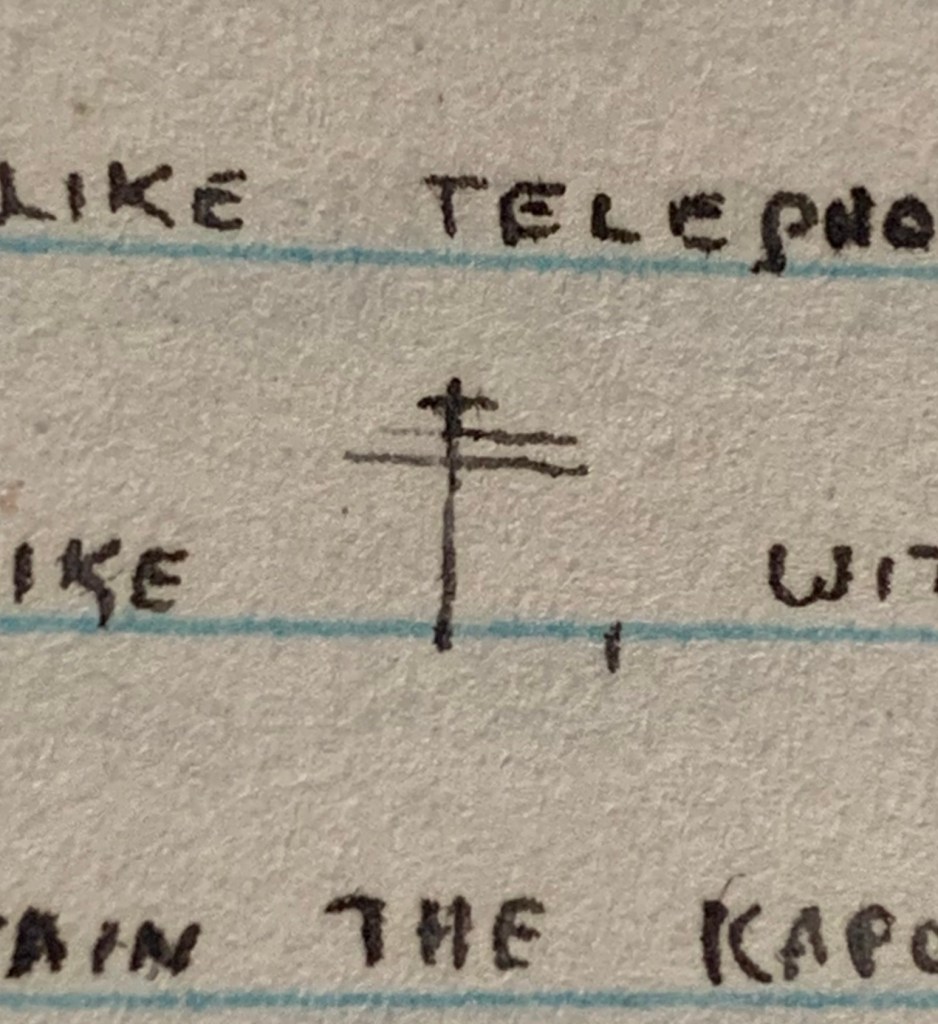
Capt. took me to Medan at 11 — drive around the town, very fresh and clean looking. Sultan's palace and office, the bright colored Mosque, the public garden with enormous pink water lilies, the trellis with frangipani, bougainvillea, yellow hibiscus, two long-legged cranes. Saw betel nut trees (like date palms, with very slim straight trunks) Kapok - trees like telephone poles, sparse branches high on the top like 'T' with pods hanging like globules which contain the kapok.
Helen’s tiny rendering of a Kapok tree, sans globules, inline in her dayto-day travel journal
Lunch at Hotel De Boer. Excellent German beer, veal liver in paper thin slices — very good. 

Blanc mange with orange sauce in honor of the House of Orange, stood up for the Dutch National Anthem, heard other Dutch airs. The public buildings decked with bunting, Dutch flags, orange streamers - the stork with crown and infant princess on the hotel top. Orange flowers on the tables, an orange streamer on the cloth.

Ate my first mangostein, round, tough shell, red inside shell, in center a small white section of fruit, very tasty, must be eaten fresh, cannot be shipped.

Shag and I on the jetty.

Side note: ‘…orange sauce in honor of the House of Orange…’ The word ‘orange’ appears five times in that paragraph above. I used to work for a Dutch company and everything was orange so none of this is surprising.

Shag and Helen on the jeeettttty! She has so much detail about everything else, even little drawings, but not about Shag and the jetty. We are left to wonder things.

[Present location:) 

Lat. 2° 47' N; Long. 101° 02" E; Dist. 156 mi.; Av. Speed 14.18 mph.

Wed. Feb. 2:

Took on 1130 tons palm oil - orange color, unloaded rice. Cranes put a load on the quay, seven coolies lifted a bag on the shoulders of another who ran at a half-trot to the warehouse. Fine buildings on this wharf.

Away at 11:30 last night. Spent today topside writing letters. Visited Shag until 9:00, then up to see Capt. again. Washed my hair at 10:30. 

Side note: Orange palm oil does track, but it is very much a coincidence that the palm oil of the region matches the favorite color of the Dutch. I’ve just found out that there was a Dutch royal named William of Orange and that is where the House of Orange name comes from. It does not come from the color. But William of Orange, of course, wore orange.

In a few years, the Japanese would invade, kick out the Dutch and their orange, and hold power until their surrender in 1945. The Dutch had been there since 1602.

Then Indonesia was born, free from colonials or occupiers, and they changed the color scheme to red and white, representing blood and courage. SIXTEEN OH TWO.

Additional side note: I just used a suggested AI assistant to analyze all the above text, and one of the tips is: – Review for repetitive phrases or themes, such as the frequent mention of orange.

32. Raucous Rickshaws and Temple Bells, Burma, Jan. 23 – 30, 1938

The After-the-Trip Letter

It was good to be clear of the dirt and the muddy Hooghly River (I thought Calcutta was a seaport, but like New Orleans, it is 150 miles from the Ocean) and to have blue water under our bows again. 

Side note: This is her first time back at sea since January 7, when she first got to Cocanada, India (now Kakinada), and then spent shore leave touring to the Taj Mahal, among other things.

In Rangoon there was a rickshaw ride one evening I'll not forget...through Chinatown...it was like being a spectator in a play...then out of the lights and din and clamor of the bazaar to the quiet of the Royal Lakes. 

Across the water lay the reflection of the flood-lit golden spire of the ShweDagon pagoda, and from over the hill came a soft dissonant jangle of temple bells. We were truly "out East". 

Side note: Cinematic, no? I wonder who she was with on this ride?? You’ll have to read on to find out!

For the quiz later: Rangoon is now Yangon, and Burma now Myanmar.

And ‘Truly out East’ is even further east of what the British had deemed east.

In Rangoon there was a rickshaw ride one evening I’ll not forget…through Chinatown…it was like being a spectator in a play…then out of the lights and din and clamor of the bazaar to the quiet of the Royal Lakes.

The Day-to-Day Journal

Sun. Jan. 23: At 5 a.m. the anchor chains began grinding and three hours later we were out in the river. Anchored in less than an hour to wait for the tide. Up anchor at 12:30. 

The rest of the a.m. with Shag, tho I did unpack first -- and oh the dirty clothes.

Visited topside as we sailed down the river in the afternoon -- same jupe mills, brickyards, bathers, hay boats with no freeboard, sail way up on top. Nothing close enough for a good picture.

Anchor again at 6:30 p.m. with only 14 ft. under our own draft of 23'.

Ate too many cashew nuts to be interested in dinner. With S. and J. until 9 and turned in at once.

Side note: Astute observers will remember she went to the market in Calcutta specifically to purchase these cashews.

[Present location:] Lat. 14° 48' N; Long. 89° 40" E; Dist. 111 mi.; Av. Speed 15.46 mph. 

Mon. Jan. 24:

Clean blue sea water again — so good to see it! Writing in a.m. — so impossibly much to put down.

Shag ordered to change room today. Capt. very chipper after lunch. Saw the chart of the Hooghly River. Sounding all the time, continual dredging.

Shag, bearded Capt. in his den after dinner, may get a room alone. Chatted Morton.

Side note: Not to be gossipy, but a room alone… OOoo.

[Present location:] Lat. 15° 45' N; Long. 43° 54" E; Dist. 340 mi.; Av. Speed 14.54 mph 

Tue. Jan. 25: Wash and iron. Write journal — busy day.

Wed. Jan. 26: Anchored at midnight off the pilot ship. Pilot came on at 6:00 a.m., started away at 7:00.

Slowly up the Rangoon River - no bathers, the whole country side looks cleaner than India.

Customs and immigration officials on at 11:30, we are anchored off Lewis St. jetty. Passengers ashore in silver launch at 3:00 p.m. to Marine Club (swankest in East) for information. Ruth and I shopped, saw some exquisite Chinese things.

Shag came over at 5. It was terrifically hot I felt very washed up. Had tea.

Shag and I took a rickshaw ride (12 As. per hour) saw extensive markets, an enormous Chinatown - some strange sights.

Side note: The rickshaw ride was with Shag!! There are some pictures from the era here.

It was a weird feeling riding in the midst of it. Out to the Royal Lakes, where it was quiet and the night was very dark and beautiful. Got down and walked along the water's edge and listened to the temple bells and in the distance saw the gold spire of Shwe Dagon. 

Burma -- there was a magic about it!

Back to town for tea and toast at the Strand. Return to the S. Willow in a sampan, in spite of wild tales we've heard of treacherous current, lives lost, women attacked and robbed, it was a quick safe journey.

Side note: S. Willow, for those new is the Silverwillow, the boat she is traveling on. A sampan is a small boat and she sounds snarky about it, like she expected a ride that would give her a story.

Thur. Jan. 27: Passengers ashore at 8 a.m. after early breakfast, in two cars for a drive around the city. Saw umbrella manufacture, went thru a rice mill, saw Shwe Dagon and Sule Pagodas, drove around the lake, stop at sacred fish tank (eels in slimy green water), Ko Dad Gui Pagoda. It is a large city, very clean -- no castes as in India. 

Got the curse — feeling very blah. P.m. in bed, but hot, interruptions, I got no sleep. Couldn't go ashore, Shag and I had a peaceful evening in the hammock watching the swift moving reflections from shore lights in the strong current of the Rangoon River.

The clamor of the rice loading games seemed an overtone far away. Acres of clothes hung on lines at the laundry, very colorful, most startling. When the tide turned every boat spun around like a top, never saw such a violent surge, faster than turning with a tug.

Fri. Jan. 28: Took pictures of harbor craft - very glad didn’t go ashore. It was very hot, still feeling punk. Away at 2:00, past teak saw mills where the elephants work when they work.

Ship vibrating badly, we're drawing 26' and there are only a couple of feet under that. In hammock on port side, gale of wind, finally went in to bed - no sleep. Evening with Jim, who began asking questions.

Side note: QUESTIONS! I suspect the questions are about Shag and the amount of time the two of them spend together, for instance in ‘the hammock watching the swift moving reflections from shore lights in the strong current of the Rangoon River…’ and other things together.

Also, this link I believe shows the sacred fish tank, though it doesn’t look much like a tank.

I don’t have the pictures she took, but here’s a picture of the boat, The Silverwillow, she was on whilst writing this
[Present location] Lat. 11° 57' N; Long. 96° 53" E; Dist. 277 mi.; Av. Speed 14.81 mph  

Sat. Jan. 29: Very hot and sticky, did a little washing and was ready for a bath. Letters and reading. P.m. off for Jim. Wrote at his table while he studied. Boat drill 4:00 p.m. Showed Capt. my Indian purchases. With Shag until 9:45, much later than I intended, slept out, warmest night we've had.

[Present location:] Lat. 5° 38' N; Long. 99° 36" E; Dist. 362 mi.; Av. Speed 15.08 mph

Sun. Jan. 30: Cooler toward morning. Up at 6:00 when the Chinese started washing decks. Writing letters, slow job. Jim cleaning deep tanks this p.m. Aft With S. later.

Side note: Things are heating up with Shag it seems as they head to sea once again. The next stop is the Dutch East Indies, which would soon-ish be Indonesia. The Dutch, like the English, often used a direction based naming scheme for lands. These were usually relative to the homeland, which can make total sense in a country or town or street or anything with boundary, but not in a big round world.

31. India, Part VI: Calcutta, the Races & a Glimpse at the Future, Jan. 18 – 22, 1938

Helen is back in Calcutta after an eventful 10-day shore leave to the Taj Mahal, a saga that took up more space in her journal than a lot of the rest of the world.

The After-the-Trip Letter

Back in the city, a round of lunching, driving, tea, movies, a formal dinner and dancing afterward at a lovely private club as the guest of a dear friend who has lived in India ten years, gave me insight into quite another facet of life there...low lights, soft music, beautifully gowned women, gracious living.

Side note: Helen was likely job prospecting in Calcutta (and other places she had prospects, like Madras). Up until she got on the Silverwillow, for over 10 years, she’d been teaching Physical Education around the U.S. Gleaning from her shore activities on this trip though, she seemed ready to take her work overseas.

At the time, the YWCA had outposts around the world focused on women’s health and P.E. She had connections there, and in the future she would indeed work for one, but presently Shag was distracting her. You can’t blame her, I mean look at them!


Helen and Roy (Shag) Shadbolt, being cute (not in India in 1938, but still)

Shag’s life plans were shifting too, for similar cutesy reasons, but a looming war would make most plans moot. That’s for later.

Our ship's Captain, who was very partial to me (I don't complain, but the other passengers might) took me to a race meeting.

Side note: She was super flirty and, by all accounts, appreciated high quality flirting in return.

I was equally fascinated by the horses running in a clockwise direction, and by the people....Indians in native dress, uniform of Scottish regiments, Europeans in sport clothes, Mahara-jas with their retinues in gala attire.

Side note: I searched about if horses still run in different directions in certain places and one of the top results was someone in a forum asking, “Why do horses run in different directions in Australia”, and someone responding, “Because they can”.

So horses still do run in different directions, if they want to.

We were glad to be back on the boat, and cleaning our teeth in water instead of tea. In India you eat no raw vegetables unless you KNOW they have been dipped in potassium permanganate water, and you don't drink water unless it's so hot you can be certain it has been boiled. 

The Grand Hotel, second best in the city had seventeen cases of typhoid just before our arrival. And since we left we hear it had another epidemic, and had to fold up and sneak out the back way. (Moral: don't go abroad without a typhoid, shot)

The Day-to-Day Journal

The above is all from her letter after the trip, likely carbon copies to friends and family, as one would do in the day.

So below we have the personal journal of the same time frame as above. It starts when she is reuniting with the boat crew after her 10 day trip away.

Tue. Jan 18: 

Shag and Jim came while we were at breakfast, good to see them. Showed them pictures and purchases, chatted until noon.

Shag came back in the p.m. and then I had a grand scramble to get ready, had to wash my hair — still feel filthy from the train. Jack looked perfectly beautiful in a dark wine chiffon. After the guests had left I was persuaded to stay to dinner (not too difficult).

We were five, and it was delightful. Back at the hotel Capt., Capt. Streets and H. Dreyer were beering. I joined them and went upstairs at 10 to be very ill.

Side note: That all just sounds grand. Except the ill.

Jack, I believe, is her friend in Calcutta. Dark wine chiffon for the win!

Wed. Jan. 19: 

Morning with Shag.

Lunch at Great Eastern and then to the races. The course is on the Maidan, looking across to the Victoria Memorial.

The track is turf, 1 1/4 mi. long (3 tracks, really, for the various monsoons), the stands are enormous, and in the center inside the track enclosure, hundreds of Indians may see the races free.

This was one of the best opportunities to see a multitude of types: every shade; style of costume; all endlessly fascinating.

The horses were good, and one race was for 5000 Rs. My first look at a race run clockwise. Picked horses in the last 3 races that won Rs. for Capt.

To Firpo's for a bottle of soda. Spent the evening with Jim.

Side note: I’ve looked up more about horse racing directions. One part of the Internet says that races in the U.S. (be it horse or human or car) are counter-clockwise as an middle finger to the British. Another part says that it makes sense to be counter-clockwise because of right handed people. My theory was that countries race in the direction they drive, but no. Germany has clockwise AND counterclockwise tracks.

What everyone should agree on, I think, is that the horses are the best and should be treated as such.

Thru. Jan 20: 

S. and I had the morning together. 

At noon rode out to the ship which is still in a dreadful mess. Pressed evening clothes in Capt.'s room, had lunch with him. 

S. and I made back to the Grand and then out to look at Calcutta. 

At 8:00 Tombazi's car came for me. Delicious food, charming people. Later to the 300 Club for dancing. All good dances, the club small, intimate, excellent piano and drums, indirect lighting, beautifully gowned women (Pellegrino water, no drinking, slot machine). 

Fri. Jan 21: Shag and I saw the stone slab that purports to cover the black hole of Calcutta — a washout as a sight. We drove around, lunched at the Grand, rode some more. Packed after he left, paid our bill, distributed annas — three were standing outside our door, another half dozen climbed on the taxi step. I bargained for a cab for 1-8, very cheap, for Garden Reach Jetty. 

Came aboard loaded to the gunwales. No running water, (glad I bathed at the hotel), but the cabin very fresh and clean. Pressed an evening dress, and at 8 Captain and I taxied uptown to dinner at Firpo's and to the metro to see Joan Crawford in "The Bride Wore Red", a stupid picture, but I enjoyed the evening.

Side note: The Black Hole of Calcutta story is not for the claustrophobic (like me), good lord.

Apparently the role in The Bridge Wore Red was not written for Joan Crawford, but after she replaced the original actress, she insisted on playing it as Joan Crawford, and it didn’t work. So says the Internet.

Sat. Jan. 22: Shag and I to town on the bike, bot scarves at the good companions. 

Had tea at A.A.B. To the market for cashew nuts — 2 Rs 9 As. for 5 lb.

Back to the boat at 3 for medical exam, which was a farce. A Chi-Chi woman felt the pulse (to see if the heart was beating, I suppose). Those without vaccination certificates have it done. Couldn't leave the boat afterward, and the ship must sail within 24 hours.

Pooped out, slept.

Side note: The A.A.B. was then the Automobile Association of Bengal and is now the Automobile Association of East India, and I like that they served tea. While Helen had her eye on P.E. teaching gigs overseas, Roy (Shag) Shadbolt had has eye on racing cars. After World War II, the two of them would go on to a run race car shop in Vancouver, Canada, known as Shadbolt Cams, which was open until just a few years ago. They even had a Facebook page.

They did trade with parts dealers in various parts of the world, like with the A.A.B.

Roy would go on to also race cars around the U.S. and Canada, and was well known in those circles.

More about all that later though! First we must finish getting around the world. Next up, the Bay of Bengal.

30. India Part V: Some New and Old Delhi and then off to Calcutta, Jan. 18 – 22, 1938

This is all from the day-to-day journal. Helen takes in history and environs in Delhi before heading back to the boat. And we shall join her.

Thru the Kashmir Gate to the 1st city of Delhi, founded at end of 12th cent. by the slave dynasty — the Turk, Mohammad Ghori established Mohammedan Rule, having no son, he raised a slave to be his heir. Kutb-Din, the slave, built the Kutb Miner, used by Muezzin to call to prayer, 238 ft. tall. The iron pillar, standing for 1600 years. 

Humayun, son of Babar 1st Moghul Emperor ruled briefly, his tomb is red sandstone, used as model for the Taj.

Side note: there will be quizzes!

The Chatta Chowk, arcades of shops, one displaying the richest wares of the East, now ivory merchants, jewelry, carved wood. 

Diwan-l-Am, Durbar Hall, where Emperor dispensed justice, even the humblest might present his petition.

The inlay in marble, the canopy incrusted with gems and held by gold poles.

The Hall of Special Audience where the peacock thrones stood, the inscription, "If there is a paradise on earth, it is this, it is this, it is this".

The Turkish baths, the fountain of 9 streams for the pregnant woman.

Side note: That is an excellent quote, no? “If there is paradise on earth, it is this, it is this, it is this…”

Drove thru New Delhi — imposing buildings, beautifully laid out, but a come down after the splendors of Old Delhi. 

To the Chandi Chowk — to the Ivory Palace — magnificent carving, lovely textiles and brass.

Stopped at the Jumma Masjid — too weary of seeing white marble inlaid in red sandstone.

Had tea at the hotel, dashed to the station to find the train 1/2 hr. late on account of the wreck yesterday of the Punjab Mail. Found we had 1 lower, 2 uppers, 1 middle aged wife of a British Major, very sporty, a mousy governess-y looking person. Resigned to 36 hrs. of grit and dirt, we're off for Calcutta fuel on the hotel bill: 6 As.

Side note: Weary of white marble…

“If there is a paradise on earth, it is this, it is this, it is this” – The Hall of Special Audience

Mon. Jan 17: Our compartment companion got off at 6:00 a.m. at Allerabad. 

We three had tea and oranges, went back to bed.

Slept occasionally until two p.m. when enormous quantities of luggage arrived — 4 huge suitcases, 4 smaller ones, a wicker box, vegetable basket, birdcage, bedding roll, tennis rackets, coats, toupees, dog, widow with a sweet 14 yr. old child.

She was a fright, but she and Dreyer struck up an acquaintance and babbled for hours.

Side note: Dreyer is Helen’s roommate from the boat (at least when Helen is not in her deck hammock). Like the new train passenger, Dreyer is also a widow.

And again people traveling with toupees! I’ve looked this up on Chat GTP, and if it’s telling the truth, toupees or wiglets were quite popular before the 1930s, but we’re still being used for specific hair styles (I imagine these could be handy whilst traveling) or to add extra oomph or to cover problem spots.

The train was 2 hours late, and the last several hours were interminable. 

Dirty, wearying, and at every stop the inevitable bangles, dolls, brass, guavas and the everlasting "No-Go Away".

At long last we pulled in to Howrah Station. The Grand Hotel man got us a feeble taxi to the hotel.

Across the world's busiest bridge and certainly every type of conveyance is on it — autos, ox carts, horse drawn tongas, rickshaws, and many on foot with bedding and baggage piled high on their heads.

A seething mass of humanity and a hollow din of rubber bulb horns — honk, honk.

At 10:00 p.m. dinner in the grill with horrible bleating music.

To crown the day: a dirty tub taking an hour to empty. 

Trip Advisor: Two Stars.

29. India Part IV: The Actual Taj Mahal and then off to Delhi, January 1938

We begin here in Helen’s journal as she is approaching the Taj Mahal. For those following, her letter home after the trip also detailed the Taj Mahal and its breathtaking glories, but the below adds elements and context and an intriguing scientist (and there’s even more that I’m leaving out if anyone wants to inquire).

To refresh, Helen is on 10-day shore leave from the ’round-the-world freight, and she is traveling with a few female civilian passengers from the boat. The passengers are, I believe, at least 25 years her senior (she is 34). And we don’t know much about them because she’s been dead set on making the engineers teach her how the boat goes vroom.

We had our first glimpse of it from the train. Dixit generously asked us to go with him. We sent our luggage to the hotel and went in his taxi.

Side note: What Helen did not mention letter home, which spoke of a series of comical-in-retrospect travel bloopers, is that she did get into a first class train car (in 1938, in India, 1st and 2nd class were vastly different).

And it was in first class that she met Dr. Dixit, a professor of physics from Gujarat College in India; he was swinging by the Taj Mahal on his way home from a conference in Calcutta. And they all joined forces.

It was just sunset when we stepped thru the red sandstone entrance gate and looked down the vista of trees and fountains to the Taj Mahal. 

Stopped to take two pictures, the 2nd a time exposure. The light faded with dull red across the sky.

Side note: She took two pictures. How many would we take today? Of a sight that is life altering?

I have an 8×10 of one of the picture she mentions, but I cannot currently locate it. When I do I will post it.

By a dim pocket torch we climbed to the top of a minaret, stopping on each balcony to gasp at the ethereal beauty as the moon came up and cast a pale light on the marble.

She wouldn’t see the photos for months. And even when she had them, the ‘dull red across the sky…’ she’d have to describe, because of black and white film.

While writing all this, I have been picturing it in black and white (it was olden times), but I want you to envision the below in all the pretty colors:

We approached close enough to see that the pattern is inlay of lapis, jade, carnelian, black marble, in white marble. 

The workmanship is superb, the labor colossal.

It was dark inside and we saw the tomb of Numtaz Mahal and of Shah Jaahn, her husband (who built the Taj), by the light of a flickering candle.

The screens surrounding the tomb are marble carved in unbelievably lacy patterns.

By a dim pocket torch we climbed to the top of a minaret, stopping on each balcony to gasp at the ethereal beauty as the moon came up and cast a pale light on the marble.

We looked at it from the river side, and lay down on the marble base on the "moon-side".

It took on the soft color of ivory, and the inlay looked like carving and the shadows are not black but gray and purple.

Return to the gate where a great carved brass hanging lamp cast leafy shadows on the sandstone walls - and took our last look thru the arch of the gate.

Words are less than useless.

To the Imperial room, every convenience, quiet dining room with a delightful atmosphere and good food. Lovely shops in the hotel. Bot a white Kashmir shawl for a skirt.

Side note: The beauty of journals is the juxtaposition of the truly spectacular and the mundane. (Bot = bought. She uses her own shorthand at times.)

Sat. Jan 15: Mr. Dixit arranged with his driver to take us for the day for 15 Ru. Drive to Fatenour Sirri, 23 mi, passed several villages — every inch of land under cultivation.

Built by Akbar in 1569 A.D., a great wall, palaces, mosques, Turkish baths, the marble tomb of the Moslem saint Shaik Salim Chisti with its mother-of-pearl sarcophagus, the gate of victory 176 ft. high, and towering above the village outside the walls, the horse stables for 175 horses around an enormous span court. All in red sandstone marvelously carved, we were there 2 hours.

Back to the hotel, then to some shops — got a couple of pieces of marble inlay to remind me of the Taj.

Had only half an hour to see the fort, could only glance at it, but it made an indelible impression.

Dashed back for our baggage and on to the station for our train at 5:30 to Delhi. The ladies' compartment filled with three Indian women and 4 children, we went in with an English couple and their adorable little girl. 3 1/2 hours to Delhi, to Maiden's Hotel, dinner in a vast dining room at 10:30 p.m.

Note to Mary on her birthday.

Side note: The Maiden’s Hotel is still there and I want to go. And also, Mary was my grandmother, who was pregnant at the time with my mother, her second child, my mother.

India Part V coming up!

28. India, Part III: Before the Taj Mahal: The Journal, Jan 11-14, 1938

“But we just left the Taj Mahal”, you say. And you are correct. But before we move forward, first we must circle back a little.

The last post presented passages from Helen’s post-trip letter to family, all nice and curated. But remember there is also a corresponding day-to-day journal, that was for her eyes only (at least until I came along)*, with fun detail and juicy context that doesn’t always make it into the letter. I’ll pare to the best bits.

*Helen gave all of her records to family, with the idea that someone might turn it all into a story and here I am doing that; I assume that she would have (and maybe did) pluck out bits she didn’t want anyone else to see.

The Day to Day Journal

Side note: We left the journal when Helen was luxuriating in a hotel (after over two months sleeping — by choice — primarily in a homemade hammock on a boat deck) before heading inland to the Taj Mahal with the ladies from the boat. But first, Helen networks a bit.

Tue. Jan. 11: Jack Frost came for me at noon, as darling as ever, to Ballygunge to her lovely home — high ceilings, airy, comfortable. Deep chairs covered in soft turquoise, a luscious Persian rug, fine silver and lined — a lawn tennis court, two dogs: Jack & Jill.

Sherry, then lunch: cold baked eggs with whipped cream & catsup, fish, peas, hot grapefruit, Kashmir English walnuts, figs, stuffed dates, Turkish coffee, Greek cigarettes.

Side note: I picture Jack & Jill as a regal, but derpy, long dogs, like Borzois. And I won’t comment on the cold baked eggs with whipped cream and catsup.

Drive with Jack about Maidan, Victoria Memorial, Fort William, cricket grounds, Gov. House, race track, 200 (Indian day, with band, hundreds listening, wrapt.) Hippo-elephants, giraffe, birds of color.

Side note: Hippo-elephant sounds like something to come out of a World’s Fair. I think she must have meant hippos and elephants, like she saw both? She’s too science-y to confuse the two (and yes I Googled whether hippo-elephants exists or have existed… no they don’t/didn’t).

To Tollygunge Club (1000 members) — race track where gentlemen jockeys hold 4 race meeting a year open to public, pays club expenses. 

The house was owned by an Indigo Planter — lovely: yellow-orange bougainvillea, enormous cannas, swim pool, golf and tennis. Had tea on the lawn, a restful spot. Thru Alipore, the other residential district (Viceroy's house) past Jodphur Club.

To 1st Empire. Ronald Coleman and Madeleine Carroll in "The Prisoner of Zenda". Nearly everyone in evening clothes. Strange to come out from the American picture to the squalor of an Indian street.

Side note: She might be again job prospecting thru YWCA connections. This sounds like a lovely spot, tea on the manicured lawn and all, but lordy the disparity (see the last two posts).

Wed. Jan. 12: Shag and I wandered back across the Maidan for a couple of precious hours together. Sigrist came to get Dreyer's blanket while D. buys her own bedding, cheap skate! If I ever get like that! 

Side note: She would get like that. Precious hours with Shaaag. She won’t see him for a whole 10 days.

Across the river to Howrah Station. Miss Skinner and party on the door of the compartment. As barren as a cattle car, narrow seats around three sides, so someone's feet are in the face of another. (R.R. & Calcutta time 24 min. different). Punjab express. We rented bedding rolls for 1 Ru. per day from Am. Ex. For 6 As. Had them delivered at station. One ladies' 2nd class compartment on each train.

To Dasashwamedh Ghat to take the boat up river first, past bathing ghats.

Everyone bathes in the river each day, then worship under the straw umbrellas where the priests sit. Many temples and palaces with stairs leading to the water's edge. Various postures as prayers are said and rites performed. Down river, where we watched one funeral pyre and saw another corpse prepared - an emaciated middle aged man, whose widow, in white, with low-coiled shining black hair, sat wailing at the top of the steps.

The Hindu belief: body is dust, fire, water, they bury material things, ashes burned in the fire are returned to water. On down the river past more palaces, rest houses, temples and return to the starting place.
Drive thru the city, saw the Monkey Temple, here barren women pray to Durga for fertility. If the prayer is answered, a goat is sacrificed. 

Thru narrow alleyways lined with beggars to several other temples - Siva, Goddess of Plenty, Ganesh, the Elephant God, the Sacred Bulls, Well of Knowledge, the Golden Temple whose beautiful spire must be observed from a balcony next door, so narrow are the streets. We were given garlands of the Niwari flower. Peepal tree sacred, may not be cut down.

After lunch to Sarnath, where Buddha preached his first sermon, gained his first 5 converts. Dammekh Stupa, built in 3rd Century B. C. near Buddhist ruins more than 1000 yr. old. Modern Buddhist temple with murals of the life of Buddha done by a Japanese.

After dinner entertained by a magician who was exceptionally good, produced a flock of live birds out of his equivalent of a hat.

Side note: ‘Equivalent of a hat…’ is a good band name, no?

Fri. Jan. 14: Tea at 5:00 a.m., left for the station in the cold gray dark at 5:30. On board the first train for Mogul Serai, our bearers carried our luggage up over the bridge to the waiting room and back again. It was 7:30 when we got away. Had an attractive young Chi-Chi girl in our compartment as far as Allerabad. 

Side note: I think Chi-Chi is like shi-shi? Someone who is stylish?

Wild monkeys, gorgeous parrots, peacocks, mud hut villages, bathing in every water hole, wells with oxen every drawing water for irrigation. 

Change trains at Tundla at 4:30 p.m., we were put in first class carriage with K.R. Dixit, professor of physics, Gujarat College, Ahmedabad, returning from the Science Congress at Calcutta, stopping over between trains to see the Taj.

Side note: Dr. K.R. Dixit wrote a paper in 1940 (two years after this trip) that appeared in the ‘Proceedings of the Indian Academy of Sciences’, which was published by Springer, which happens to be the publisher for whom I work. And we publish their conference proceedings still, almost 100 years later. La de da!

So here we bid adieu, with the ladies choo chooing along with Dr. Dixit, chewing the rag about Helen’s favorite things: science and facts.

Next time we will, again, visit the Taj Mahal, but from a different perspective.

27. India, Part II: Awe at the Taj Mahal: The Letter Home, Jan 1938

With ten days of shore leave at hand, Helen embarked on a complicated, multi-day side trip inland — traveling over 1,200km each way — via boat and train. She reflected upon it all quite colorfully in both the after-the-trip letter and the day-to-day journal. So much color in fact, it will take two posts.

First, the shorter after-the-trip summary…

The After-the-Trip Letter

(I mentioned in the last post about the unfortunate state of things for many in India at the time. That state of things is reflected in her observations below.)

The ship went into dry-dock in Calcutta, and while hundreds of coolies swarmed over the boat day and night, riveting, hammering, scouring, repairing, and refurbishing, the passengers had ten days "on their own”. 

Three of us, Lysol bottle in hand, braved the so-called perils of travel by train.

“You must travel 1st class, and you MUST take a bearer (servant)", everyone said, so we went 2nd class, without bearers -- you have to take your own bedding on Indian railroads...we rented bedding rolls from American Express for one rupee ($.38) a day...the natives steal everything on the train that is not securely fastened, so the comforts thereof are negligible, if not non-existent.

We found the trains unbelievably dirty, the sleeping accommodations thin (the berths were 2 in. thick, and the mattress...well, to be generous, maybe one-half inch...these came with the roll of bedding), the beggars persistent, the station platforms crowded with squatting Indians surrounded by their luggage, and innumerable peddlers who urged us in all the dialects of Hindustan to buy knives, bangles, brassware, guavas, betel nut (one walks the streets of India mentally holding in one's skirts, for chewing betel nut is the national pastime, and you never can tell from where he sits how far the chewer is going to spit the bright red juice whose spots give India's pavements a perpetually gory aspect). 

We wouldn't have missed the experience, and we learned to bargain, and to accept only good rupees (about half the currency is counterfeit, and you have to “ring" every coin before you take it, or they will "take" you…) and how to get off a train without tipping six porters and their uncles and their cousins and their aunts. 

Side note: She was warned! By ‘everyone’! But see… up there she says she wouldn’t have missed it.

Oh, and ‘we’ in his passage of the letter is not about Shag, but instead about her two female traveling companions on this side trip. They are both fellow civilian passengers from the boat. Which two right now I cannot recall, but they will appear in the next post in some detail.

And lastly, a public service announcement: The betel nut, like many consumables that are fun and/or frowned upon, can be addictive and harmful to the health.

In Benares we sat in wicker chairs and were rowed up the Holy Ganges River past the spectacle that is the sacred city of the Hindu (for a Hindu to die in Benares is to assure his salvation, and they come in countless thousands, pilgrims of every age, to bathe in the holy river -- pardon me while I hold my nose). It is the bath, the laundry, the medicine, the chapel, the lavatory and the crematory AND the drinking water! UGH! 

Side note: Here is a video of what she might have experienced, taken in 1937. I found some photos that aren’t all Benares, but there are great photos from India in the 1930s.

Let's escape to Agra. I'd heard so much about the Taj Mahal that I expected to be disappointed, but that evening has a page all its own in my book of memories. The setting sun shed a rosy glow on the white marble as we saw it first...then it was almost dark inside the mausoleum when we entered, and I had a momentary feeling of stepping into the past...a voice called 'Allah, Allah, Allah', and ages later the echo came back hollowly. By candle-light we examined the exquisitely carved marble screen surrounding the sarcophagi, and the wall panels inlaid with lapis-lazuli, carnelian, jade, jasper, in delicately wrought patterns. 

Side note: The Taj Mahal was built in 1631 (!) in honor of the emperor’s favorite wife. I don’t know when I thought it was built, but that is older than I expected.

And did she just know the names of those inlaid rocks and how to spell them? As a child in Colorado, I used to go to a rock and mineral shop almost weekly with my mother — each for our own reasons — and I’ve never heard of lapis-lazuli or carnelian.

Our companion, a young Indian professor of Physics from Ahmedabad, lighted our way with a dim pocket torch up a circular staircase to the top of a minaret. We had not long to wait for the moon to cross the river. It touched the marble with a caress, softening the lines until the Taj looked like a rare old ivory carved by a master craftsman. 

In Delhi we saw acres of marble buildings inlaid with semi-precious stones, built by the Mogul Emperors five hundred years ago.

Our eyes stood out on stems and our chins rested on our chests. It was so gorgeous we lost the power to react to it. 

Side note: We’ll talk more about this young professor in the next post, but for context, at some point her little group ends up in First Class on the train and there she meets a young professor who is headed to the same place they’re going. And the four of them then travel to the Taj Mahal together.

Another side note: The bit about the phrase, ‘Our eyes stood out on stems…’ evokes old cartoons, no? And it’s fitting. The art and architectures that humans build for their myriad gods are some of the most eyes-on-stems and chin-on-chest inducing of any, even for non-believers.

“Our eyes stood out on stems and our chins rested on our chests. It was so gorgeous we lost the power to react to it.”

The trip back to Calcutta is a volume in itself, so don't get me started on our compartment mates with their 14 suitcases, the garden flowers, the lunch hamper, the tepees, tennis rackets, basket of vegetables, raincoats, birdcage and catch terrier. 

Side note: Tepees?

26. India, Pt I: Cocanada, Budge-Budge, and the Hooghly River, Jan 7-9, 1938

After the round-the-world trip ended, Helen sent a three-page, airmail letter to family and friends to summarize it all. Word count and word choice were important back then — each ounce mattered — unlike now where we can just plod along forever and then absentmindedly click send and a typo-laced missive instantly transmits to the nearby and/or far-flung.

Almost one whole page of her three page letter was devoted to an overly complicated in-land side-trip to the Taj Mahal.

  • Two of the three pages consisted of: colorful descriptions of all of the world that she saw except the part about getting to the Taj Mahal.
  • One of the three pages consisted of: getting to the Taj Mahal.

She did other things in India though that don’t get covered in the letter, but do in the journal, where there was not a word or weight limit. And we can’t miss the whats and whos of Cocanada and Budge-Budge back in early 1938, can we??

The Day-to-Day Journal

Side note: We start here while still on the Motorvessel Silverwillow and we are forging ahead towards Coconada, India (now Kakinada — both of these similar sounding names came from the British and Dutch). This port town, like so many, has long suffered the deeds of those looking to stake claim and/or pillage — land, resources, women, men, jewels, crops, minerals, power, etc.

Fri. Jan. 7: 

Capt. up at 4:00, not long after the engines stopped (we'd been creeping along on one most of the night so's not to arrive too soon). With dawn came barges sailed with lateen rig, from Coconada, 4 miles away.

On one barge breakfast was in progress, process of washing plate with water from a small glass jar, wiping it off with dirty hand, scooping white meal from common bowl, pouring on some water, eating with hand, plantation, betel nut. Four fires kindled in the bottom of boat, iron pots boiling water, cooking rice, spoons of coconut shell with bamboo handle, drain in large mat baskets.

Side note: The above is a window into colonialism and the caste system at work, with the former taking advantage of tenants of the latter (we’ll see more of this, in much more detail, in the next post). The people on the boat were likely Labourers, which is the lowest official caste, but there are countless others who don’t get a caste.

[Present location:] Lat. 20° 22' N; Long. 87° 22" E; Dist. 341 mi.; Av. Speed 14.44 mph. 

Sat. Jan. 8: Study in a.m., boat deck at 2:00 for a lesson on "Day's Work". Hooghly River pilots have a very handsome yacht, they're a snooty crowd. Came on board at 4:00 and we start towards the Ganges River, 30 miles away.

Side note: the Hooghly River is a tributary of the Ganges and they are heading up it to Budge Budge on their tug tug. And they are meeting some puffed up yacht snooties along the way.

BUDGE-BUDGE 

Sun. Jan. 9:

At 2:30 a.m. woke when the pilot took over my hammock saying, "You shouldn't be sleeping out here, it's the best way to get malaria" — then clutched me in an embrace.

H [a pilot] stayed until 4:45, sitting on the floor talking. He's a fool and an overbearing braggart, if this is the Englishman in Gov't service abroad, heaven preserve us. At breakfast he appeared again — to tell us of the 23 glasses of champagne at the Governor's ball.

Side note: This was all between 2:30am, 4:45am, and breakfast? If this ‘pilot’ is all the same person, we don’t like him. Handsy, overbearing, braggart. There might be more than one pilot being mentioned though, but we definitely don’t like English Pilot H.

“The helmsman stands like Hosea draped in a long robe and standing high above the oarsmen at the stern, makes a strange solitary figure against the sky.”

Went ashore at Budge-Budge when finally we got alongside (it took 3 hours) to the customs house to phone to the city about rooms, with not much success. Wild wind and rain storm while we were there.

Side note: I just learned that Budge-Budge got its name from the sound Portuguese boots would make in the local marshes.

Shag and I walked in Budge-Budge: squalid huts, innumerable people in sanitary arrangements on whatever spot is convenient at the moment. We did find a moon shining on the water off a lagoon. 

Mon. Jan. 10: Out in the stream at 11:00 a.m. after three hours getting away. 1/2 is carried aft and we are made fast to the wharf chains by them, a very slow process.

The helmsman stands like Hosea draped in a long robe and standing high above the oarsmen at the stern, makes a strange solitary figure against the sky. Men come down from inland villages and live on the boats and work on the river for months. There are no women on them.

River channel narrow with dangerous shoals, sharp turns, quicksand's (the James and Mary) necessary to wait for tide. Directly to dry-dock. So we had to get off at once. To Grand Hotel on Chowringee, high ceilings, marble floors, dingy, eccentric plumbing — Lysol!

Out to see about travel in India.

Side note: That is the Royal James and Mary, thank you very much. It is also my name reversed. We’re going to ignore that Royal James and Mary refers to quicksand, because I am afraid of quicksand and pretend it doesn’t exist.

Instead we will imagine how wonderful it must have been to stay at a hotel after the months on the hammock.

But she wouldn’t be comfy for long, as soon she’d be on her way to the Taj Mahal, where she’d make a misstep or three….