35. Moving Towards, but Also Away From, the Dutch East Indies, Feb 8 – 12, 1938

To recap, Helen was just recently in the Dutch East Indies for Chinese New Year (1938 = year of the Tiger), then took a tour through a brink-of-war Singapore, with its air raid drills and harbor full of battleships. And now, though she keeps her forward momentum, she is back in the Dutch East Indies.

To visualize the geography of this, I have created a map of all the places she stopped on the five month trip around the world (the loop-de-loop is her inland visit to the Taj Mahal). There are some zigs and zags, but no backtracking.
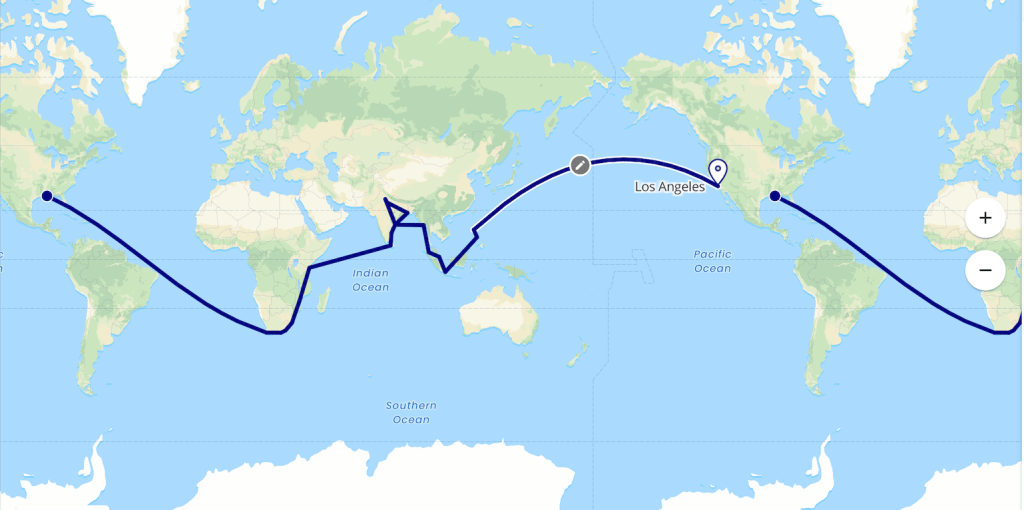
The M.S. Silverwillow started its voyage in New Orleans in 1937 and ended (at least Helen’s leg of it) five months later in Los Angeles, in 1938

A zoom-in on the map might not show the exact seafarers’ route (but never doubt that there could have been some Fitzcarraldo-esque boat-over-a-mountain stuff going on). Even if it weren’t a crow’s fly map made with a free app, you can still tell, geography-wise, how a boat might visit the Dutch East Indies (now Indonesia) twice, before and after a stop in Singapore.
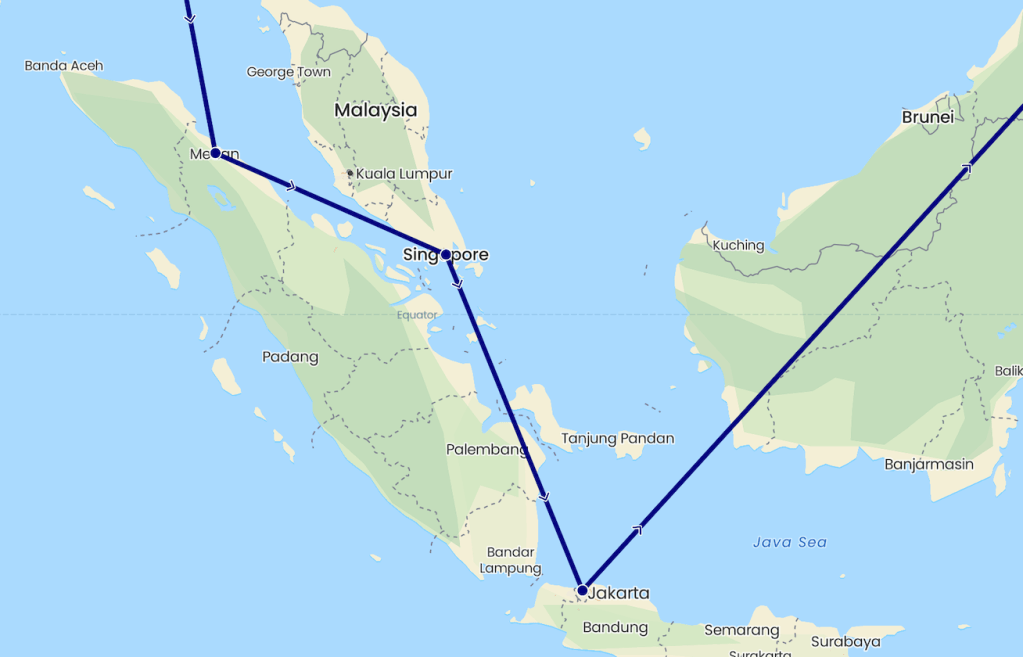
Helen’s exact route, via boat, through South East Asia, 1938.

Now that we (I) understand the trajectory, we snap back to a world simmering in war.

Day-to-Day Journal

Tue Feb 8 

Up with the anchors at 6:00 a.m. into the harbor of Tandjong—Priok past two rows of warships, 3 French, 2 Dutch. Still wind blowing, came too close to the Dutch Navy for comfort as we made two passes at the mooring buoy.

Silverteak came in just astern of us, did not go alongside as we expected.

Side note: The Silverteak survived World War II. The Silverwillow (the boat Helen was on) was used by the British navy, and was destroyed by U-Boats on October 30, 1942. Several men died.

To Batavia (8 mi.), a canal runs alongside the road from Batavia to the New Batavia Centrum (no Europeans live in the old city now (malaria)). 

Took pictures of the laundry being done in the canal.

Side note: I wish I had more pictures. There are barely a dozen of the whole trip, and most from the early time at sea. The canal might have looked like this.

Batavia was known as Cemetery of Europeans because of the rates of malaria.

Fine stores, we went in only one, having no more time. Thru Batavia museum, beautiful dignified building with white columns, filled with Javanese work: carving, silver, models of types of houses, costumes, implements, Batik, musical instruments, boats — a fascinating place to spend days. 

Outside were many Hindu and Buddhist Gods from Borobudur and elsewhere.

Side note: Most if not all of these artifacts survived WWII, but the local population did not fare as well. The Japanese occupied the Dutch East Indies in January 1942. They were welcomed at first at liberators, after hundreds of years of Dutch colonialism, but ultimately four million people died there during Japanese occupation due to forced labor and famine. The gory details can be found here.

Saw sacred cannon decked with flowers, incense burning. Pony carts like Sumatra, but with flat tops, called a delman - with ponies from Bali. Buffalo hides drying (use for fans, belts, lampshades, etc.) thru the country. Opium factory (control by Gov't.) next to medical college. 

Everywhere along the road coolies in big hats carrying baskets. Hundreds piled high with rambutans (fruit with red soft-spiny shell — hang in great clusters on the trees), mangostein, pomelo, banana, ucus (like small pale lemon, inside formed like a pomelo, has a tinge of banana flavor), also vegetables, tinware, all manner of household articles.

Side note: By ‘ucus’ I believe she meant ugli, which is an unfortunately named fruit. It is also known as uniq in some circles and Jamaican tangelo in others. So much learning.

Goodyear has a large factory, produce 6,000 bicycle tires, 600 truck tires per day. (Gov't. collects 1,000,000 in fees from the bicycles in Java). A large market-looking place with hundreds of people around it proves to be a pawnshop, one of sixteen Gov't. operated ones in Batavia. 

Side notes: The government had its hands in pawnshops, opium factories, and salt. Also, remember my hint in the last post about Helen being back in this part of the world decades later, and that it would be related to rubber? Here is another hint.

Acres of rice fields, tapioca (use root), rubber, sugar, miles of kapok trees, sago palms, pith used for making sago-like small tapioca beads, also ground for bread flour — leaves dried to make thatch roofs for houses, juice makes vinegar and a native alcoholic drink. 

Indigo plants about 3 ft. high have white blossom, plant soaked in water 15 days, crushed, extracting juice, water left to evaporate, indigo powder remains. Tamarind trees growing along road, from them a hot extract for flavoring salads. The palm with the red stem is sealing-wax palm. Betelnut tree a tall very straight-trunk palm with a tuft of leaves at the top, clusters of nuts like the date betel leaf, in which natives wrap the nut comes from a small shrub-like tree, is chewed like chewing gum.

Side note: Sago palm does just about everything, doesn’t it? Puddings, breads, roofs, boozes, and last but certainly not least… BOBA TEA. The also magical indigo powder is used to regrow thinning hair AND to cover grays. In India, she complained about the red betel nut chewing spit splats everywhere, if I recall. The betel nut was more like a cigarette in effect than chewing gum though.

In Buitenzorg the zoological museum, then the Botanical Garden (largest in the world) many thousands of trees I never saw before — trees with trunks like concrete walls, cannon ball tree (fruit the size and shape of c-ball), pandanus, from which Panama hats are made. 

Side note: The Panama hats she saw might have been called Tamsui hats, from Taiwan. They are the same looking. I don’t think the actual Panamanian Panama hats were made from pandanus, as it didn’t grow in Panama. Those (at the time at least) were usually made from the Carludovica palmata plant, indigenous to the region.

Lily ponds with enormous pads, pink lilies, lotus flower — monument to Mrs Raffles. 

Side note: Sir Thomas Stamford Bingley Raffles built The Lady Raffles Memorial for his wife. He was a Colonial governor in the Dutch East Indies in the 1800s. Helen mentioned a Raffles Hotel in Singapore. And I know I’ve heard of Raffles whilst traveling in that part of the world. It’s all the same guy, but the latter without the Thomas or the Bingley. Why is a British dude the governor of a Dutch colony? Google says because of a capture, for number of years, of Java by the British during the Napoleonic Wars. Then it went back to the Dutch. Maybe the monument was nice so they kept it.

Houses in Java are made of bamboo matting, for there is no good building wood here except teak, which is very expensive and a Government monopoly. Bamboo house lasts about 20 yr.

Side note: Teak was not indigenous to the region, but had been growing there since the 16th Century. Excellent building material (rugged stuff used for floors and boats and furniture) was available locally, but the colonial government hoarded it for their own use and profit, and locals got to build bamboo houses that last for 20 years. Cruelty and greed.

A new passenger on our return — youngish, male, married, from Sacramento. Daisy nabbed him. 

Side note: Daisy is ‘Miss Daisy Mount’, who Helen described as, “Sweet little old lady, dainty, birdlike, speech a bit breathless as tho people wouldn’t listen. Pioneer stock.” But here she is ‘nabbing’ a youngish married man. In a post several months ago, Helen said that Daisy, “had an acquaintance”, and she also was involved in some gossip, telling Helen there was “axe in the offing”.

I think I may have found her! Sarah Fisher ‘Daisy’ Mount was born in 1867 in the San Francisco Bay Area. In 1938, she would have been 71, so that tracks (Helen was 34, so 71 would be quite old). After docking in Los Angeles, Helen traveled north through California, visiting Daisy in SF on the way.

Helen also mentions that Daisy has ‘pioneer stock’ and pioneers were settling all around the Bay Area in the 1860s. And now here was Miss Mount seeing the world and nabbing young men. Go Daisy!

Miss Mount passed away in SF in 1945 at age 78.

Why we know so little about the few other civilian passengers on the boat is because Helen was focused (people-wise) almost exclusively on the men that worked on the boat.

Wealthy Chinese own much of the land in Batavia. 

Started sleeping out, hot and humid — coughed for hours in spite of Jim's toast at 10:30 — paced deck, slept in for a couple of hours.

Ashore in a boat with a port oar and a paddle in the stern. -10 Java cents each way. Quite something to see our passengers climb in and out.

Side note: Sleeping ‘out’ probably means that she is back in the hammock that she helped measure, cut, sew, and hang on her way from New Orleans to Cape Town.

And regarding people climbing in and out of the boat… I think she is poking fun at the more elderly of civilian passengers, who mostly have at least three decades on her.

Wed. Feb. 9: Dropped the pick in the early dawn at Cheribon. Tug with 7 lighters came alongside. Unloading gunnies from Calcutta, taking on a few tons of Sago flour. 

At 11:00 Capt. asked if we wanted to go ashore. H.Q. & I went with him. Stopped for a beer at Hotel Cheribon, Then 30 mi. south to Lingga-Djati, to Hotel Rustoord, beautiful drive. Rice fields and rice fields, men, women, and children working in them — every separate shoot planted by hand. Mt. Cheribon — 10,000 ft. volcano shrouded in clouds most of the day, extinct for 200 yr., became active last year. Sandwiches, milk, fruit for lunch (my first glass of milk since Capetown and this was boiled).

Side note: I cannot find anything about the Hotel Rustoord, but the word ‘rustoord’ means old people’s home in Dutch.

The Mt. Cheribon she mentions is indeed a Mt. near Cheribon, but it is actually named Mount Cereme (or Ciremai or Ciremay).

There is so much Dutch East Indies that we must cut this one in half… but stay tuned because next we have more war, but also some peace.

25. Dr. Jo, and a Frolic from 8am to the P.P.M., Madras, India, Jan 5, 1938

The After the Trip Letter

We saw the hills of India for hours before we came alongside at Madras. There was only one white person, on the quay, and she was meeting me! Jo and I had  parted in New York four months before, saying, "See you in India in January!" and here we actually were! I had to pinch myself! We had a most delightful evening with mutual friends (we had been graduate students together) who teach in the college at Saidapet. 

And that aggravating boat WOULD sail that same night...cargo first, last, and whenever.

Side note: Only with kismet could two people plan to meet up on a dock several months into the future and then actually do it, right?? Nope. They organized it somehow, even while they were both be-bopping about to different parts of the world, in 1938.

And who is this ‘Jo’, you ask?! Stay tuned!

(For historical context: Madras is now Chennai and Saidapet is and was a neighborhood there.)

The Day to Day Journal

Side note: The journal starts the day before she gets to Madras and to her friend Jo. For here we start while she’s cruising alongside the lovely and lush Ceylon coast…

[Present location:] Lat. 6° 41' N

Tue. Jan. 4: Saw porpoises leaping, many ships visible, sails along the East Coast of Ceylon, mountainous. 

Took a Lat. And figured our course by dead reckoning.

1 anna - 2 ½ cents (round coin, square edge) 
1/12 anna = pie (copper)
Wed. Jan. 5: Study and the traverse tables are about to get me down. Saw India this afternoon. Could see Madras by 4:00 p.m. 

The jetty has a tricky double S curve, I thot my eyes deceived me but the glass confirmed that Jo Rathbone was standing on the quay. It seemed eons before the gangplank went down and our passports stamped — marvelous to see her. Jo's driver got a car for the other passengers and it turned out that Katy came with us, to be dropped at the Theosophical Society H.Q., drove thru spacious grounds to a beautiful building. 

Had a panoramic impression of the city as we drove thru at sunset. Stopped at the Cannemora Hotel, very swank European, many of the business buildings have domes and minarets. Everywhere flags and bunting are draped for the visit of the Viceroy next week. The members of the Indian Congress are not to be present at the reception and all Europeans are commanded to be on hand.

Side note: Jo, mentioned in the letter above, was the one and only Dr. Josephine Rathbone. In her storied career, she worked to advance physical and physical education therapy, she wrote textbooks about health; she ran a relaxation clinic, and at Columbia was into yoga waaaay before it was made hip in the west. After then, she was co-founder of what would become American College of Sports Medicine (ACSM) and was VP of American Physical Therapy Association.

How do I suddenly know so much about Helen’s friend Jo? I was fortunate enough to find an informative article, all about Dr. Rathbone, and I reached out to its author, the very helpful Dr. Carol Ewing Garber. She was kind enough to send over an autobiography Dr. Rathbone wrote, and what a life. Worth a checking out.

Herd of water buffalo with enormous horns spreading six ft, white oxen with tall horns drawing carts quite different from those in Ceylon. Indian huts rectangular, with high pointed roofs, palm trees against a red sky. 

Not so many people as I expected. New housing development, very square modernistic a la Germany. Wide main streets. (25 Catholic schools for Indians in Madras) 

Several cars at Bucks, met several groups just leaving. Mr. Buck remembered me — a charming house, paneled walls, book cases built in, every room has French doors leading out — on 2nd floor to a balcony, bedroom's have sleeping porches. The whole house is open and airy, very unusual, most livable. A young English politician was there, an Indian Rec. Director, handsome, and a Sikh, turban, beard, small clothes, small sword, bracelet - the 5 requirements of the Sikh religion. 

Side note: Mr. Buck is also known as Mr. Harry Crowe Buck. He’d founded the YMCA College of Physical Education in Madras over a decade earlier. How fun.

Reading this all again, now more in slow motion…. if Helen wasn’t distracted by a certain engineer on this boat trip, would she be happily bound for one of those YMCAs?

She would, a few decades after this meet up in India, work for the YWCA in Canada, so the answer is yes, but it might have been more immediate. Seems the physical education world back then stayed tight.

Tall, fine looking, large sparkling eyes, graceful hands. 

Finally, all were shooed away, and we five sat at dinner at 8 p.m. Larkspur and zinnias, fresh fruit, soup in lacquer bowls, chops, fresh peas, grilled tomato, frozen prune whip, celery and raw carrots, grapes from U.S. 

Mrs. B. has made a lovely lawn and garden from a rubbish dump. Came back for 10p.m. sailing after an unforgettable evening - found we are staying until morning. 

Shag and I walked on the jetty. Many stars, luminous clouds. We found happiness in one another. Coffee and toast in the mess room at 3 a.m. Very cool evening, no heat all day.

Side notes: 1) prune whip; 2) Mrs. B is composting! Also, Mrs. B = Mrs. Marie Buck, who taught P.E. and published a volume entitled “A Programme of Physical Education for Girls’ Schools in India”, mentioned here; 3) and last but not least, after an unforgettable evening ashore schmoozing with sparkly eyed men, Helen finds happiness with Shag there on the jetty, stars and clouds just so. Topped off with coffee and toast at THREE in the A.M.

Hearts are just brimming, it seems. This might be controversial to say, but, just at this port, I wonder if the brimming isn’t just for Shag, but also for the potential of far flung job opportunities. Meeting up with professional associates around the world, planned in advance, seems strategic.

And maybe Shag senses this? No one can know for sure. But one could suspect some tug of war with choices.

On these pages she seems to speak in code… like in case someone found it. The text is tiny, the names abbreviated, language often coy. But she definitely wasn’t averse to family (aka me, as it were) disseminating it, as she gave it to us with her blessing, but more like she didn’t want people on the boat sneaking it. Who can blame her? It’s a small boat with the same people on it more or less for five months. There’s intrigue happening. Who wouldn’t get a bit paranoid or revengeful?

Thu. Jan. 6: Woke at 6, saw a blazing red sunrise, standby at 6:40 - full away by 7. The harbor pilot was 1st Mate on the Palm, under Capt. Tulloch. Dozens of fishing boats — proas with slender lines, a turned up bow, rowed by shovel-shaped oars. "Day's work" is driving me nuts. 

Traverse tables still a mystery. Took a sight, got the same as bridge, found the next course and distance. P.m. and p.p.m. with S.

Side note: P.m and p.p.m indeed.

After much Googling, I found that ‘Day’s Work’ is guidance about ship navigation and dead reckoning.

24. Ceylon For Good Tea (and Frangipani), Jan. 3-4, 1938

The After the Trip Letter

Across the Indian Ocean to the garden city of Colombo, on the beautiful Island of Ceylon. A harbor teeming with shipping, for here the vessels of all the world stop to refuel, and most visitors have only a tantalizing breathless glimpse of it.

Side note: In 1972 Ceylon was renamed The Republic of Sri Lanka*

*Sri Lanka has had many names over the centuries. My very favorite is Serendip. Was it found unexpectedly, or perhaps… serendip-itously??

The Day to Day Journal

100 cents = 1 rupee
Mon. Jan. 3: Woke when the anchor chains started clanging, my first daylight sight of the island was a huge neon sign -- Ceylon for Good Tea. 

Out for a look at the harbor, a mass of boats: British, a French gunboat with a seaplane that buzzed about all day, German, the President Pierce of the $ Line, a Chinese ship that was flying the Japanese flag when she sailed in the p.m., twelve large freight and passenger ships at the mushroom buoys at 7 a.m. Continual arrival and departures. 

Had our passports stamped and harbor police examined them at the head of the gangway. 

Side note: That very day, Roosevelt spoke of the troubled world. Soon, many of those boats and planes buzzing about the harbor would be at war.

Tourist agent came on board, made arrangements for a 3-hour ride at 1£ for the car. Ashore in the passenger launch for a rupee. The first picture was the quay swarming with bullock carts. Thru the customs gate to a wide plaza flanked by the Grand Oriental Hotel and business buildings, in a 7 passenger touring Chrysler, out past the lake, the handsome race track to the Cinnamon Gardens. Leaf and a twig from the cinnamon, rubber, ebony, acacia, mango, frangipani, coffee, cocoa, coconut (here they use the yellow ones for milk, the green for oil, copra), banyan (the shoots hang down and take root, so the tree has a huge trunk and a maze of small trunks), giant bamboo, papaya, bread / fruit, the rain tree. Huge canna, coxcomb, bougainvillea in rosy red and pink and orange, much prettier than our purple. Hibiscus - not a very large flower, gardenias - not in blossom. 

Out to Mt. Lavinia, large mansions in luxuriant tropical setting, Colombo is like one large garden. 

Side note: It all just sounds so perfectly colorful! I had to look up half the plants she mentions… and what they all have in common is color.

Speaking of, frangipani is not only fun to say, it is also the lovely and fragrant flower that is known, among other things, for its use in Hawaiian leis (which I’ve just learnt). Personally, when I think of tropics, I think of that flower and its extra aromatic fragrance and delicate curly bits. It always was frangipani! Stupid me never asked what the flower was called.

And the banyan, not only is it a magical canopy with a trunk maze underneath, but also it is a badass, resilient old-soul kind of tree. The famous one that recently burned in Lahaina, Hawaii, is showing signs of growth just five weeks after the fire. Don’t mess with banyans!

The Grand Oriental Hotel is still around and was built in 1870s. And Cinnamon Gardens is a fancy neighborhood, not a garden of cinnamon.

Here’s a British-y video about Ceylon from 1940, just two years after she was there. Watch it, but imagine it’s in color.

Stopped at a gem store, watched the ebony carvers chipping elephants with a chisel. Bot some straw bags, a tortoise shell cigarette case. Back to town thru the Indian Bazaar, past Buddhist temples, Moslem mosques, Church of England, Methodist church. 4 million people on the island: 3 million are Buddhists (the shaven headed men in the bright orange robes are Buddhist priests), 1 million live in Colombo. Very dark-skinned, bare-footed, the men wear wrap-around skirts belted at the waist, even when they wear European coats. 

Side note: Diospyros ebenum, or Ceylon Ebony was/is highly sought after. The harvesting of it is now super restricted, because the usual suspects over did it.

The women bright colored sarongs, or a tight blouse like our old fashioned corset cover, leaving some skin exposed above the gay skirt. The men (from Madras) wear long hair hanging to the waist, or knotted in the back of the neck, often held by a tortoise-shell comb. In the native quarter we see the history of transportation on a single street: men carrying huge baskets on their heads, other pulling primitive carts, diesel trucks, bullock carts, Buick cars, bicycles, motorcycles, and from one shop comes the shrill piping of oriental music, from another the tinny bleating of ‘I can’t give you anything but love, baby." 

Side note: Observation mode! Close your eyes and imagine shrill piping on one side, tinny bleating on another, and in between the whole history (up until 1938) of transportation in action.

Celluloid toys from Japan mingle with glass dishes from a Woolworth fire sale, and luscious oriental silks are separated by a single wall from a market where the flies drone over tracks of uncovered meat. It's a heterogeneous confusion, but fascinating if you can stand outside looking in. 

The old Dutch fortifications are 300 years old and descendants of the Burghers, are very - shall I say sunburned. The marine drive (Galle Dr.) has some attractive hotels, might be resort hotels inside South U.S. 

To the boat in the Silver Launch, at 4:00, to find the last oil would not arrive before 6 and sailing at 9: and so much to be seen in town. We didn't go back, tho, we stopped here only for fuel oil for our engines, 2700 tons. 

Shag in a boiling rage about today.

Side note: I don’t know if Roy Shadbolt (aka Shag) was wheeling and dealing at this port on this trip, but many decades later, Helen would find herself back in Colombo, and her reason was related to Shag and rubber. But she would not travel there with Shag. Stay tuned for more about that!

Was Shag in a boiling rage about ship stuff… or perhaps over rubber dealings??

The M.S. Silverwillow would push off from Colombo after the last bit above.

Then, just five months later, a small group of Nazis, on a racially motivated research expedition, would arrive on that same lush, frangipani-scented shore. Ceylon was a stopover on their way to India, where they were looking for the origin of the aryan race. The Nazis wanted to stay a bit in Colombo, probably to measure heads, but the British stopped them, and they continued on their fools’ errand. How has Werner Herzog not made a film about that trek??