36. War (and Peace), Dutch East Indies, 1938

The Dutch East Indies was (and now Indonesia is) made up of 17,000 islands, I’ve learned. The Dutch had been taking up space on them since 1600. Their time was almost up though, not that the local population would benefit, as they were next occupied and indentured by the Japanese. After World War II, an independent Indonesia was born, free of colonizers and occupiers.

In February 1938, while countries in every direction fortified their armies, Helen slipped into her boat deck hammock and cracked opened War and Peace.

Day-to-Day Journal

Thru. Feb. 10: Tegal 

Anchor at 5:30 a.m. — everything very damp. Wrote all a.m. Hot and muggy, no one went ashore — usual round of visits on boat deck. Started Tolstoy's "War and Peace".

Side note: What a book to be reading as war is percolating. I mentioned the Napoleonic Wars in the last post, since they were the reason the Dutch East Indies briefly had an English governor.

So Napoleon is the ‘War’ in War and Peace, but though I minored in (Russian) literature, I never read the book, and I don’t know what the ‘Peace’ is. My husband read it last year (I harbor both jealousy and pride for this feat) so I could ask him, but will instead suss that ‘Peace’ is the class of those mostly unaffected by (at least the combat and blood of) ‘War’.

Anyhow, Helen’s gonna be reading A LOT about the Napoleonic wars.

Semarang’s volcano purplish against a graying sky, at sunrise beautiful cloud masses with just the suggestion of light shining thru

It was decided we'd drive to the Borobudur, but the agent changed our minds. Said in the West monsoon it is liable to be very rough in the afternoon and we'd have to be prepared to go on to Sourabaya by train. 

Sigrist frothed at the mouth, but wouldn't risk the expense, so we went in to Semarang on the Agent's launch. The driver took us up on the hills into the residential section, charming homes, grand view out over palm, banana, acacia, flamboyant trees to the ocean.

Side note: This frothy Sigrist, mad because of a monsoon, is a 72-year-old widow whom Helen liked at first, but now does not, and she’s probably only currently traveling with her because of limited options.

I’ve mentioned that we do not learn much about the other few civilian passengers on the freight boat (eight total I believe) because Helen is focused on the ship and its men. But she does give her impression of the passengers for the first few weeks of the trip. Here are Helen’s journal notes about Sigrist:

Nov. 10 - Stolid, but spry for her age, widow, rises very early, reading Shakespeare, walks on Engnrs. deck an hour after each meal. White hair, stooped, a strong, kind face. 

Nov. 12 - has traveled much, keen, fine sense of humor, widely read.

Dec. - stubborn, dirty, rude, determined to have own way, does not know how to play, is mad if she does not win. Am in doubt about sense of humor. The engineers have dubbed her "Old Corrugated" and it fits her like a glove. Mrs. D. calls her Queen of Sheba all the time. She's a hag out of a Dickens novel. Would rather walk a mile than spend a nickel.

Side note: The December note doesn’t even get a date. Sigrist is just a plain old pain by then. Moral: rudeness trumps your good qualities so don’t be a Karen.

Stop at a Batik factory — under a shed a man drawing designs on white cloth in pencil, freehand, two women squatting waxing the intricate patterns with a tiny brush. Bot 2 pieces of hand block work @ f2. each. 

Read all afternoon. At 5 to listen to Shag's radio and again in the evening (it rained cats and dogs), best music in months. 

I wanted to dance and Shag was inspired to draw a charcoal stage setting for it. 

Side note: When I search about radios on boats in 1938, most of the hits are about War of the Worlds and how Orson Wells would scare the bejeezus out of people later that year.

But Helen and Shag would have been listening to offshore radio and I bet it sounded something like this, but all staticky. I don’t know if young men commonly learned to dance in 1938, but even if they did, I bet Helen was leading. She taught dance as a P.E. instructor, as it was part of physical education for women then. She also notes in her timeline that she attended dance seminars and conferences over the years. And dance doubled as a flirting mechanism and tripled as a way to judge men.

But back to the boat, the dance, Shag, and charcoal drawn-stage… ballroom dances were Helen’s favorite. Those tend to take up quite a bit of room, but I’m quite sure they made due, dramatically dipping in front of the chalky stage outline. Let’s remember how cute they were.
Thot I was back in Calcutta when I came along the starboard alleyway. Packed like sardines with sleeping figures — the stevedores stay on board here until the job is finished. They were sleeping on bamboo mats on the iron deck with rain pouring in on them.

Side note: We are back in the real world now, witnessing more of the ravages of colonialism.

Sat. Feb. 12: Capt. and the male passenger went ashore today, while the rest of us stayed aboard and I for one enjoyed just sitting on a beautiful green sea, reading, writing. Sat in Capt.'s new chair all a.m. The hammock was most comfortable in the p.m. 

Jim had cut off a pair of white ducks that had worn out at the knees, I did a little hemming and there are now shorts.

Side note: White Ducks still are around. They were and sometimes still are very wide leg dungarees that sailors/navy men wear and imagining them as shorts is fun.

SOERABAJA - MALANG

Sun. Feb. 13: Pilot came on at 5:20 a.m. and we were alongside by 7:30. 

On to Malang — 95 km. Distant volcanoes and mountains all around us — a resort town, Tretes, on the volcano on our right. 

Here the rice fields are in every stage, much of it like seas of green grass, some of it headed and ripe. 

Passed some carts carrying rice shocks. Teak trees blooming, creamy white plums. Miles of sugar cane, several sugar factories (work 8 mo. in the year). Kapok factories, and many coolies carrying big baskets of kapok pods. 

Numerous Durian markets, the fruit tied in banana leaves, baskets of tapioca root and several tapioca factories. An unfamiliar plant growing like tapioca which the driver said was used for color for Batik. 

Off the main road to look at two stone Buddha's and a Hindu monument. Saw ducus, pomelo, oranges, papaya growing, mango trees, first I've seen to recognize them since Burma — much smaller than African tree.

Side note: She keeps mentioning durians but does not mention the smell. All I know about durian is that they smell and are banned from Singapore markets (or were in 2015).

To a park in the heat of the day to feed the monkeys and strikes me as being too too ridiculous — were almost overwhelmed by a dozen girls with bananas and peanuts to sell who climbed all over the car and shouted for us to buy. 

Into Malang, quite high and very new and modern, a beautiful town. Resort for people from the coast, soccer, hockey fields, tennis courts, race track. 

Side note: Malang was popular among the Dutch and other Europeans so made to be all swanky.

To Palace Hotel — Dutch, tile scenes of Jaye around the dining room. Had my first ricetafel, a typical Dutch dish of the country: a soup plate of rice, followed by seventeen dishes (some places use 17 waiters), some go on a side plate but most go on the rice, then stirred up in it. Prawns, fried chicken, bamboo shoots, bean sprouts, onion, fish. All of it very hot, topped by a poached egg - delicious. For dessert avocado pear mashed with coffee extract poured over it. Must have some more one day. Coffee in the lounge — coffee extract, hot milk. During the drive back it poured a deluge — got quite wet.

Side note: The Palace Hotel is still around and looks very fancy.

In Soerabaja to a Batik shop, but found nothing I especially wanted. To a wood carving, silver, etc., store, bot nothing. Saw several things I'd like if I had money and a home. Return to ship at 5:30. Shag and I found a grassy bank in the moonlight on the canal. Saw strange boats with queer sails.

Side note: Helen is right that she doesn’t have a ‘home’ home, as she likely lives in teacher housing during the school year, and at various summer camps, where she also teaches P.E., during warm climes.

Her timeline doesn’t have an address for her between when she first goes to college 1919 and 1938 (that’s foreshadowing…) and she fully appears to have wanted it that way. She was scouting for jobs on this trip after all, which woulda meant a lot more temporary housing.

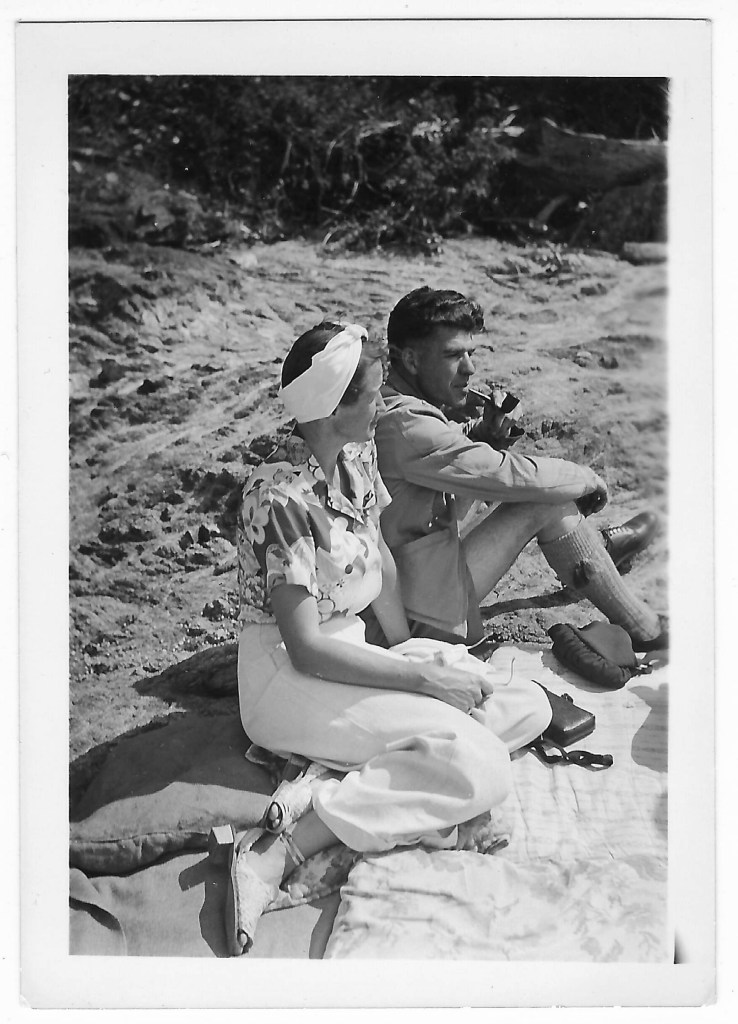
Helen would get a home soon though (I kept you in suspense after that foreshadowing!), one where she’d have a place for all her travel trinkets, and someone to admire them with.

Is that someone with her now ‘…in the moonlight on the canal’ on the grassy knoll? Read on to find out!

18. Cape Town, South Africa, Dec 3-6, 1937

The Letter From After The Trip

Cape Town, crossroads of the world, lies in a perfect setting on the slope of flat-topped Table Mountain. It is a lovely 50-mile drive to the Cape of Good Hope, where we stood on a breezy headland and looked down at two Oceans. Sheer scraggy mountains, clean windswept beaches, cozy suburbs with exquisite rock gardens... the stately home of the Prime Ministers... the breath-taking 2 1/2 acre amphitheater of blue hydrangea in full bloom. One of the engineers had his motorcycle on board ship, and we wrangled it through Dutch Customs Inspection and roared up Table Mountain on it for one of the most exhilarating rides I've ever had (I had frowned on motorcycles for years!)
Helen, discovering the joys of motorcycles, Table Mountain, Cape Town, South Africa, 1937. Photo by “one of the engineers”

The During-the-Trip Journal

The journal picks up a few hours after she sees a cloud-flanked Table Mountain from the ship deck at 4am two posts ago. She goes back to sleep, but then:

Woke again at 7:00 when immigration officers came aboard. Much pro-ing & con-ing about sightseeing. 5 went this am on the 100 mi drive. Shag, James, and I went uptown. Adderley St is the main drag. A wise, interesting St, but clothes are hideously unattractive and very expensive. Displays garish. Most cafes seem to be in galleries above the street.

Side note: The civilian passengers go one way, she goes the other (with engineers tagging along). Like we’d expect any different.

And here are photos of what Adderley St looked like then, in all its wise- and interesting-ness.

5:45 — Shag and I walked up on the hill toward town, vistas down the streets toward Table Mountain, Dutch architecture, severe stucco buildings, red roofs, quaint chimney-pots — some spiraled. Crosses standing out against the mountain which is rocky, sheer, looks a wilderness.

Side note: I imagine it was strange, or at least different, for the two of them to be on land together, strolling around on their sea legs, going places that aren’t on a boat.

Types of people: Cape Coloured — mixture of Hotentot, original Portuguese, other tribes — all shades. Square, stolid Dutch, English, some of the stevedores are the blackest blacks I ever saw. Hindus in turbans — there are more Indians than whites. Boys in fez. The black boy on the mule cart singing Al Jolson to the life with the inflections, the gestures — he couldn't have been more than 11 yrs. old.

Side note: Racial nomenclature was of course quite different in 1938. We can never know Helen completely, but a personal journal can be a pretty good window. She strikes me as an observer and, of course, fact collector (you’ve seen those copious lists). I don’t pick up derision towards people in her (except towards civilian passengers who annoy her).

In the evening with Shag and James in the Kloof Nek bus to Table Mountain, and climbed up to the cable station. Below us, the lights of the city, behind us the menacing shadow of Lion's Head, above: the luminous sheerness of the table.

Side note: What a picture. Shag and James and Helen on a bus up a mountain, which may have looked like this, zig zagging switch backs in slow motion. Would Shag and James, who’d seen these ports before, be doing touristy things if not for Helen?

Capetown — English style traffic, on the left, with right hand steering wheels. Many American cars, some Eng., little M.G. sportsters snort around, most intriguing. 

Side note: Snort around.

Street signs in Dutch and English. Capetown Harbor: fancy maneuvers to get in from the breakwater. Handsome powerful tugs (15 knots at sea) do the trick. Praetoria — Deutsch-Afrika Line — large passenger ship in next berth — flying the swastika.

Side note. The Deutsch-Afrika Line was, as it sounds, Deutsch, hence the diabolical flag it is flying (with its stolen ancient symbol).

Praetoria was the name of the German boat, and good lord look at its history… The Silverwillow didn’t make it through the war, but a German ship gets to become all sorts of other types of ship until it retires in the 1980s? Not quite fair.

Sat. Dec. 4: Driver was to come at 9:30 to take Mrs. Sierist, Mrs. Dreyer and me on the 100 mi. drive. He came — his price having risen to 3£, we argued (the price having been set yesterday) in vain. We refused to go. We hired a car and I had the idea of taking Shag long. Came back to get the movie camera, picked up Shag at the P.O. started at 11:00. 

Side note: This is brilliant. Remember, Mrs Sierist is the passenger that Helen, at some point this month, decides she doesn’t like; and Mrs. Dryer is Helen’s roommate. They are both over 60s. So, three women aged 34-70ish are inviting a 23 year old crewman to take a 100 drive. And he says yes.

Out Victoria Road past the Lion's Head and the Twelve Apostles. Follow the shore line, passing attractive homes, bays where bottle green and sapphire waters mingle. The curves of the shore bring ever new vistas of mountain peaks, a dazzling stretch of pure white sand and ice green rollers curling in from the sea give no intimation of its dangerous quicksands. Inland a few miles thru barren boulder strewn hills to the Cape of Good Hope where two oceans meet. Stop at a little Dutch farm house for hot scones, fresh strawberry jam and large glasses of milk, served in a tea garden overlooking the Indian Ocean. Returning along False Bay thru Simontown, base of SA Naval Squadron. Took moving pictures of Muizenderg one of the most beautiful beaches — white sand, clear water, good surfing, as they say — and two stunning peaks rising behind it.

Side note: A 23 year-old man having scones with strawberry jam and large milk with the ladies is fun to picture.

Then thru the southern suburbs: Diep River, Winberg, Kenilworth to the De Waal Drive, where we stop at Groote Schuur, Rhodes House, in which the prime ministers live. Beautiful gardens — the jacaranda, wisteria just past its best but still lovely. Roses as big as chrysanthemums. The house, high ceilinged, is stately, sombre, panel walls of teak, ponderous furniture of teak, satinwood, stinkwood. Folding window blinds with superb brass fittings. Dutch wardrobes with silver drawer pulls, pieces inlaid with ivory, a clock of Napoleon's, and many handsome grandfather clocks. A gallery looking toward the garden with a row of wooden chests.

Side note: How can anyone spell chrysanthemums correctly in a journal just casually?

Proof that Helen was a super-speller
8 p.m.: Capt. and I went to the plaza. Saw Vogues of 1938. Modernistic theater, just misses being very attractive. News reels, shorts and ads from 8:15 — 9, then an "interval", and finally, one showing of the feature, ending with a picture of George VI, and playing "God Save the King". To Del Monico's, new Venetian restaurant and night club, spiral columns, artificial sky, Hindu waiters. A shilling for a chocolate ice cream soda, which was just a flavored club soda chilled — it never saw any ice cream.

Side note: 45 minutes of news, shorts, and ads! ‘Vogues of 1938’ was a technicolor musical about a fashion designer and his escapades. The theater the “just misses being very attractive” I believe is this averagely attractive theater.

And I think the George VI ‘picture’ was colonial propaganda like this God Save the King.

Chief mechanist took us aboard the H.M.S. Amphion, a light cruiser — 7500 tons (3 mo. In S.A. — flagship), 72,000 engine horse power, 80,000 boiler H.P., 16 engines (oil fired steam turbines — quadruple screw) speed well over 30 knots. 12 6" guns (we went into the gun turrets), 4 4" anti-aircraft guns, 2 airplanes, detachable pontoons, catapult. He is also Chief diver and we saw diving helmets, shoes with 10 lb. of lead soles. 

Side note: Remember what I said about fact finding?

A light cruiser, such as the Amphion, was a war ship, hence the guns. I did not know cruiser meant war ship. Learning!

The diving helmets, my goodness, look like torture devices.

Train back at 5:47. English style coaches, crowded with people going back from the beaches. Shag and I left for town, walked in, took bus to Kloof Nek again, and the lovely walk toward the cable station — evolved some foundations for a friendship. Back to the ship by 12:00 but S. wouldn't go aboard until 1 a. We walked up on the breakwater — waves rumbling in, stars bright.

Side note: Evolved some foundations 😍. This is what Cape Town Harbor looked like from above around that time.

Mon. Dec. 6: 9:00 a.m. — Shag and I buzzed to town on the motorbike ... and roared off up Table Mountain to the Cable Station. It's as beautiful by day as by night. A layer of cloud like froth lay on it, poured over the side in a stream and vanished. Took some pictures — hope they'll be good. It was a morning to remember forever. I take back all I ever said about motorcycles, there's a tremendous exhilaration about it and our minds and hearts and appreciations were in tune to make it a quite perfect trip.

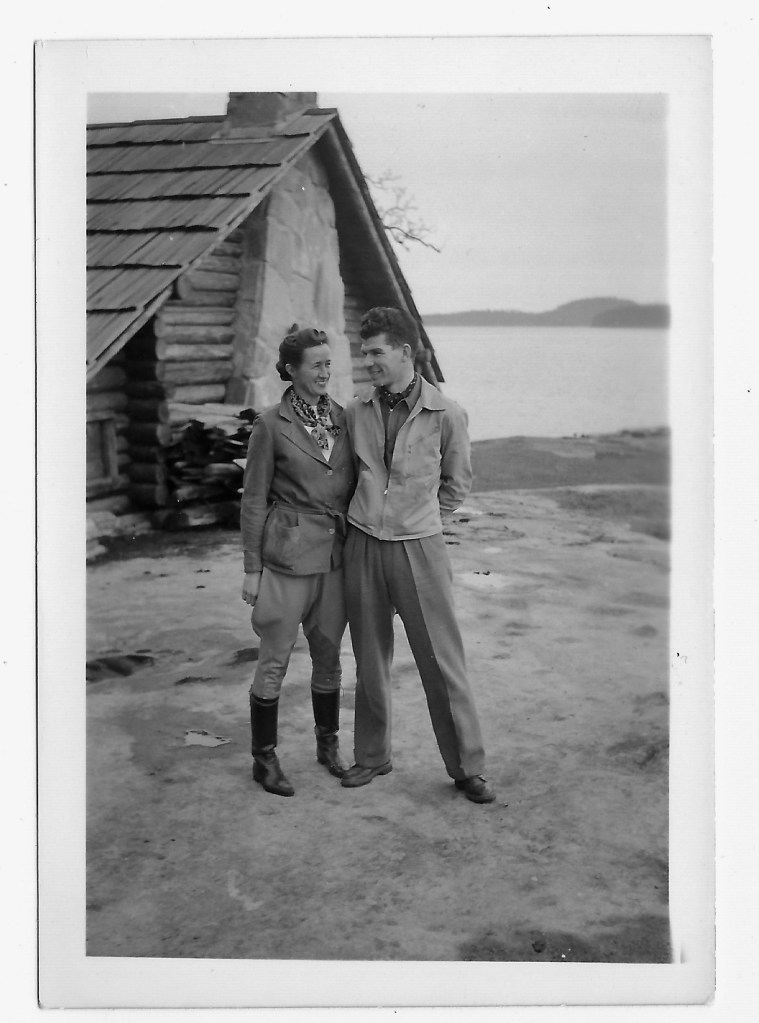
Side note: Pictures?? Why yes, some of them turned out just fine. Look who it issss…. SHAG! Told you he was cute, and he matures into Hollywood-dapper in a year or two. Just watch.

Roy (Shag) Shadbolt and motorcycle, Table Mountain, South Africa, 1937, photo by Helen Skinner

Is that helmet-head? I hope they wore helmets, but it was early days so probably anything went. Note the pirate laces on his shirt.

I always assumed there were two motorcycles, and they rode them up the mountain side by side. But ‘motorcycle’ is always referred to in the singular. So there must have been just one, and they took turns posing with it. Due to Helen’s dislike of motorcycles, I’m going to assume she didn’t know how to ride one. Maybe it was at Table Mountain where he showed her how. Vroom vroom!

Helen Skinner, 1937, Table Mountain, South Africa, photo by Roy (Shag) Shadbolt
Took the bus back to town after lunch. Took a look around numerous stores. Could hardly tear myself away from stinkwood pieces. Ivory figures from Rhodesia, lion skin bags, zebra cases, elephant hair jewelry.
A gale blew up this p.m. at 6 when the tugs came alongside the wind was just a beam in the entrance to the harbor. Water, wind blown in sheets thru the air, as dry snow is blown off the top of drifts. With port engine full ahead and starboard full astern we just cleared the breakwater. Wind at 65 m.p.h. all evening, cold as blitzen, Lion's Head and the Apostles very grand as we passed by. Not dark until 8:30. Exchanged experiences with Ruth. Bed at 10 with a murder story, but couldn't stay awake.

Side note: “Cold as blitzen” must derive from one of her schools, as it’s a pretty rare Appalachian saying, from what I can tell.

Ruth is either the woman about her age or her roommate. She introduces the passengers by last name only but then calls them by their first names quite a bit in the day to day.

And then they are again afloat! From Cape Town, they steer up the east side of the continent to see what adventures await.

13. Come Sail Away, Come Sail Away With Meeeeeee! 🎵

Setting Sail

In The Helen Files, I mentioned that my uncle Bob had transcribed Helen’s travel journal from her 1937 trip around the world, with its eensie handwriting, and that it came out to 70 typed pages. When a printed version made its way to me, a smart-me would have scanned it and used a software to make it into editable typed text. But stupid-me got excited, underlined a bunch of it, circled some, and put stars and exclamation points all over.

When I went to scan it, the transcribing software got confused by my scribbling and made half of the text like *)H%%soiwue)(. But the other half was ok, and, through re-re-transcribing it, I got to live the tale again, and I noticed all sorts of new detail.

There are two main artifacts. The first is the journal, with all the daily detail and juicy bits, peppered with buried hints. That along with A LOT of particulars. And the other is a three page letter, summarizing it all beautifully. I shall section them in a juxtaposed way, in chronological order.

The Letter – Post-Trip 1938

To preface, when Helen was 34, she did a 360 degree world-loop, solo, on a freight boat, with nary a few civilian passengers (but at least one really nice crewman).

Here it is:

M.S. Silverwillow. Helen spent five months aboard, from 1937-38, going worldwide, dodging real and figurative fireworks

The letter is likely a carbon copy, and the same letter sent to multiple people. And it was written from Arlington, New Jersey, where her parents lived. By October 1938, her parents definitely would have known all that is in the letter, as she returned several months’ prior. As would her sister. So maybe she wrote this to friends and less immediate family.

See:

Post trip letter from Helen, likely a carbon copy sent to multiple people, Part I, 1938

Here she starts:

October 29, 1938 

The Motorvessel Silverwillow is heading north from Panama on her way to New Orleans again. She has been around the world since I left her last March at San Francisco, and it's nearly a year since I sailed for Cape Town and points east. It is high time I attended to some sadly neglected correspondence.

Side note: ‘Motorvessel’ must be the M.S. in the boat’s name: The M.S. Silverwillow. Google says this could mean Motor Ship and that is interchangeable with Motor Vessel. As for how she knows where the boat is located a year later after her trip, it is likely because she maintained relations with a, now former, crewman.

It was Nov. 9 when, loaded with lumber, mining machinery, asphalt, shingles, apples, canned salmon, Ford trucks (to mention a few items of cargo) and eight passengers, the freighter Silverwillow nosed out into the Mississippi and set her course for South Africa. 

Side note: November 9, 1937, to clarify. Right around when a certain World War was brewing.

My fellow travellers were a heterogeneous assortment: a retired rancher and his wife from Canada, who left us in Africa (he had fought in the Boer War, and was going back to see what it was all about)... a fluttery 70-year old spinster from Frisco... a neurotic woman of about my age who was dangling on the brink of divorce...three widows, two of them past 70 years of age, and the third, my roommate, was a dear, a good traveller, easy to live with. 

Side note: Heterogeneous for middle income civilian travelers from America with the means to travel for five months in 1937, yes. But this wasn’t a highball-up, pinky-out kind of trip. Though the Booze Cruise freight boat experience did seem quite opulent, this one was no frills. No costume parties or Gin Rickeys whilst perched on railings. The eight civilian passengers had buckets for showers, slop with the crew, and glorified cubby holes for rooms. We will learn all this…

It chipped years from my age to be the youngest in the crowd, and guess I was the 'enfant terrible’ of the voyage. Anyway I'm sure I had the best time and saw the most, even if I skipped a museum now and then. 

Side note: She absolutely had the best time.

End first scene!

The Journal – The Realtime Timeline

And over to the journal now, where we get to dive in and see what was really going on. She starts by meeting the boat.

Present Location:  

Lat. 26" 57' N 
Long. 87° 52" N  

Mon, Nov 8 

At last — the Silverwillow. 

Captain said, "I'm glad to see some young blood getting on — it looks like an old ladies' home." A cheerful thrust for an introduction — went on board. 

Side note: Cheeky captain! We learned from her last travel log that she quite enjoys a good flirt.

Wandering around the boat, C___ encounters the Captain, we all go up on his deck where he makes us at home, offers smokes and beverages. We talk for a couple of hours. He takes us back to town in his cab. Capt. asks if I want to go back to the boat or for a bit of a dance — to the Blue Room. He listens to my navigation aspirations, sounds hopeful about the possibilities. Back to the ship at 1:30 — roommate still up. The Capt. is a fine person — if only the trip may be as pleasant as the send off.

Side note: She drops off her things, and finds herself promptly on the Captain’s deck, smoking, drinking, and schmoozing, and I’m certain this is exactly where she wanted to be, as it’s the Captain who needs to make her navigation aspirations real. The place where she goes to boogie with the Captain (until 1:30am!) was NOLA’s swanky new club, The Blue Room, which would see the likes of Frank and Louis and Ella in its day.

Tue. Nov 9: 

5:30 a.m. wake when the loaders start shouting and the winches begin to creek putting aboard objects of 10,000 lb. At 8:00 and 8:30 jangling of a bell: warning and breakfast. 

Boiled potatoes are depressing in the morning even if someone else is eating them. Good toast and eggs. Stewards and cooks Chinese — food British. 

9:00 a.m. — I take a taxi to town, buy stationery, gum, some golf clubs at a bargain. 

Side note: She goes to town to get necessities for her trip at sea… like golf clubs. Hm. Also, she only had four hours of sleep due to all the dancing. And while I’m a big fan of the potato and don’t like it disparaged, this is golden:

“Boiled potatoes are depressing in the morning even if someone else is eating them.” – Helen Skinner

To the boat. Mr. Sparks introduces the apprentices and things look up. There are four, three of them and a Junior Engineer are clean, intelligent looking youths from Canada. 

Side note: This is key, as one of these youths is a 23 year old Mr. Royal E. Shadbolt of Victoria, British Columbia, Canada. And when you see what he looks like, you’ll understand why she said ‘things are looking up’. But you’ll have to wait until South Africa for that. Also, it’s too cute that she is already meddling again with the crew rather than lounging with the passengers.

At 5:45 we cast off, the wharf recedes, we are turning in a wide arc and heading down the river. 

It has actually happened — I am starting around the world.

I feel excited and nervous for her, even though I know what all transpired.

That is the end of the pre-boat preparations! We are sailing!!