33. Chinese New Year and the House of Orange, Dutch East Indies, Jan 31 – Feb 2, 1938

The After-the-Trip Letter

In the Islands of the Dutch East Indies we stopped at many ports, unloading rice from Burma, picking up spices, tapioca flour, tea, kapok, rubber. 

We drove inland at each stop as far as we had time to go.

There were mountains, volcanoes, miles of terraced rice fields, and an endless procession of coppery brown Malays going to market, carrying two baskets hung on a bar across the shoulders: pottery, sugar cane, durians, mangosteens, kapok pods...we couldn't carry the loads, but they've developed a peculiar jog to balance and distribute the weight, and as days pass it becomes hauntingly familiar to watch, until, for the visitor it becomes a part of the memory of the scene. Gay, colorful in face and dress, clean, cheerful, the Malays seem a happy people.

Side note: Durians! Below is a picture I took in Singapore, where they are banned for smelling bad.
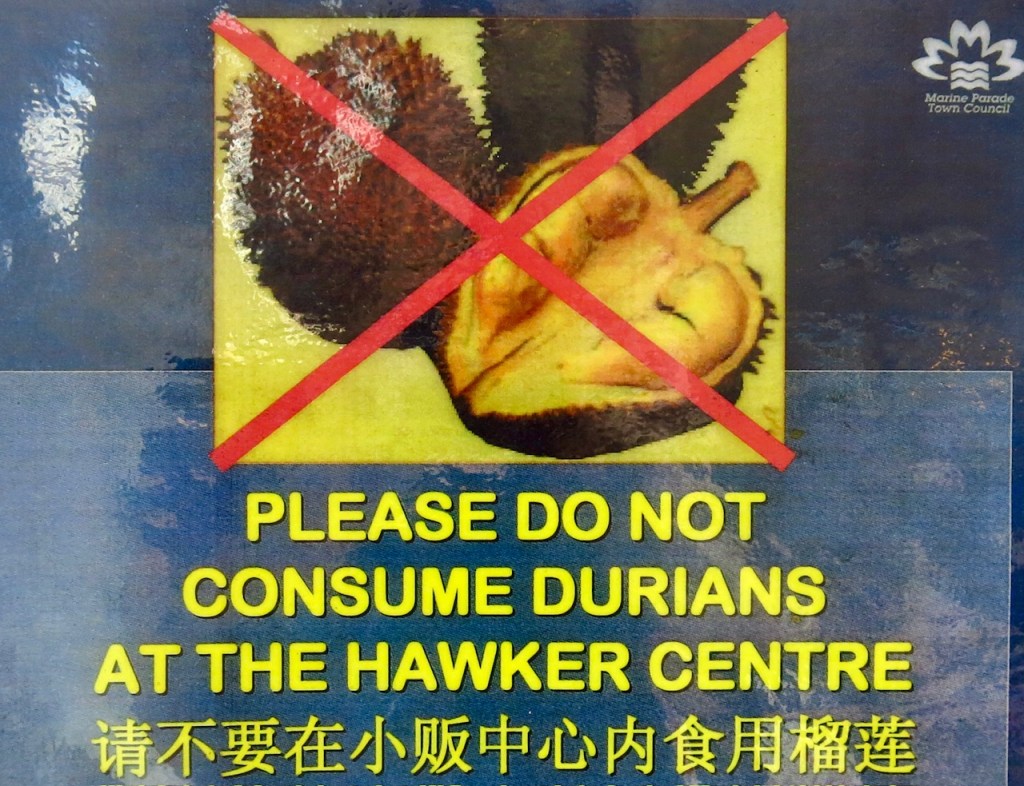
A picture I took in Singapore where durians weren’t allowed in most (if not all) markets due to smells. Circa 2015.

The Day-to-Day Journal

Belawan-Deli — Brastagi - Indonesia 

Mon. Jan. 31:

Off the ship at 9:00 a.m. in a 7-passenger car thru Medan and up 4800' to cool mountains.

Gorgeous scenery - thousands of coconut palms, dates, bananas, tobacco barns of palm thatch, tobacco fields protected by thatch sheds, tea plantations - the white flower resembles a syringe, paddy fields, coffee. Hair-pin turns, good driver.

Side note: These are likely some of the lovely lush locations she looky-looed. Imagine exploring those sights though while driving in a 1930s vehicle on 1938 roads. A seven-passenger car back then did not look very agile and probably didn’t have the best shocks absorbers.

It is the Chinese new year, fire crackers every where, many Chinese in Belawan, Medan, dressed in holiday clothes, horse back riding, riding in the curved-top pony carts, on the streets. 

Thru the town of Brastagi with its market, pagoda, pony carts, trim lawns, to the Grand Hotel, Dutch, very plain exterior, set in rolling hills at the foot of a volcano (Sibajak), and looking off toward a Berkshire-like range in the distance.

Our "Dutch" lunch consisted of "omelet americanine", filet mignon and French fried potatoes. An "Am. Ex." round-the-world party here.

Cool in the mountains, beautiful drive down, steaming hot when we returned to the ship.

Learned that Princess Juliana had given birth to a girl.

Shag and I for a walk, then boat deck until 11.

Side note: 1938 was the year of the Tiger.

The new Dutch royal was Princess Beatrix, who went onto become queen, and who is still kicking. Due to the impending war, little Beatrix would soon flee the Netherlands with some of her family, and settle in Canada, where they were treated like royalty but purportedly were nice enough not to act like it.

Tue. Feb. 1:

In bed until 10 a.m. — cooler than being out on hot smelly deck.

Capt. took me to Medan at 11 — drive around the town, very fresh and clean looking. Sultan's palace and office, the bright colored Mosque, the public garden with enormous pink water lilies, the trellis with frangipani, bougainvillea, yellow hibiscus, two long-legged cranes. Saw betel nut trees (like date palms, with very slim straight trunks) Kapok - trees like telephone poles, sparse branches high on the top like 'T' with pods hanging like globules which contain the kapok.
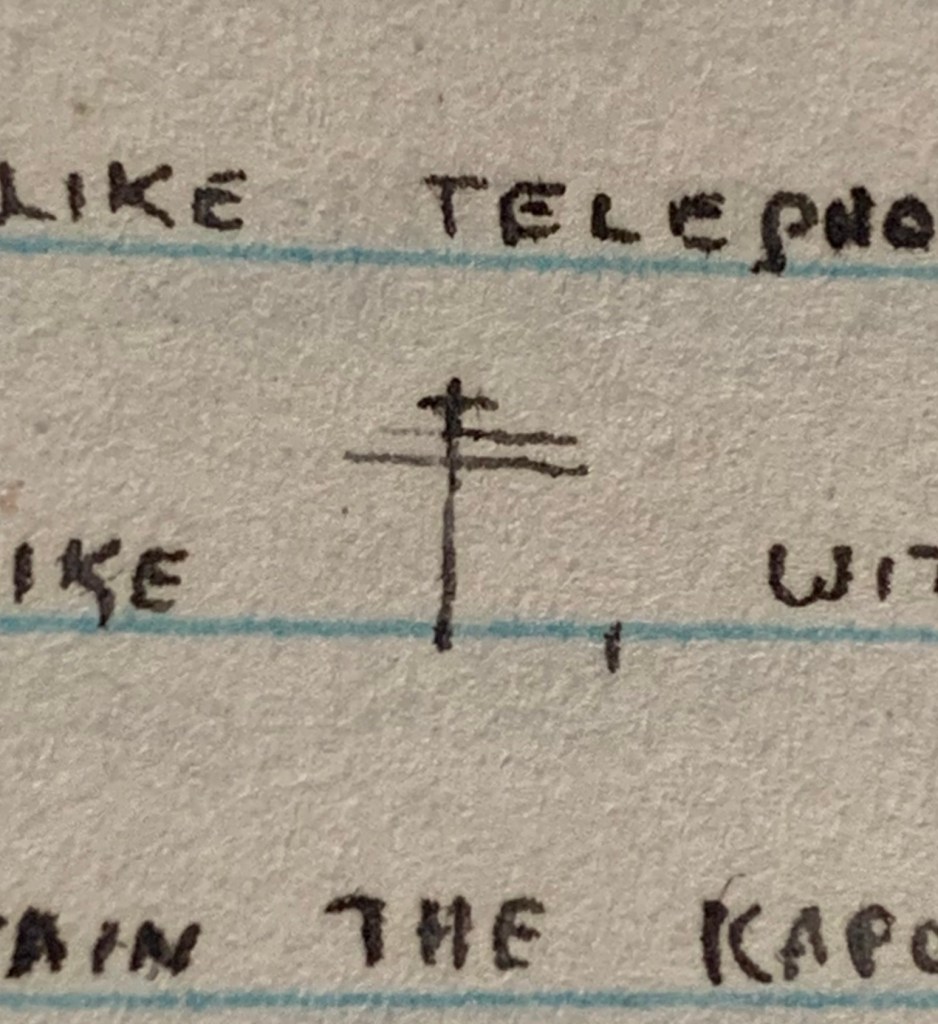
Helen’s tiny rendering of a Kapok tree, sans globules, inline in her dayto-day travel journal
Lunch at Hotel De Boer. Excellent German beer, veal liver in paper thin slices — very good. 

Blanc mange with orange sauce in honor of the House of Orange, stood up for the Dutch National Anthem, heard other Dutch airs. The public buildings decked with bunting, Dutch flags, orange streamers - the stork with crown and infant princess on the hotel top. Orange flowers on the tables, an orange streamer on the cloth.

Ate my first mangostein, round, tough shell, red inside shell, in center a small white section of fruit, very tasty, must be eaten fresh, cannot be shipped.

Shag and I on the jetty.

Side note: ‘…orange sauce in honor of the House of Orange…’ The word ‘orange’ appears five times in that paragraph above. I used to work for a Dutch company and everything was orange so none of this is surprising.

Shag and Helen on the jeeettttty! She has so much detail about everything else, even little drawings, but not about Shag and the jetty. We are left to wonder things.

[Present location:) 

Lat. 2° 47' N; Long. 101° 02" E; Dist. 156 mi.; Av. Speed 14.18 mph.

Wed. Feb. 2:

Took on 1130 tons palm oil - orange color, unloaded rice. Cranes put a load on the quay, seven coolies lifted a bag on the shoulders of another who ran at a half-trot to the warehouse. Fine buildings on this wharf.

Away at 11:30 last night. Spent today topside writing letters. Visited Shag until 9:00, then up to see Capt. again. Washed my hair at 10:30. 

Side note: Orange palm oil does track, but it is very much a coincidence that the palm oil of the region matches the favorite color of the Dutch. I’ve just found out that there was a Dutch royal named William of Orange and that is where the House of Orange name comes from. It does not come from the color. But William of Orange, of course, wore orange.

In a few years, the Japanese would invade, kick out the Dutch and their orange, and hold power until their surrender in 1945. The Dutch had been there since 1602.

Then Indonesia was born, free from colonials or occupiers, and they changed the color scheme to red and white, representing blood and courage. SIXTEEN OH TWO.

Additional side note: I just used a suggested AI assistant to analyze all the above text, and one of the tips is: – Review for repetitive phrases or themes, such as the frequent mention of orange.

6. Helen – The Socials, The Box, and The Early Years, Phase I

The Early Years are broken down into two phases — Phase I is the ‘Going through all the documents in order…’ phase.

Exhibit I The Birth Certificate

Certificate and Record of Birth, Helen Grace Skinner, Born Sept 7, 1903 in Menands, New York

Helen was born September, 7, 1903 near Albany, New York. As you will see at the bottom of the document, this is a ‘true copy (photostatio)’ – I cannot find the word ‘photostatio’ even in Google, but the document looks to be an official mimeograph, ordered in 1935, with a raised seal and stamp on the back that says in red “New York State, Received 3 Aug 1904, Department of Health.” .

But Menands, noted above, is in Upstate New York near Albany.

The document says, at the time of her birth, her father, Frank Skinner, from Charlton, New York, was a 31 year old Civil Engineer; and her mother, Gertrude Skinner (nee Bunyan), from Saratoga, New York, was 27. Helen was their first child.

The tiny picture that accompanies the birth certificate at the bottom, which had become unglued, must have been part of a photoshoot that also produced the pictures below, as her shirt and hairdo are the same.

Exhibit II: Baby Photos

Gertrude and Helen Skinner, early 1904. Note Helen’s stylish middle part. It says ‘Age 5 Mo’ in the bottom corner.

A baby book, titled ‘Baby’s Red Letter Days’, also includes a picture from the same photo shoot along with lists detailing milestones and such.

Exhibit III: Baby’s Red Letter Days

A page from Helen’s baby book. They lived at the time on Brookside Ave in Menande, NY., very close to Albany (and close to both Charlton and Saratoga, where her parents were from, respectively)

A look inside the baby book:

Pages from Helen’s baby book, completed by her mother, Gertrude, 1903-1904

Some of the notes inside include (with punctuation/spelling intact):

  • Christmas Has Come – “Went to Ballston to spend the day. Very good girl all day.”
    • Side note: It’s hard to be very good all day, even for adults.
  • Short Clothes – February 24, 1904 – “our Baby dons short cloths”
    • Side note: In the baby book, ‘Short Clothes’ has its own page like the ones above, but with illustrations that look like mini adult clothing.
  • Cute Sayings – “At the age of 19 mos Helen exclaims to the astonishment of Dady and Mother, “Oh, my sakes.'”
    • Side note: this is adorable, proper and intelligent, all with a hint of theatrics.

The more juicy stuff is housed in the back of the booklet in a section called ‘Mother’s Notes’:

  • Feb 15 – First played with rubber ball intelligently
    • Side note: my high standards theory, validated
  • At 7 1/2 months Helen begins to say da-da-da and ma-ma-ma-ma and ba-ba-ba
    • Side note: Google says this would give her an A+, age-wise
  • At 8 months Helen can get around on the floor quite well. She does not creep but hitches along
    • Side note: hitching, I learned, means kind of crawling but with one foot on the ground that is pulling the body forward, and it’s something that is corrected today
  • June 29 – I find my baby standing behind my chair
    • Side note: if worth noting it must have been a milestone and/or startling
  • Helen begins to be very orderly. At age of 14 1/2 mos she picks up her daddys slippers and shoes and puts them in the closet and shuts the door
    • Side note: an astrology minded person would say she was a Virgo through and through
  • 18 mos – Helen gets loaf of bread and knife and comes upstairs and says ‘piece’
    • Side note: this might also be startling

What was the world like then, outside of Menands, New York? Some highlights: Teddy Roosevelt was president; the Ford Motor Company formed and released the Model A (also known as a horseless carriage); the first silent film was released; and, more apropos to Helen’s future, The Wright Brothers had their first flight on the Kitty Hawk. And refrigeration and electricity were not yet widespread. In other words, it was a long time ago (at least in American terms).

There are two pictures of houses in with the childhood photos.

Phase I, Exhibit III: House Pictures

Skinner Homestead, Charlton, N.Y.

The back of the picture of states:

Back of photo of Skinner Homestead, Charlton, N.Y. picture.

The house above was where her father grew up (and many Skinner generations before him). The Van Dam Hotel in Saratoga, Springs, N.Y. mentioned above, still stands, but under a different name.

The other house picture:

Henry Mead Home – West Charlton, N.Y.

The 2nd house was owned by some combination of different branches of her mother’s side of the family, with names such as Mead, Smeallie, Cavert, and Bunyan. The back of the picture (which is actually an unsent postcard), says “Helen Skinner (and later Mary), and Betty Bunyan spent summers on the farm until it was sold in 1918. Grandma Mead moved to Brooklyn and lived with The Skinner Family.”

Phase I, Exhibit IV: People Pictures

This is the only other baby picture of Helen, and it’s a cutey.

Back says: Helen Skinner. [This was likely 1904 in Menands, N.Y.]

Maybe the clothes in the picture above are Short Clothes, even though they are long? That little sweater looks quite sophisticated. I can’t tell what the black thing is to the left of her. I first thought a loom and then perhaps a croquet set stand.

Then jump forward a few years and there are three more pictures. The first one isn’t labeled except for her name, but she looks maybe eight?

Helen Skinner, circa 1911

I thought the above might be a school uniform, but nixed that idea after some Googling. But what I did find is that it was a sailor dress popular in around 1910, made by the designer Peter Thompson. So she was on trend.

Pictures of Helen, her sister Mary, cousins, and grandmothers – West Charlton, N.Y., likely 1913

Both of the above pictures were taken at the 2nd house in West Charlton, NY. The cute little girl with the bowl cut is Helen’s sister. Helen is the taller of the older girls (the one not in stripes). The other girl and little boy are their cousins, Betty and George Bunyan. The two women are Grannie Janie and Grandma Mead (one from each side of the family).

Betty looks unhappy in both pictures, but I was assured they were best of friends and partners in crime for decades.

And that was all I had from the childhood years based on chronology. Later I found a trove of additional detail.

Next up: The Early Years, Phase II.