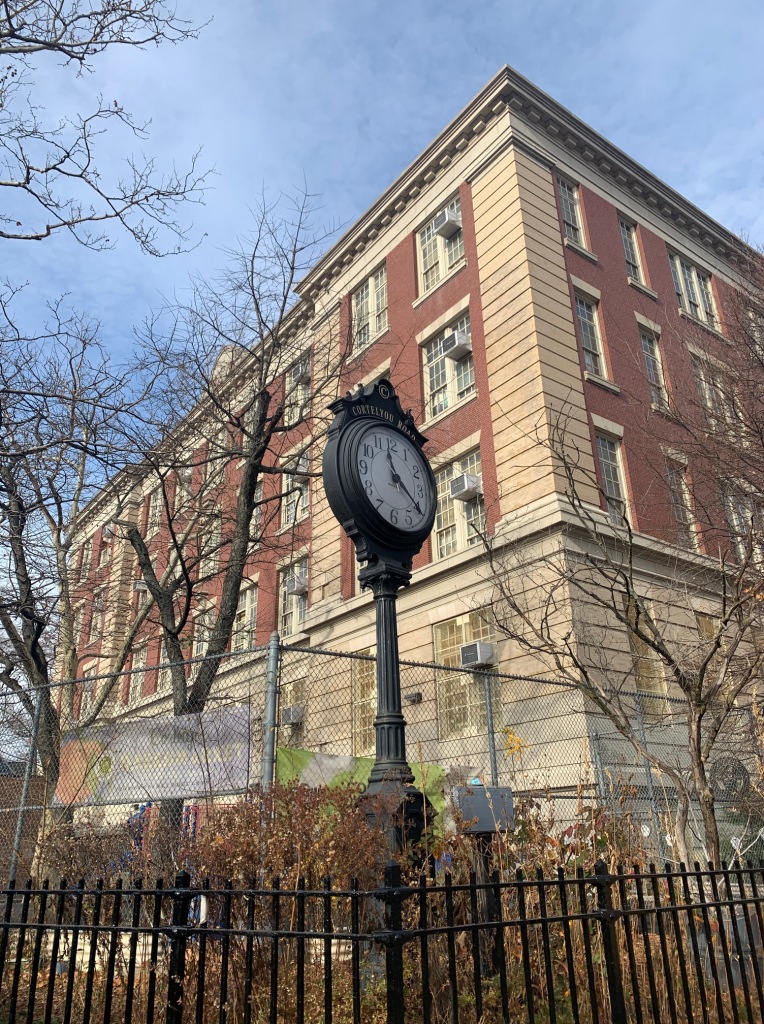
31. India, Part VI: Calcutta, the Races & a Glimpse at the Future, Jan. 18 – 22, 1938

Helen is back in Calcutta after an eventful 10-day shore leave to the Taj Mahal, a saga that took up more space in her journal than a lot of the rest of the world.

The After-the-Trip Letter

Back in the city, a round of lunching, driving, tea, movies, a formal dinner and dancing afterward at a lovely private club as the guest of a dear friend who has lived in India ten years, gave me insight into quite another facet of life there...low lights, soft music, beautifully gowned women, gracious living.

Side note: Helen was likely job prospecting in Calcutta (and other places she had prospects, like Madras). Up until she got on the Silverwillow, for over 10 years, she’d been teaching Physical Education around the U.S. Gleaning from her shore activities on this trip though, she seemed ready to take her work overseas.

At the time, the YWCA had outposts around the world focused on women’s health and P.E. She had connections there, and in the future she would indeed work for one, but presently Shag was distracting her. You can’t blame her, I mean look at them!


Helen and Roy (Shag) Shadbolt, being cute (not in India in 1938, but still)

Shag’s life plans were shifting too, for similar cutesy reasons, but a looming war would make most plans moot. That’s for later.

Our ship's Captain, who was very partial to me (I don't complain, but the other passengers might) took me to a race meeting.

Side note: She was super flirty and, by all accounts, appreciated high quality flirting in return.

I was equally fascinated by the horses running in a clockwise direction, and by the people....Indians in native dress, uniform of Scottish regiments, Europeans in sport clothes, Mahara-jas with their retinues in gala attire.

Side note: I searched about if horses still run in different directions in certain places and one of the top results was someone in a forum asking, “Why do horses run in different directions in Australia”, and someone responding, “Because they can”.

So horses still do run in different directions, if they want to.

We were glad to be back on the boat, and cleaning our teeth in water instead of tea. In India you eat no raw vegetables unless you KNOW they have been dipped in potassium permanganate water, and you don't drink water unless it's so hot you can be certain it has been boiled. 

The Grand Hotel, second best in the city had seventeen cases of typhoid just before our arrival. And since we left we hear it had another epidemic, and had to fold up and sneak out the back way. (Moral: don't go abroad without a typhoid, shot)

The Day-to-Day Journal

The above is all from her letter after the trip, likely carbon copies to friends and family, as one would do in the day.

So below we have the personal journal of the same time frame as above. It starts when she is reuniting with the boat crew after her 10 day trip away.

Tue. Jan 18: 

Shag and Jim came while we were at breakfast, good to see them. Showed them pictures and purchases, chatted until noon.

Shag came back in the p.m. and then I had a grand scramble to get ready, had to wash my hair — still feel filthy from the train. Jack looked perfectly beautiful in a dark wine chiffon. After the guests had left I was persuaded to stay to dinner (not too difficult).

We were five, and it was delightful. Back at the hotel Capt., Capt. Streets and H. Dreyer were beering. I joined them and went upstairs at 10 to be very ill.

Side note: That all just sounds grand. Except the ill.

Jack, I believe, is her friend in Calcutta. Dark wine chiffon for the win!

Wed. Jan. 19: 

Morning with Shag.

Lunch at Great Eastern and then to the races. The course is on the Maidan, looking across to the Victoria Memorial.

The track is turf, 1 1/4 mi. long (3 tracks, really, for the various monsoons), the stands are enormous, and in the center inside the track enclosure, hundreds of Indians may see the races free.

This was one of the best opportunities to see a multitude of types: every shade; style of costume; all endlessly fascinating.

The horses were good, and one race was for 5000 Rs. My first look at a race run clockwise. Picked horses in the last 3 races that won Rs. for Capt.

To Firpo's for a bottle of soda. Spent the evening with Jim.

Side note: I’ve looked up more about horse racing directions. One part of the Internet says that races in the U.S. (be it horse or human or car) are counter-clockwise as an middle finger to the British. Another part says that it makes sense to be counter-clockwise because of right handed people. My theory was that countries race in the direction they drive, but no. Germany has clockwise AND counterclockwise tracks.

What everyone should agree on, I think, is that the horses are the best and should be treated as such.

Thru. Jan 20: 

S. and I had the morning together. 

At noon rode out to the ship which is still in a dreadful mess. Pressed evening clothes in Capt.'s room, had lunch with him. 

S. and I made back to the Grand and then out to look at Calcutta. 

At 8:00 Tombazi's car came for me. Delicious food, charming people. Later to the 300 Club for dancing. All good dances, the club small, intimate, excellent piano and drums, indirect lighting, beautifully gowned women (Pellegrino water, no drinking, slot machine). 

Fri. Jan 21: Shag and I saw the stone slab that purports to cover the black hole of Calcutta — a washout as a sight. We drove around, lunched at the Grand, rode some more. Packed after he left, paid our bill, distributed annas — three were standing outside our door, another half dozen climbed on the taxi step. I bargained for a cab for 1-8, very cheap, for Garden Reach Jetty. 

Came aboard loaded to the gunwales. No running water, (glad I bathed at the hotel), but the cabin very fresh and clean. Pressed an evening dress, and at 8 Captain and I taxied uptown to dinner at Firpo's and to the metro to see Joan Crawford in "The Bride Wore Red", a stupid picture, but I enjoyed the evening.

Side note: The Black Hole of Calcutta story is not for the claustrophobic (like me), good lord.

Apparently the role in The Bridge Wore Red was not written for Joan Crawford, but after she replaced the original actress, she insisted on playing it as Joan Crawford, and it didn’t work. So says the Internet.

Sat. Jan. 22: Shag and I to town on the bike, bot scarves at the good companions. 

Had tea at A.A.B. To the market for cashew nuts — 2 Rs 9 As. for 5 lb.

Back to the boat at 3 for medical exam, which was a farce. A Chi-Chi woman felt the pulse (to see if the heart was beating, I suppose). Those without vaccination certificates have it done. Couldn't leave the boat afterward, and the ship must sail within 24 hours.

Pooped out, slept.

Side note: The A.A.B. was then the Automobile Association of Bengal and is now the Automobile Association of East India, and I like that they served tea. While Helen had her eye on P.E. teaching gigs overseas, Roy (Shag) Shadbolt had has eye on racing cars. After World War II, the two of them would go on to a run race car shop in Vancouver, Canada, known as Shadbolt Cams, which was open until just a few years ago. They even had a Facebook page.

They did trade with parts dealers in various parts of the world, like with the A.A.B.

Roy would go on to also race cars around the U.S. and Canada, and was well known in those circles.

More about all that later though! First we must finish getting around the world. Next up, the Bay of Bengal.
29. India Part IV: The Actual Taj Mahal and then off to Delhi, January 1938

We begin here in Helen’s journal as she is approaching the Taj Mahal. For those following, her letter home after the trip also detailed the Taj Mahal and its breathtaking glories, but the below adds elements and context and an intriguing scientist (and there’s even more that I’m leaving out if anyone wants to inquire).

To refresh, Helen is on 10-day shore leave from the ’round-the-world freight, and she is traveling with a few female civilian passengers from the boat. The passengers are, I believe, at least 25 years her senior (she is 34). And we don’t know much about them because she’s been dead set on making the engineers teach her how the boat goes vroom.

We had our first glimpse of it from the train. Dixit generously asked us to go with him. We sent our luggage to the hotel and went in his taxi.

Side note: What Helen did not mention letter home, which spoke of a series of comical-in-retrospect travel bloopers, is that she did get into a first class train car (in 1938, in India, 1st and 2nd class were vastly different).

And it was in first class that she met Dr. Dixit, a professor of physics from Gujarat College in India; he was swinging by the Taj Mahal on his way home from a conference in Calcutta. And they all joined forces.

It was just sunset when we stepped thru the red sandstone entrance gate and looked down the vista of trees and fountains to the Taj Mahal. 

Stopped to take two pictures, the 2nd a time exposure. The light faded with dull red across the sky.

Side note: She took two pictures. How many would we take today? Of a sight that is life altering?

I have an 8×10 of one of the picture she mentions, but I cannot currently locate it. When I do I will post it.

By a dim pocket torch we climbed to the top of a minaret, stopping on each balcony to gasp at the ethereal beauty as the moon came up and cast a pale light on the marble.

She wouldn’t see the photos for months. And even when she had them, the ‘dull red across the sky…’ she’d have to describe, because of black and white film.

While writing all this, I have been picturing it in black and white (it was olden times), but I want you to envision the below in all the pretty colors:

We approached close enough to see that the pattern is inlay of lapis, jade, carnelian, black marble, in white marble. 

The workmanship is superb, the labor colossal.

It was dark inside and we saw the tomb of Numtaz Mahal and of Shah Jaahn, her husband (who built the Taj), by the light of a flickering candle.

The screens surrounding the tomb are marble carved in unbelievably lacy patterns.

By a dim pocket torch we climbed to the top of a minaret, stopping on each balcony to gasp at the ethereal beauty as the moon came up and cast a pale light on the marble.

We looked at it from the river side, and lay down on the marble base on the "moon-side".

It took on the soft color of ivory, and the inlay looked like carving and the shadows are not black but gray and purple.

Return to the gate where a great carved brass hanging lamp cast leafy shadows on the sandstone walls - and took our last look thru the arch of the gate.

Words are less than useless.

To the Imperial room, every convenience, quiet dining room with a delightful atmosphere and good food. Lovely shops in the hotel. Bot a white Kashmir shawl for a skirt.

Side note: The beauty of journals is the juxtaposition of the truly spectacular and the mundane. (Bot = bought. She uses her own shorthand at times.)

Sat. Jan 15: Mr. Dixit arranged with his driver to take us for the day for 15 Ru. Drive to Fatenour Sirri, 23 mi, passed several villages — every inch of land under cultivation.

Built by Akbar in 1569 A.D., a great wall, palaces, mosques, Turkish baths, the marble tomb of the Moslem saint Shaik Salim Chisti with its mother-of-pearl sarcophagus, the gate of victory 176 ft. high, and towering above the village outside the walls, the horse stables for 175 horses around an enormous span court. All in red sandstone marvelously carved, we were there 2 hours.

Back to the hotel, then to some shops — got a couple of pieces of marble inlay to remind me of the Taj.

Had only half an hour to see the fort, could only glance at it, but it made an indelible impression.

Dashed back for our baggage and on to the station for our train at 5:30 to Delhi. The ladies' compartment filled with three Indian women and 4 children, we went in with an English couple and their adorable little girl. 3 1/2 hours to Delhi, to Maiden's Hotel, dinner in a vast dining room at 10:30 p.m.

Note to Mary on her birthday.

Side note: The Maiden’s Hotel is still there and I want to go. And also, Mary was my grandmother, who was pregnant at the time with my mother, her second child, my mother.

India Part V coming up!

27. India, Part II: Awe at the Taj Mahal: The Letter Home, Jan 1938

With ten days of shore leave at hand, Helen embarked on a complicated, multi-day side trip inland — traveling over 1,200km each way — via boat and train. She reflected upon it all quite colorfully in both the after-the-trip letter and the day-to-day journal. So much color in fact, it will take two posts.

First, the shorter after-the-trip summary…

The After-the-Trip Letter

(I mentioned in the last post about the unfortunate state of things for many in India at the time. That state of things is reflected in her observations below.)

The ship went into dry-dock in Calcutta, and while hundreds of coolies swarmed over the boat day and night, riveting, hammering, scouring, repairing, and refurbishing, the passengers had ten days "on their own”. 

Three of us, Lysol bottle in hand, braved the so-called perils of travel by train.

“You must travel 1st class, and you MUST take a bearer (servant)", everyone said, so we went 2nd class, without bearers -- you have to take your own bedding on Indian railroads...we rented bedding rolls from American Express for one rupee ($.38) a day...the natives steal everything on the train that is not securely fastened, so the comforts thereof are negligible, if not non-existent.

We found the trains unbelievably dirty, the sleeping accommodations thin (the berths were 2 in. thick, and the mattress...well, to be generous, maybe one-half inch...these came with the roll of bedding), the beggars persistent, the station platforms crowded with squatting Indians surrounded by their luggage, and innumerable peddlers who urged us in all the dialects of Hindustan to buy knives, bangles, brassware, guavas, betel nut (one walks the streets of India mentally holding in one's skirts, for chewing betel nut is the national pastime, and you never can tell from where he sits how far the chewer is going to spit the bright red juice whose spots give India's pavements a perpetually gory aspect). 

We wouldn't have missed the experience, and we learned to bargain, and to accept only good rupees (about half the currency is counterfeit, and you have to “ring" every coin before you take it, or they will "take" you…) and how to get off a train without tipping six porters and their uncles and their cousins and their aunts. 

Side note: She was warned! By ‘everyone’! But see… up there she says she wouldn’t have missed it.

Oh, and ‘we’ in his passage of the letter is not about Shag, but instead about her two female traveling companions on this side trip. They are both fellow civilian passengers from the boat. Which two right now I cannot recall, but they will appear in the next post in some detail.

And lastly, a public service announcement: The betel nut, like many consumables that are fun and/or frowned upon, can be addictive and harmful to the health.

In Benares we sat in wicker chairs and were rowed up the Holy Ganges River past the spectacle that is the sacred city of the Hindu (for a Hindu to die in Benares is to assure his salvation, and they come in countless thousands, pilgrims of every age, to bathe in the holy river -- pardon me while I hold my nose). It is the bath, the laundry, the medicine, the chapel, the lavatory and the crematory AND the drinking water! UGH! 

Side note: Here is a video of what she might have experienced, taken in 1937. I found some photos that aren’t all Benares, but there are great photos from India in the 1930s.

Let's escape to Agra. I'd heard so much about the Taj Mahal that I expected to be disappointed, but that evening has a page all its own in my book of memories. The setting sun shed a rosy glow on the white marble as we saw it first...then it was almost dark inside the mausoleum when we entered, and I had a momentary feeling of stepping into the past...a voice called 'Allah, Allah, Allah', and ages later the echo came back hollowly. By candle-light we examined the exquisitely carved marble screen surrounding the sarcophagi, and the wall panels inlaid with lapis-lazuli, carnelian, jade, jasper, in delicately wrought patterns. 

Side note: The Taj Mahal was built in 1631 (!) in honor of the emperor’s favorite wife. I don’t know when I thought it was built, but that is older than I expected.

And did she just know the names of those inlaid rocks and how to spell them? As a child in Colorado, I used to go to a rock and mineral shop almost weekly with my mother — each for our own reasons — and I’ve never heard of lapis-lazuli or carnelian.

Our companion, a young Indian professor of Physics from Ahmedabad, lighted our way with a dim pocket torch up a circular staircase to the top of a minaret. We had not long to wait for the moon to cross the river. It touched the marble with a caress, softening the lines until the Taj looked like a rare old ivory carved by a master craftsman. 

In Delhi we saw acres of marble buildings inlaid with semi-precious stones, built by the Mogul Emperors five hundred years ago.

Our eyes stood out on stems and our chins rested on our chests. It was so gorgeous we lost the power to react to it. 

Side note: We’ll talk more about this young professor in the next post, but for context, at some point her little group ends up in First Class on the train and there she meets a young professor who is headed to the same place they’re going. And the four of them then travel to the Taj Mahal together.

Another side note: The bit about the phrase, ‘Our eyes stood out on stems…’ evokes old cartoons, no? And it’s fitting. The art and architectures that humans build for their myriad gods are some of the most eyes-on-stems and chin-on-chest inducing of any, even for non-believers.

“Our eyes stood out on stems and our chins rested on our chests. It was so gorgeous we lost the power to react to it.”

The trip back to Calcutta is a volume in itself, so don't get me started on our compartment mates with their 14 suitcases, the garden flowers, the lunch hamper, the tepees, tennis rackets, basket of vegetables, raincoats, birdcage and catch terrier. 

Side note: Tepees?

26. India, Pt I: Cocanada, Budge-Budge, and the Hooghly River, Jan 7-9, 1938

After the round-the-world trip ended, Helen sent a three-page, airmail letter to family and friends to summarize it all. Word count and word choice were important back then — each ounce mattered — unlike now where we can just plod along forever and then absentmindedly click send and a typo-laced missive instantly transmits to the nearby and/or far-flung.

Almost one whole page of her three page letter was devoted to an overly complicated in-land side-trip to the Taj Mahal.

  • Two of the three pages consisted of: colorful descriptions of all of the world that she saw except the part about getting to the Taj Mahal.
  • One of the three pages consisted of: getting to the Taj Mahal.

She did other things in India though that don’t get covered in the letter, but do in the journal, where there was not a word or weight limit. And we can’t miss the whats and whos of Cocanada and Budge-Budge back in early 1938, can we??

The Day-to-Day Journal

Side note: We start here while still on the Motorvessel Silverwillow and we are forging ahead towards Coconada, India (now Kakinada — both of these similar sounding names came from the British and Dutch). This port town, like so many, has long suffered the deeds of those looking to stake claim and/or pillage — land, resources, women, men, jewels, crops, minerals, power, etc.

Fri. Jan. 7: 

Capt. up at 4:00, not long after the engines stopped (we'd been creeping along on one most of the night so's not to arrive too soon). With dawn came barges sailed with lateen rig, from Coconada, 4 miles away.

On one barge breakfast was in progress, process of washing plate with water from a small glass jar, wiping it off with dirty hand, scooping white meal from common bowl, pouring on some water, eating with hand, plantation, betel nut. Four fires kindled in the bottom of boat, iron pots boiling water, cooking rice, spoons of coconut shell with bamboo handle, drain in large mat baskets.

Side note: The above is a window into colonialism and the caste system at work, with the former taking advantage of tenants of the latter (we’ll see more of this, in much more detail, in the next post). The people on the boat were likely Labourers, which is the lowest official caste, but there are countless others who don’t get a caste.

[Present location:] Lat. 20° 22' N; Long. 87° 22" E; Dist. 341 mi.; Av. Speed 14.44 mph. 

Sat. Jan. 8: Study in a.m., boat deck at 2:00 for a lesson on "Day's Work". Hooghly River pilots have a very handsome yacht, they're a snooty crowd. Came on board at 4:00 and we start towards the Ganges River, 30 miles away.

Side note: the Hooghly River is a tributary of the Ganges and they are heading up it to Budge Budge on their tug tug. And they are meeting some puffed up yacht snooties along the way.

BUDGE-BUDGE 

Sun. Jan. 9:

At 2:30 a.m. woke when the pilot took over my hammock saying, "You shouldn't be sleeping out here, it's the best way to get malaria" — then clutched me in an embrace.

H [a pilot] stayed until 4:45, sitting on the floor talking. He's a fool and an overbearing braggart, if this is the Englishman in Gov't service abroad, heaven preserve us. At breakfast he appeared again — to tell us of the 23 glasses of champagne at the Governor's ball.

Side note: This was all between 2:30am, 4:45am, and breakfast? If this ‘pilot’ is all the same person, we don’t like him. Handsy, overbearing, braggart. There might be more than one pilot being mentioned though, but we definitely don’t like English Pilot H.

“The helmsman stands like Hosea draped in a long robe and standing high above the oarsmen at the stern, makes a strange solitary figure against the sky.”

Went ashore at Budge-Budge when finally we got alongside (it took 3 hours) to the customs house to phone to the city about rooms, with not much success. Wild wind and rain storm while we were there.

Side note: I just learned that Budge-Budge got its name from the sound Portuguese boots would make in the local marshes.

Shag and I walked in Budge-Budge: squalid huts, innumerable people in sanitary arrangements on whatever spot is convenient at the moment. We did find a moon shining on the water off a lagoon. 

Mon. Jan. 10: Out in the stream at 11:00 a.m. after three hours getting away. 1/2 is carried aft and we are made fast to the wharf chains by them, a very slow process.

The helmsman stands like Hosea draped in a long robe and standing high above the oarsmen at the stern, makes a strange solitary figure against the sky. Men come down from inland villages and live on the boats and work on the river for months. There are no women on them.

River channel narrow with dangerous shoals, sharp turns, quicksand's (the James and Mary) necessary to wait for tide. Directly to dry-dock. So we had to get off at once. To Grand Hotel on Chowringee, high ceilings, marble floors, dingy, eccentric plumbing — Lysol!

Out to see about travel in India.

Side note: That is the Royal James and Mary, thank you very much. It is also my name reversed. We’re going to ignore that Royal James and Mary refers to quicksand, because I am afraid of quicksand and pretend it doesn’t exist.

Instead we will imagine how wonderful it must have been to stay at a hotel after the months on the hammock.

But she wouldn’t be comfy for long, as soon she’d be on her way to the Taj Mahal, where she’d make a misstep or three….

24. Ceylon For Good Tea (and Frangipani), Jan. 3-4, 1938

The After the Trip Letter

Across the Indian Ocean to the garden city of Colombo, on the beautiful Island of Ceylon. A harbor teeming with shipping, for here the vessels of all the world stop to refuel, and most visitors have only a tantalizing breathless glimpse of it.

Side note: In 1972 Ceylon was renamed The Republic of Sri Lanka*

*Sri Lanka has had many names over the centuries. My very favorite is Serendip. Was it found unexpectedly, or perhaps… serendip-itously??

The Day to Day Journal

100 cents = 1 rupee
Mon. Jan. 3: Woke when the anchor chains started clanging, my first daylight sight of the island was a huge neon sign -- Ceylon for Good Tea. 

Out for a look at the harbor, a mass of boats: British, a French gunboat with a seaplane that buzzed about all day, German, the President Pierce of the $ Line, a Chinese ship that was flying the Japanese flag when she sailed in the p.m., twelve large freight and passenger ships at the mushroom buoys at 7 a.m. Continual arrival and departures. 

Had our passports stamped and harbor police examined them at the head of the gangway. 

Side note: That very day, Roosevelt spoke of the troubled world. Soon, many of those boats and planes buzzing about the harbor would be at war.

Tourist agent came on board, made arrangements for a 3-hour ride at 1£ for the car. Ashore in the passenger launch for a rupee. The first picture was the quay swarming with bullock carts. Thru the customs gate to a wide plaza flanked by the Grand Oriental Hotel and business buildings, in a 7 passenger touring Chrysler, out past the lake, the handsome race track to the Cinnamon Gardens. Leaf and a twig from the cinnamon, rubber, ebony, acacia, mango, frangipani, coffee, cocoa, coconut (here they use the yellow ones for milk, the green for oil, copra), banyan (the shoots hang down and take root, so the tree has a huge trunk and a maze of small trunks), giant bamboo, papaya, bread / fruit, the rain tree. Huge canna, coxcomb, bougainvillea in rosy red and pink and orange, much prettier than our purple. Hibiscus - not a very large flower, gardenias - not in blossom. 

Out to Mt. Lavinia, large mansions in luxuriant tropical setting, Colombo is like one large garden. 

Side note: It all just sounds so perfectly colorful! I had to look up half the plants she mentions… and what they all have in common is color.

Speaking of, frangipani is not only fun to say, it is also the lovely and fragrant flower that is known, among other things, for its use in Hawaiian leis (which I’ve just learnt). Personally, when I think of tropics, I think of that flower and its extra aromatic fragrance and delicate curly bits. It always was frangipani! Stupid me never asked what the flower was called.

And the banyan, not only is it a magical canopy with a trunk maze underneath, but also it is a badass, resilient old-soul kind of tree. The famous one that recently burned in Lahaina, Hawaii, is showing signs of growth just five weeks after the fire. Don’t mess with banyans!

The Grand Oriental Hotel is still around and was built in 1870s. And Cinnamon Gardens is a fancy neighborhood, not a garden of cinnamon.

Here’s a British-y video about Ceylon from 1940, just two years after she was there. Watch it, but imagine it’s in color.

Stopped at a gem store, watched the ebony carvers chipping elephants with a chisel. Bot some straw bags, a tortoise shell cigarette case. Back to town thru the Indian Bazaar, past Buddhist temples, Moslem mosques, Church of England, Methodist church. 4 million people on the island: 3 million are Buddhists (the shaven headed men in the bright orange robes are Buddhist priests), 1 million live in Colombo. Very dark-skinned, bare-footed, the men wear wrap-around skirts belted at the waist, even when they wear European coats. 

Side note: Diospyros ebenum, or Ceylon Ebony was/is highly sought after. The harvesting of it is now super restricted, because the usual suspects over did it.

The women bright colored sarongs, or a tight blouse like our old fashioned corset cover, leaving some skin exposed above the gay skirt. The men (from Madras) wear long hair hanging to the waist, or knotted in the back of the neck, often held by a tortoise-shell comb. In the native quarter we see the history of transportation on a single street: men carrying huge baskets on their heads, other pulling primitive carts, diesel trucks, bullock carts, Buick cars, bicycles, motorcycles, and from one shop comes the shrill piping of oriental music, from another the tinny bleating of ‘I can’t give you anything but love, baby." 

Side note: Observation mode! Close your eyes and imagine shrill piping on one side, tinny bleating on another, and in between the whole history (up until 1938) of transportation in action.

Celluloid toys from Japan mingle with glass dishes from a Woolworth fire sale, and luscious oriental silks are separated by a single wall from a market where the flies drone over tracks of uncovered meat. It's a heterogeneous confusion, but fascinating if you can stand outside looking in. 

The old Dutch fortifications are 300 years old and descendants of the Burghers, are very - shall I say sunburned. The marine drive (Galle Dr.) has some attractive hotels, might be resort hotels inside South U.S. 

To the boat in the Silver Launch, at 4:00, to find the last oil would not arrive before 6 and sailing at 9: and so much to be seen in town. We didn't go back, tho, we stopped here only for fuel oil for our engines, 2700 tons. 

Shag in a boiling rage about today.

Side note: I don’t know if Roy Shadbolt (aka Shag) was wheeling and dealing at this port on this trip, but many decades later, Helen would find herself back in Colombo, and her reason was related to Shag and rubber. But she would not travel there with Shag. Stay tuned for more about that!

Was Shag in a boiling rage about ship stuff… or perhaps over rubber dealings??

The M.S. Silverwillow would push off from Colombo after the last bit above.

Then, just five months later, a small group of Nazis, on a racially motivated research expedition, would arrive on that same lush, frangipani-scented shore. Ceylon was a stopover on their way to India, where they were looking for the origin of the aryan race. The Nazis wanted to stay a bit in Colombo, probably to measure heads, but the British stopped them, and they continued on their fools’ errand. How has Werner Herzog not made a film about that trek??

21. Lourenço Marques & Beira, Mozambique, Dec 17, 1937 (featuring a snake lady AND A TWIST)

The After the Trip Letter

Lourenço Marques, Beira, Mozambique: Portuguese...tropical...apple-green water over coral shoals...coconut palms against blue sky and puffy white clouds...lacy-leaf’d royal poinciana trees topped by masses of flame-colored blossoms...the ancient fort whose gates sagged open on rusty hinges, tho it's used as a jail...a prisoner lolled in the doorway of his cell at the noon hour drinking lukewarm tea from a battered "Flit" can! 

Again: slamming doors, swirls of dust, window panes crashing to the yard below, and we dashed for shelter as a brief but violent "shower" whipped in from the sea and drenched us before we could find a roof. 

Side note: You can kinda smell the rain, huh? The internet and my husband confirm that ‘Flit’ was an insecticide, not a beverage, which would make the exclamation point make sense.

The Day to Day Journal

Fri. Dec. 17: 6 a.m. docking at Lourenço Marques. 

Side note: Lourenço Marques was a Portuguese explorer, who, in 1544, explored a land he would creatively call Lourenço Marques. I say, if you land at a place with people already there you should not get to name it after yourself. In 1975 though, the city became Maputo. It was and is the capital of Mozambique.

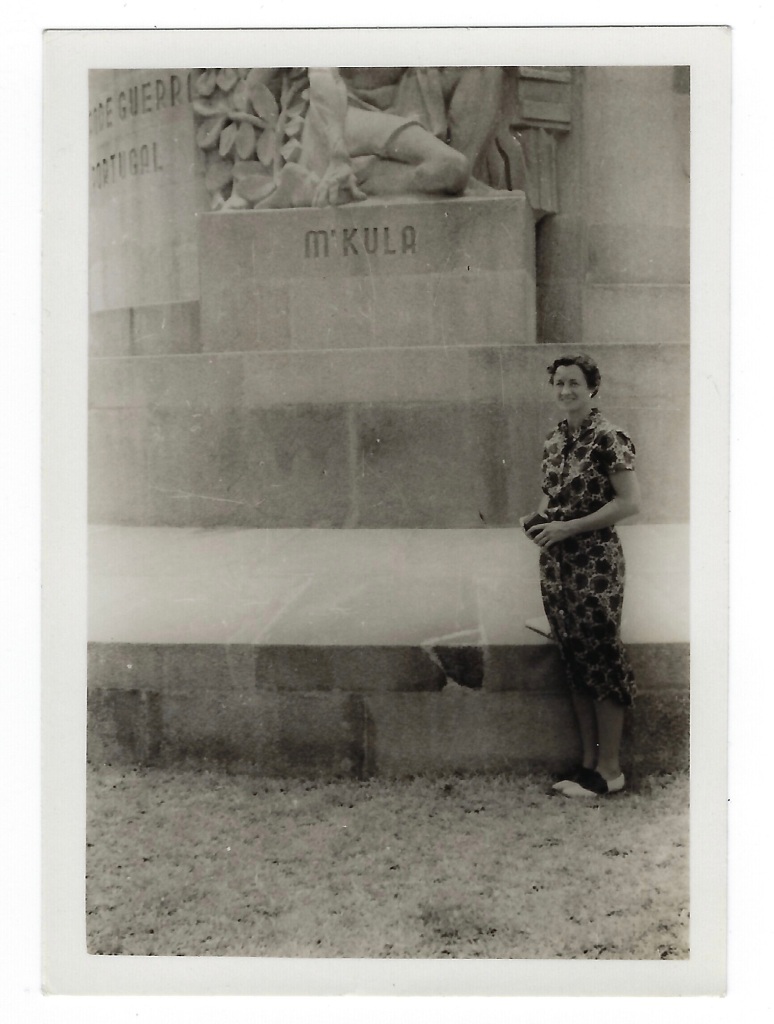
The back says “Mozambique, Lourenço Marques, At The Foot of the War Memorial”. Also, look at her cute shoes.
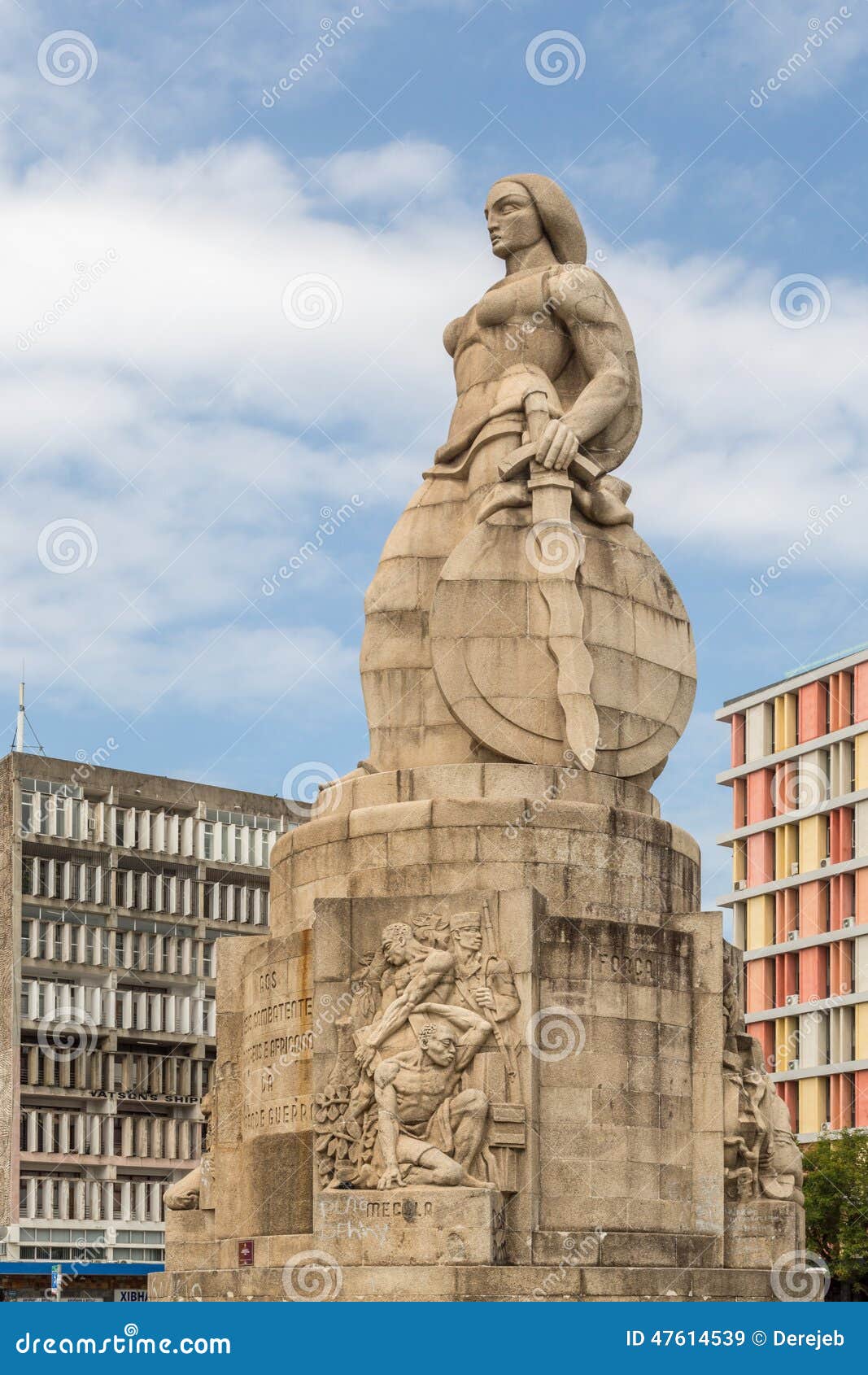
Shag and I to town - the war memorial across from the R.R. Station appealed to me as no other so far. An heroic figure of a woman on a round base with 4 fine plaques. 

Side note: The war memorial had its debut two years earlier, in 1935. Though a heroic figure of a woman indeed, it represented the Portuguese fending off Germans, and not struggles of the local people.

It was to be demolished as the city shed colonial relics, but it turned out too fortified, so it stayed. But over time, its significance changed to represent a strong woman fending off snakes in order to save locals, and she was deemed ‘The Snake Lady’, where she fends to this day.

The streets are wide, 3 flank-columns of red plumed royal poincianas standing at attention down the avenue. Most shops have roofs over the street - they're needed, for shade. The workers are prisoners, two men with ankles' chained together - clank, swish, clank - makes an ominous sound.

Side note: Mozambique had horrid colonial history and though slavery was abolished, prison labor doesn’t seem much different.

At 5:00 Shag and I taxied to the beach, made arrangement to be picked up at 11. Thunder and lightning and a full moon! Tropical rain. Shelter under a tin roof at a picnic table. The taxi did not come back - we walked back in 1 1/2 hours! - most amusing. But Shag was an hour late for his watch.

Side note: That beach date sounds like a plot for a romantic comedy, maybe even one with dance numbers in the rain?

Sat. Dec. 18: Lunch at Polana Hotel, high overlooking beach: prawns (like large shrimp, lobster flavor, delicious).

Side note: Her first prawn! I was also in my 30s the first time I had a prawn, but for different reasons than her.

Big wind blowing up as we drove back along the beach, and wavy as we returned to the ship. Up anchor at 7:00 p.m., got into swells that made us roll. 

Boat deck with Shag. One wave caught athwart boat deck spills over engine room ventilators. Bottles and dishes rattled back and forth all evening.

Side note: Athwart is a good word

Sun. Dec. 19: Read pages of "The Nile" to Shag.

Side note: Now she is reading The Nile TO Shag. A book about Egypt… where they want to motor off to together. So cute.

Beira

Mon. Dec. 20: Dawn in Beira. The anchor is swung from the bow and the anchor chain fastened to an enormous buoy. 

Took a tattered bus for sixpence over bumpy roads. Poked into several unattractive stores and just then the heavens opened, a deluge descended, wind blew, doors banged, glass broke. Shelter in a store until a taxi rescued us, took us to the Savoy Hotel. Lunch back to the ship, very wet - afternoon in Shag's room, reading. Typed cargo lists topside this evening, fascinating - timber, refrigerators, Ping-Pong tables, apples, wax, paint.

Side note: Her love of lists is endearing, and it has been passed down through the generations.

Tue. Dec. 21: a.m. on the boat deck, reading "The Nile" with Shag. I read him yards of figures: r.p.m., per day, per hour, generator, valves, etc. Reading in the hammock, a lovely day, wore shorts for the first time. Peered down #2 Hatch while rolls and crates of paper came swinging out on the lighters.

Side note: When I first read the second sentence above, I thought she meant she was reading to Shag the ‘…yards of figures’, like as pillow talk, which for them, could very well be. But then just below she says ‘more figures for Chief’ so most likely she was studying for Ship Shop (get it? like Wood Shop or Metal Shop in school, but about ships?). Whichever way, it’s cute.

And for our trivia for today: define ‘Lighters’ (in relation to shipping).

[Answer key: Lighters = a mini boat used to move stuff back and forth. Maybe its name derives from it being lighter than the boat it resides on??]

An amber moon cut off on top, sliced its way up thru clouds to sail off majestically into the soft black night

Sailed 6:00 p.m. More figures for Chief, then Shag. An amber moon cut off on top, sliced its way up thru clouds to sail off majestically into the soft black night. 

At Sea 

Wed. Dec. 22: Very hot in the sun. Engines stopped 1/2 hour during Shag's watch. Paced deck with S., wrote numerous cards, typed more cargo lists. Reading more "Nile" in p.m. with S. 

More abstract for Chief at 4:00, first scotch & soda visit topside after dinner - heard the news Frank Billings Kellogg is dead. 

To the boat deck, passed a vessel, saw the Morse light work for the first time, could read it, which was a bigger thrill. 

Another moon rise, a soft glow swelling to a crescendo of light, lines of cloud-like sooty brush strokes across the sky, the moon-path so bright as to seem elevated from the water. Slept out tonight with the moon in my eyes.

Side note: Frank Billings Kellogg helped usher in a bill (named after him) that would stop wars from being waged. You can ask the year 1945 how that went. But the bill was used to charge people responsible for the war with a Crime Against Peace (or Crime of Aggression) which was, ironically, punishable by death.

And that moon rise she watch from her outdoor hammock, I wish she’d bottled that so we could all live it.

Mozambique 

Side note: She’s been in Mozambique this whole post, but is now docking in Mozambique?? I, too, was confused. But it turns out Mozambique is the name of the country and a town in it. Welcome to Mozambique, Mozambique!

Thur. Dec. 23: Katy, Dreyer, Shag and I went ashore - 2 shillings round trip, paid a penny at the gate. The town different from any we've been - no motor traffic, narrow streets, phaeton hooded rickshaws, everything looks clean and newly washed, no wind to stir the dust. Buildings mostly built in long rows, houses distinguished from one another by the color - lovely sun-mellowed shades, crushed raspberry, dull gray-green, terra cotta, mild yellows. The triangles where streets come together with green grass plots and young flamboyance. The yellow wall and the palm trees against most glorious puffs of cumuli. The brick church with its white spire. 

Side note: Pottery Barn must have a color called ‘sun-mellowed’, no? And ‘crushed raspberry’? But maybe not ‘dull gray-green’. She was on a tear in that paragraph — the ‘young flamboyance’ of the street corners. ‘Puffs of cumuli’ clouds.

The walk along the beach, the avenue of tall spreading trees with poincianas in between. Looking up thru the lace patterns of the leaves and the flame-red blossoms toward the sun. The marble war memorial "Aos Mortes da Grande Guerra", the ancient bullet scarred fort (1502) its iron gates swung open. Inside-barred doors hanging open while prisoners scarcely guarded carried plates of black beans and rice form the line at the mess hall door some patch of shade for lunch. In one corner of the hot open square a small chapel, one door for "Europeaos", the other for natives. 

Side note: Separate doors in a church?? How so very pious of you, Europeaos.

Back to the ship, the P.O. closed 11:00 — 2:00 for siesta — "for only mad dogs and Englishmen go out in the noonday sun", and it was hot! Not humid, like Beira, but blazing white heat — the Portuguese wouldn't let me go ashore without a toupee, borrowed one of Shag's. Under way at 1:00 p.m. along the beach the most vivid apple green water I've ever seen, over coral reefs and dark green water until we'd cleared the bay. Most gorgeous banks of cloud and on the water the exotic touch of lateen sails. One running before the wind like an enormous bird, wings spread. On a coral reef right off the light hangs a freighter much like ours, abandoned last October. S. and I decide not to see so much of each other. 

Side note: So first… WHAT!?!? I’ve read all this before and kind of remember that last sentence, but don’t remember it being so matter of fact. It even has the same measured handwriting as all else (her handwriting is tidy, to say the least). My journal would have had one of two things woven into that sentence: a weak, pained chicken-scratch or an heavy-hearted bold. And in both cases, a splash or two of wine. Maybe she was doing the breaking off and Shag is off somewhere with a wine stained journal?? Stay tuned!

Lastly, that song lyric is from by Noel Coward and is about traveling near where she is traveling, but oooh boy the lyrics are a lot dated.

19. Port Elizabeth & East London, South Africa, Dec 7-10, 1937

The After the Trip Letter

Port Elizabeth and East London are bustling, growing cities, thriving as ports for the diamond mines and South Africa's young export business. Durban is cosmopolitan, cultured, as modern as most large American cities. I went with our British Captain in a Reo driven by a Mohammedan to a South African theater owned by a Jew, to see an American movie...had supper in a Dutch restaurant where we were served by turbaned Indian waiters...and rode back to the ship in a rickshaw pulled by a Zulu.

Side note: In 1937, the passenger cruise industry was not yet hopping, so activities at the ports were likely catered to those in the import/export trade, the mining industry, the military… so men, and then all the people who cater to them and their whims. As is often the case, port towns are playgrounds of booze and flooze for some; hard labor for others.

An aside: While Googling about things she mentions in the paragraph above, I discovered the ‘Reo’ car she mentions is a REO SPEED WAGON! Who knew!? To me that is a band. But first, it was a car.

For supper she goes Dutch, literally. Get it?!

I had to look up what Dutch foods are. There are surprisingly few Dutch restaurants here in New York City, despite it once being called New Amsterdam. Of the top 10 Dutch restaurants in NYC on Yelp, only two are actually Dutch, and one of those is an hour into New Jersey. Another has ‘Dutch’ in the name, but serves American food. Three are Belgian. One is a food hall without any Dutch cuisine.

Poor Dutch food!

Have you heard of poffertjes? I have not. And I have been to Amsterdam and I worked for a Dutch company for four years. Poffertjes are the most popular food there, according to Google. If this rarity-of-Dutch-cuisine was true also back in 1937, then it might have been quite exotic to eat in a Dutch restaurant. She does not comment on the food, which is out of character. Is that good or bad?! Were the poffertjes pleasant or poor?

The Day to Day Journal 

Tue. Dec. 7: Washing - and high time too. Sewed sail in afternoon, cut out the jib. Hike on boat deck, then topside for more sewing — only one more day at sea before Durban, and it must be done by then. 

9:45 p.m. — went on the bridge to see the chart of the Cape, watch the plotting of tonight's course. Tennents and crayfish sandwiches.

Side note: I know from my incredibly short stint as a student of sailing (I should have asked Helen if she forced her students to purposely capsize in the middle of winter) that a jib is a canvas-y thing, and I believe it is connected to the boom (which is the part that hit me in the head more than once during said class). (The real reason I gave up on classes is that they were far too early in the morning for a college student. Like 8am or something!)

Helen is taking her self-appointed sail-sewing job very seriously, with set-in-stone deadlines. The chart and plotting are of course also jobs she’s taken on. No tipsy squabbles over cribbage with the retirees for Helen!

(I think Tennents is a beer.)

Port Elizabeth 

half penny
penny ticky = 3 pennies
six pence
12 pence = 1 shilling = 1 bob
2 shillings = florin
2 1/2 shillings = half crown
20 shillings = 1 pound

Wed. Dec. 8: 5:00 a.m. — woke to see land ahead. Engines stopped about 5:45. Fine concrete wharf with many loading cranes. Shag got the bike off early and we rode out to the beach past Humewood to a beautiful cove, rocky, breakers tumbling in. Sat on the beach — idillic.

Side note: Land ahoy again! The vision of Helen and Shag zooming along the coast to a cove, then the sitting and taking it all in… m’waw!

Time for a family related aside… Helen’s grand nephews, the two sons of her sister Mary’s son, Bob, used to run a motorcycle shop in California. And I purchased a motorcycle from them in 1997ish when I was in college (a 1984 Kawasaki 305), and I lived by the sea, and riding along coast, with the misty air, salty breezes, and white caps crashing into jagged rocky walls was life affirming.

And even extra for her, Helen was experiencing it all with her crush.

Back to the boat at 11:45. 

Changed clothes and walked in to town again. 

Lunch with Ruth and Daisy at Cleghorn's on the market square. The town is spotlessly clean, many new modernistic buildings. The tall square tower above the jetty is "To commemorate the landing here of British settlers in 1820". It was one of the first towns in Africa settled by the British. Ruth and I visited the museum (poor taxidermy of native animals). Beautiful tropical birds in the aviary: a red-orange one — a velvety black with a red spot and long black tail. The snake garden was hemmed in by hibiscus bushes and trumpet vine. Cobras, pythons, puff adders dozing pretty peacefully in the sun. 

Side note: Can hibiscus bushes and trumpet vine keep snakes away from humans?? They are skinny, slithery, and sly (but not slippery. An ex I lived with for many years had a snake so I know all this, reluctantly, up close and personal).

East London

Thur. Dec. 9: Shag and I went ashore at 9:30, walked thru the town, out to the beach, life histories. Small town, built up recently, ultra modern architecture.

Side note: life histories = looove 👩‍❤️‍👨

A note folded up in Helen’s files from the trip, dated Dec 9, 1937

The note above was written on Dec 9, 1937 (the day that the life-history-sharing was going on) and I want to think it was from Shag to Helen and that they met up in the sail loft, where all work on sails was halted so they could flirt. (The main part doesn’t look like her handwriting; but the date written at the bottom does, hence it was to her and she added the date for memory purposes.)

In the harbor are 3 square-riggers out of Finland, "Killoran", "Pamir", "Viking". Went aboard the "Viking" (built Sweden, 1907) she is unloading lumber, next goes to Australia for grain, (4 masted barque), crew of 16, young boys learning to sail, 2 Americans, Finns, Swedes, Danes, Capt. has his wife aboard, and an Australian girl is working her way home as mess girl. They are not radio-equipped, keep off the steamship lanes. 

Side note: Seems well equipped to be a pirate ship, no? Lurking through the night with no radio… maybe ‘lumber’ and ‘grain’ are code names for types of illicit loot.

Worked on sail in afternoon, and in evening, my usual hike and a game of ping-pong and Tennents with Chief. 10 — 45 knots tonight, have a 5-knot current. Many planes flying about. Mail plane came in Trimotor Junkers, some RAF formation flying.

Side note: Was she bugging the mailman for plane specs?? I hope she asked to fly it.

Fri. Dec. 10: Topside at 10:30 to finish sewing the corners on the jib. Put grommets in the corners of both sails and she's ready for action. At 3:00 p.m. we were being piloted into Durban harbor, dropped anchor, it began to rain. First word was we'd stand by for the Silvercedar to vacate her berth, but later it was decided to spend the night at anchor. Shag and I were going ashore, but it was too wet. Captain showed Ruth and me Mr. Dreyer's movies of the canal of New Orleans, of me painting the lifeboat. Called on Jim and Shag, saw some of their pictures.

Side note: If she’s only just heading up to finish the jib at 10:30am, she must have been quite confident she’d finish before Durban (her self-imposed deadline).

‘Vacate her berth…’ sounds more dramatic than it is, which is just a ship moving.

And a video! How cool it must have been in 1938 to see film of yourself moving around. I hope Mr. Dreyer’s relatives were bequeathed that film and that they kept it and that it is living somewhere.

14. ON A BOAT! NOLA to ‘at Sea’, Nov 9-13, 1937

By now I thought we’d already be to South Africa, if not further. But here we have just shoved away from The Big Easy’s decadent docks. There are just so many good bits to share.

From a distance, we are now steaming steadily ahead, eastward ho, on the three-week salt-water-y trek to Cape Town, South Africa. Shall we peek in?

The Letter

(As a refresher, we look at the passage from the nice and concise after-the-trip letter and then the corresponding bits from the day to day journal.)

The passengers were left to themselves to get on as best they could. I chose to take part in the daily routine of the ship. During the 23 short days on the Atlantic I studied navigation with the Captain every morning, painted lifeboats with the apprentices, peered into the intricacies of the engine room, learned to send morse signals, sewed canvas with the quartermaster, made myself a sailors hammock and slept on deck under the southern stars. 

End Scene!

Kinda like a movie trailer, right? Just giving the highlights. But then the lights go down, and we watch it all unfold, one morse signal at a time.

The Journal

Lights, camera, action!

[Present location:] 

Lat. 26" 57' N 
Long. 87° 52" N 

Wed. Nov. 10:  

8:30 — Breakfast — prunes.  

Wander over to watch the apprentices work and get a job setting grommets in a piece of canvas that's to enclose the Captain's deck. 

Side note: She did wait until after prunes to find the engineers and land a job, but this was her first morning at sea, so she certainly didn’t waste time.

The apprentices are the ‘clean, intelligent looking youths from Canada’ from the last post, mind you. We will get to know (at least one of) them plenty.

After lunch the Captain tells me he has discussed with the Mate my studying navigation — decided they'd experiment and see if an inexperienced person of normal intelligence can really learn how to steer a course in five months.

Side note: Normal intelligence. Pfft. Her two degrees from Columbia U would beg to differ! But maybe five months is a short amount to learn to navigate a freight boat? So if she could do it she was not just of normal intelligence, but extra?

Sadly, this was probably the only way she could learn ship navigation. Women weren’t navigating boats in 1937 (and barely even today). I looked this up, and a few women were ‘allowed’ to navigate when they got stuck at sea because the Captain became incapacitated or dead. And a few women disguised themselves as men and got to navigate… until they got found out. You may read more about it here.

But Helen got to learn while dressed as she pleased and while all the men on board were at full capacity. Good on you, men of the Silverwillow!

She was clearly meant to maneuver ships, as you can see:

M.S. Silverwillow, 1937, with its Captain and with Helen Skinner, learning to navigate with a sextant (this must be the Captain she went dancing with in NOLA??).
Listened to "One Man's Family" and the Chesterfield Program on the Capt.'s radio.

Side note: I love when she mentions movies, politics, radio. It puts a timestamp (era-stamp?) on things. One Man’s Family was a radio soap opera, that, like the soaps still do, ran forever (silly me didn’t know they had soap operas before TV!).

The ‘Chesterfield Program’ means ‘Chesterfield Time‘ radio variety show (named after their sponsor, Chesterfield cigarettes). And I’m listening now to Chesterfield Time, and I suggest you do too, as it is leg shaking, fast talking fun. Era-stamps are important.

And then note that she is listening to these programs ON THE CAPTAIN’S RADIO — I hadn’t caught that before. Nice mood music, too. Hm.

Weather: wind force 4. 

Sun in a.m. It may just be the day, but there is almost no sensation of motion of the ship. The engines throb through your conscience, but unless you look at the water you can't be sure you're moving. 

Inspection of after deck with Capt., the ship's potatoes are kept in a huge bin. News: Ramsay McDonald is dead. Brazil set up a dictatorship on the Nazi pattern.

Side note: a lovely thing about random journal entries is how they jump from topic to topic so effortlessly. From throbbing engines, to potato storage, to Nazis.

You can almost hear the staticky Walter Cronkite crackly type voice, more static, and then ***ATTENTION: We interrupt this programming with breaking news out of Her Majesty’s England. We have just learned that the former Prime Minister, Ramsay McDonald, has died. I repeat…***

Maybe they wouldn’t break in for Ramsay? But you can still hear the voice, can’t you?

And on November 10, 1937, Brazil’s Getúlio Vargas did indeed make for himself a new constitution and cancelled elections. Not good.

The bath procedure: Bucket of hot water, placed in rack in tub, sponge off or dump it in the tub. For a rinse fill the tub with sea water.

Side note: like I mentioned, a no frills trip.

Present location: 

Lat. 22" 22' N
Long. 85° 04" W

Thru. Nov. 10

10 a.m. at the Captain's desk — I am set to work learning definitions for my first lesson in navigation. Study until 11:30.

Side note: For what she’s gonna be learning, this eighth grade level short on nautical navigation was way too much for my brain.

At dinner lettuce cooked with a fried onion and tomato sauce, artichokes. 

Pacing the Capt.'s deck after dinner. Learned how the Dutch are displacing the English in South Africa, since all in govt jobs must be bilingual — Africans and English, and the English won't bother.

Capt. says I may follow the 'prentices — do what jobs I want, and he'll have them practice Morse code sending with me. 

Side note: How about the Dutch and English just leave it all well enough alone??

And now the promising young men from Canada have been ordered to teach her whatever she wants, whenever she wants. And she wants to know everything.

Nov. 11 Foster taught me 4 knots: bowline on a bite, the knot used for handcuffs, hangman's noose, crown. Capt.'s wife expecting a second child momentarily.

Side note: The ‘prentices get right to work helping her do what she wants. And again, a married captain! Hm.

Notes from journal on ‘Capacity of Tanks’ and ‘Anchors’, perhaps taught to her by ‘prentices
Present location: 

Lat. 20" 23' N
Long. 30° 11" W
Dist. 330 mi.
Av. Speed 13.95 mph 

Fri. Nov. 12: I begin my pursuit of navigation this a.m., The Capt. explains the ecliptic and in a flash it is mine permanently.

After lunch — on the Engineers deck, had a try at Foster's hammock. It was a delightful sensation, mentioned it to the Capt. and he said, "why don't you make one?'. Within 5 min. the canvas was cut and ready. Service!

7:30 p.m. — "Not to be opened until Fri. Nov. 12" — so the box of candy Kay and Ann gave me made its debut in the Capt.'s room tonight.

Side note: The ecliptic is a navigational thing I just read about but don’t understand (not ‘in a flash mine’), so see the link from the beginning of this sentence.

And also, enter… the hammock! She mentioned it in the letter snippet above and here it is, happening, on day four.

Lastly, she is back in the Captain’s room, eating candy. Hm.

Helen (right) hanging out on the M.S. Silverwillow. (Yes, the woman on the left seems to be missing an arm, but I think that is a photo illusion, as Helen describes all the passengers, and with her level of detail, that would have come up).
Present location: 

Lat. 18" 21' N 
Long. 74° 48" W
Dist. 330 mi.
Av. Speed 13.96 mph 

Sat. Nov. 13: Woke at 4:00 a.m. Up and had a look at the stars, they seem so much closer in these southern skies. Up again to see the sunrise and watch the boat come to life about 6 a.m. 

In a haze off to starboard lies the mountain that looked like a cloud bank, but is Jamaica. Started figuring GMT, and am painfully dumb at it. Navassa Is. to starboard this a.m. and shortly after the beautiful slopes of Haiti loom up to port. Low banks of cumulus clouds give the effect of a volcano from the highest peak. Foster undertakes to give me some help in navigation, until tea time working problems. 

4:15 — Worked on my hammock with one eye on the clouds. The last view of Haiti was a soft gray mist with purple shadows on the land as a peak shone thru here and there. This morning the water was sapphire, and the waves so smooth it seemed you could slide on the surface. At sunset: puffs of pink cloud all around the horizon, and the water almost motionless, a turquoise color with iridescent reflections.

End scene!

“This morning the water was sapphire, and the waves so smooth it seemed you could slide on the surface.” – Helen Skinner

And side note: if stars look close in a good way, I suspect her heart is full (she has her trifecta of machines, travel, and men). If the stars were close in a bad way, they’d feel claustrophobic, and that is gleaned nowhere in her writing.

I’m also sure she’s not dumb at GMT (Greenwich Mean Time). They are moving around the world, slowly, so the time is constantly changing. How, without Google, would anyone know the time!?

I am ending this one here, as I believe Haiti is the last bit of land she sees for about 20 days, and that seems a good place for an intermission.

Next up: latitudes, handwriting analysis, a tiny bit more land (oops), the backhouse trot, and engineer intrigue (not just the how of it, but some of the ‘who is this smart hot cute engineer’ of it?’). Stay tuned!!

9. Posture Parades, a Field Trip, a Binder Full of Family, & the 13 Colonies

I was wrapping up the ‘The Early Years’ section, with Helen exiting the U.S. for the first time in the early 1930s to voyage around Central America, but then two things happened. One Google thing, and the other a weekend upstate where Helen was born and spent summers.

Posture Parades

While Googling schools where Helen taught, I found a write up by her in a yearbook online. It declares, “Miss Helen Skinner, Director of Physical Education, Gulf Port College, Gulfport, writes, ‘Sailing, canoeing, surfboard riding, boat trips to Ship Island for swims in the surf, bicycle trips, long walks on the sea wall, picnics on the beach, moonlight horseback rides — these are some of the activities that make the Athletic Association at Gulf Park one of the most popular and important organizations on the campus. We are proud of our 100 per cent attendance…at our third Annual All-School Play Day…competition was keen and colorful in tennis, golf driving, ping-pong, deck tennis, horseshoe pitching, posture parade.’*

*Posture parade!

The below looks like she is dressed for one of those moonlight horseback rides, no?

Helen Skinner, 1936, Gulf Port College, Mississippi

A Field Trip, a Binder Full of Family, & the 13 Colonies

Charlton, New York, where Helen spent summers, have an historical society. I messaged them on Facebook. They wrote back, saying they would look into the names I mentioned.

I wrote again about a month later when I was planning a trip, asking if I could say hi. Unbeknownst to me, they had been digging deep into the families and had surfaced with a boat load of facts and connections going all the way back to Braintree, England in the 1500s. And found that the Skinners were settlers in the first 13 colonies.

They researched, typed, scanned, organized, printed, and presented it in a binder. It has copies of census records, wills, cemetery plots, inventories, property records, bibles, birth records, death records, etc. Thank you to Erin Miller at the Charlton Historical Society!

From the binder, in short… back in Braintree, England, in 1560ish, William Skinner worked as a yeoman (either the owner of a small amount of land or a high ranking servant). A generation or so later, the Skinners traveled across the Atlantic to live in the new Connecticut Colony (one of the 13 founding ones). John Skinner is a FOUNDER of Hartford, CT. He is even buried in the Ancient Burying Ground in Hartford. And a relative from a subsequent generation has a headstone there that’s still legible.

The Skinners moved to Upstate New York in the mid-1700s and stayed until 1904 (at least Helen’s family line) when they moved to Manhattan.

Behold this:

This is a will or inventory from John Skinner dated 1690. If I were a handwriting analyst I might say he was a bit dramatic.

In Charlton, I toured an old one room school house and church that has been turned into a museum with many items from around the time Helen was growing up. Below are two of the transportation options.

The Old Scotch Church is where Helen was made to go on Sundays. The church there now isn’t the original, due to fires, but we can pretend it is. The church is where she pilfered candies in the summer with her cousin Betty back in and around 1910. There’s a vivid description of their time at the church by a relative here.

There’s a cemetery catty corner from it filled with family names. Helen’s parents, Frank and Gertrude are buried side by side. See below.

Above are the gravestones of Helen’s parents. Though they moved from upstate to Manhattan to Brooklyn to New Jersey, here they are together near where they met.

The Skinner house is no longer, and the Mead house (where summers were spent) couldn’t be found.

Many thanks once again to Erin at the Charlton Historical Society!

Now we jump ahead to when Helen takes a break from Posture Parades to country-hop around the Caribbean and Central America.

7. The Early Years, Phase II. (And a Moral: Always Look for Letters)

Helen didn’t have the final version of letters that she sent, but being such a detailed person (with foresight), she had drafted them first and kept the drafts (at least a few of them). And she had received some letters as well. There is one from her father, Frank Skinner, on wafer thin airmail paper, from 1940, about the family:

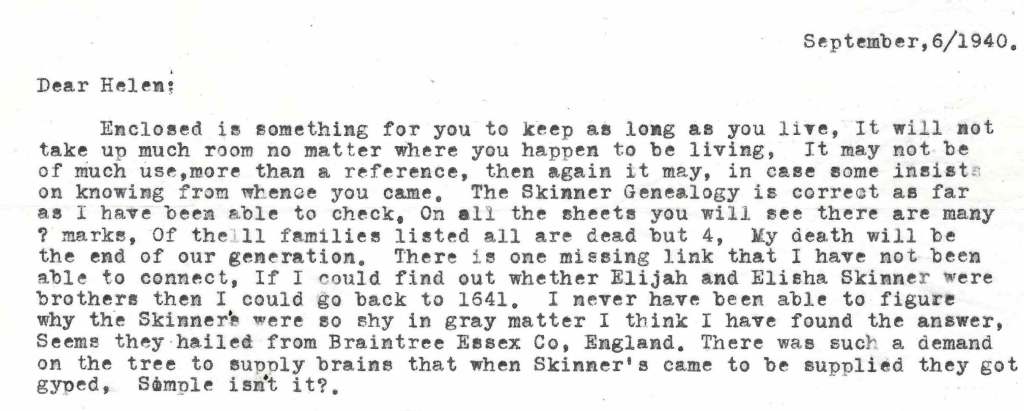
A ‘From Whence You Came’ Letter from Helen’s father, Frank Skinner, Sept, 6 1940

The evolution of Frank’s Skinner line, as he notes, ended with him. I like her father’s non-sequitur self-disparagement about Braintree and a lack of brains on the tree (though it is more a family-disparagement than a self one).

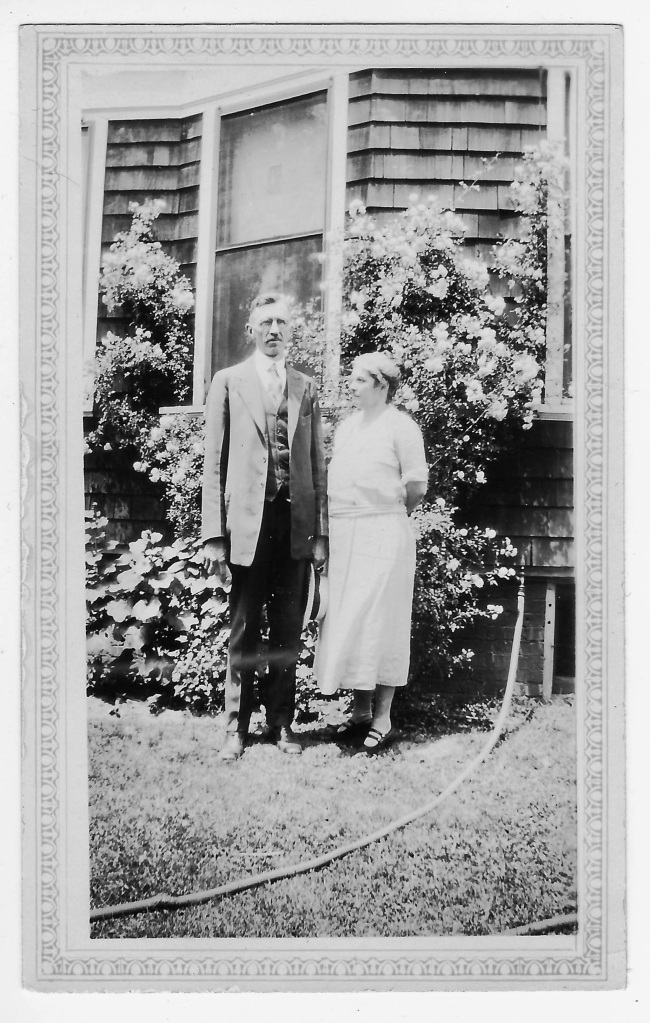
Frank and Gertrude Skinner, likely Arlington, New Jersey, 1940ish (around when the letter was written)

Halley’s Comet

The letter below doesn’t indicate to whom it was written or when, but based on the bit about Halley’s comet, it was after 1986, so she was at least 82. This is from Helen to someone who knew of Menands (where she was born, near Albany). To paraphrase:

Only once have I met anyone who knew where MENANDS NY is located.... My parents, Gertrude and Frank Skinner, took their daughter Helen to live in New York City when I was six months old.... One summer in the early thirties I drove through Menands on the way to somewhere else. So much for one’s old home town.

Side note: Somewhat strange that they moved from a super small town upstate New York to the great big Manhattan with a six month old baby. Perhaps for a job? Family? Regardless, when I picture the little family in NYC, I envision people dressed up in complicated looking long black attire with big hats, scurrying about super fast, like in those old choppy black and white videos.

I have never known where or how long we were in NY but next we moved to Brooklyn. The Skinners occupied the second floor of a house and mother’s brother Jack Bunyan, his wife Jessie and their new baby Betty had the lower floor. Two things I remember: There was a dumbwaiter which could be pulled up or down between the two kitchens and at some point Betty and I rode up and down on it (well supervised) to visit each other; 2) one night I recall mother taking me to the bathroom, closing the toilet lid and standing me up on it so I could look out the window (it was the only window on that side of the house) where the sky was bright as day -- a blazing light. She said to me ‘remember this: you’ve seen Halley’s Comet, and it won’t be back for 75 years.” I regret that while I was still around for the comet’s next appearance, it was performing in the Southern Hemisphere, and I missed it.

Side note: I’m not sure where the dumbwaiter duplex was other than it was in Brooklyn. Haley’s comet made appearances in April 1910 and April 1986. She would have been seven for the first one, 82 for the next. The next next one is in 2061, fwiw. And I love the imagery of the comet ‘performing’ in the Southern Hemisphere, like it was on tour.

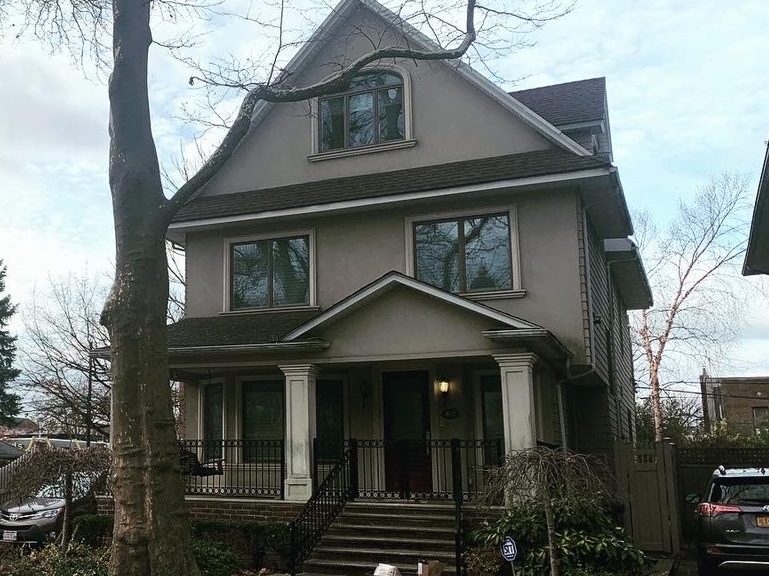
The Bunyans and Skinners bought houses next to each other at XXX and XXX Stratford Rd. Our two backyards fenced around the outside made a wonderful playing space. The back of our lots faced on Coney Island Ave where streetcars went to that destination and in summer... Bathing suits were jumper like garments which came just below the knee, elbow length sleeves, black bloomers and black stockings and sneakers.

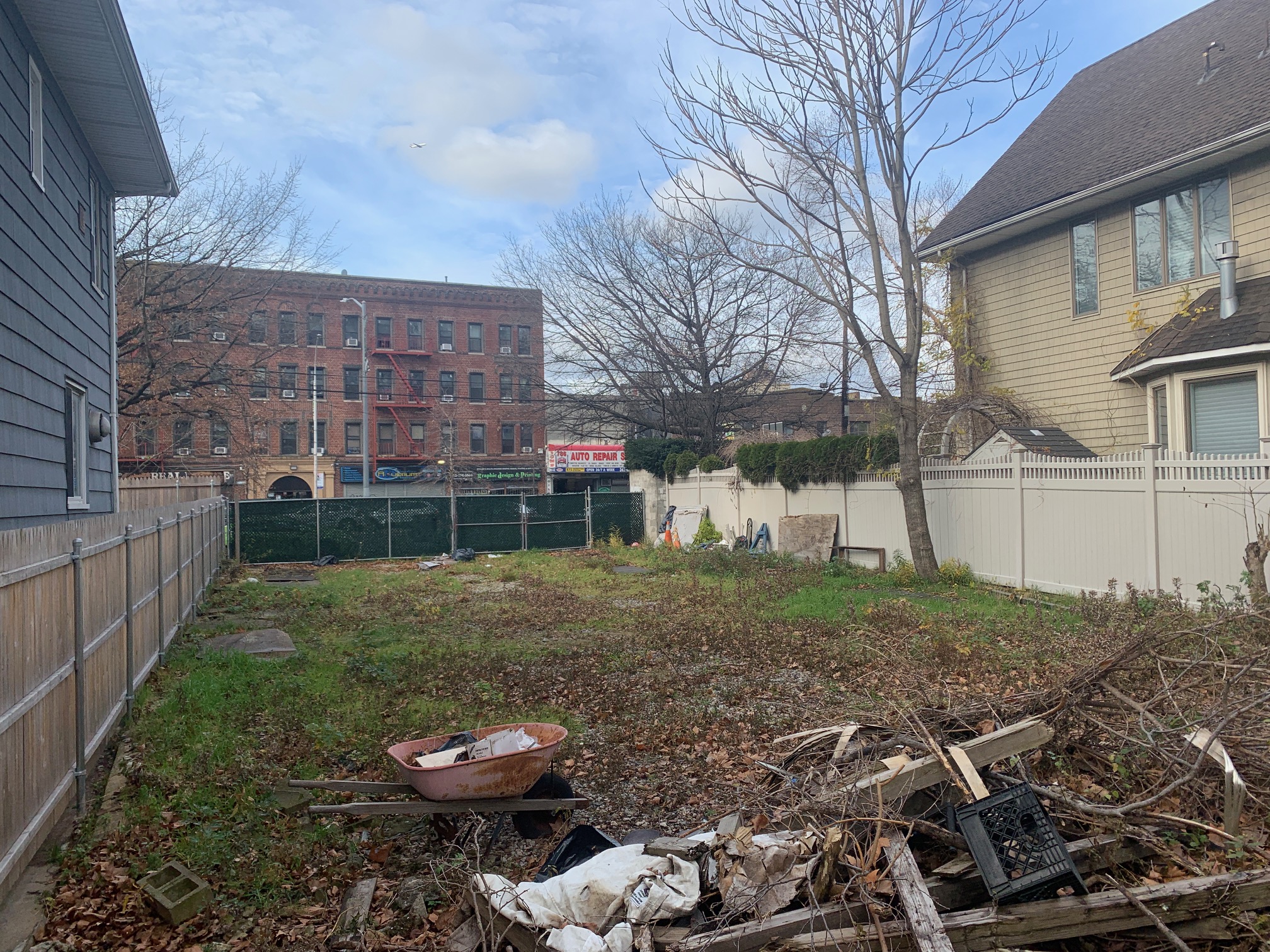
Side notes: Stratford Road is south of Prospect Park and is now the Flatbush/Kensington neighborhood of Brooklyn. Zillow told me the house remaining (one was an empty lot) was still the original house, so the same one that she (or Betty) lived in.

I went to Kindergarten at PS 139 (rah rah rah the rose and the pine. Long live, long live 139).

Side note: This school exists and operates and is a few blocks north of the house on Stratford Road. Some sleuthing shows it was built in 1902. And I hope that is still their fight song.

The school looks like an old East Coast educational facility, and one that I imagine is purported to be haunted. It was built in 1902 and it looks old, so some of it must be original.

P.S. 139, Brooklyn, New York, 2021, at 11:20am ET

Draft Letter II – this letter was written by Helen in the late 1970s. The draft letter is five and a half handwritten pages and details family history from early 1800s – 1990s, but only a little is about her childhood and I’ll just include that (for now…). After a quick intro, she starts:

I never had the slightest interest in ancestors until most of the people died who might have helped to fill the family tree... However, if you prefer to have your ear bent, I’ll bring you up to date on the ones I know. In 1916-18 I went to St Paul Minn to stay with my mother’s half-sister Mary Mead Cavert, while I was in my first 2 years of high school. I then returned to Brooklyn to graduate from Erasmus Hall High in 1920.

Side note: This was not a short trip. It’s an 18 hour drive by today’s standards. Erasmus Hall High is still standing.

I don’t know where you dreamed up ‘at college in Missouri’ for I went to Columbia in NYC - I admit I wasn’t home very much, for I lived in a dorm, camp in the summer, I was a counsellor at varsity camps.

Side note: this is the only time she mentioned Columbia, and I still think it’s strange she didn’t brag more about it. She says the family moved to Arlington, New Jersey in 1920, which is when Helen started college and never went back home to live. I’m not sure if the cousin’s family moved with them so they could continue being neighbors.

The letter picks up again in the late 1930s and everyone will have to wait to hear about that.

Online Account – a remembrance of things past

Through Googling, I found a bit more nostalgia about young Helen. The material is from Chapter 6 of a book called The Mead Family, written by Jane Mitchell (the names Mead, Cavert, and Bunyan all appear — all on the mother’s side). Helen contributed to the book, and writes about her time with her cousin and bestie Betty:

Betty was known to her best friends as Lizzie Smellie Onion (her full name was Elizabeth Smeallie Bunyan). We were brought up almost as twins. We would shout between our houses (we didn’t have a phone) “What are you going to wear?’ by way of starting the day. She was in our house as much as in her own. We spent many summers at the Mead farm until I was sent off to St. Paul for 2 years in 1917.1

Smellie Onion is a very fun nickname (Betty is the girl scowling in the pictures in the last post, but that she allowed her best friends to call her smelly onion indicates she did indeed like fun). The pictures of the kids in the last post were taken at this Mead farm in West Charlton, New York. Betty comes up later in Helen’s story as well, and it seems they stayed very close (not geographically though).

I recommend that you to read the description of the Scotch church in the link above. It paints a picture of a colorful congregation in their Sunday best, crooning away to hymnals in a small old musty house of god, with Helen and Betty pilfering candies and trying not squirm. You can kind of picture it (and smell it).1

Now we will move onwards and upwards to the 1930s (literally upwards, as there are airplanes).

References

1 – http://charltonnyhs.org/2017_Mary%20Mead%20Cavert.pdf