34. Fancy Fliers, Cossack Choirs, and Balmy Tigers, Singapore, Feb 3 – 7, 1938

The After-the-Trip Letter

Singapore...magic name...it can be anything you want it to be. Will you have pineapple and rubber plantations and factories, a new modern airport whose administration building is second to none in the world....

Side note: The fancy Kallang Airport was born in 1937 and Amelia Earhart had swooped by there shortly after its debut. Her fateful flight was just a month or so later.

Remember who also flew planes? Helen. Purportedly, Helen and Amelia lived in the same dorm room (not at the same time) at Columbia University’s Teacher’s College, where Helen received her Bachelor’s (1920-24) and Master’s (1931) in Physical Education. Amelia lived in the room in 1919-20 and Helen in 1931, says my sleuthing.

Another coincidence is that they both taught at Purdue, in the same year (1936), and they used the same airfield, but apparently never met. I’m pretty sure Helen only taught one summer semester at Purdue, but still. Here are some snippets from a newspaper story about Helen: “First woman on the Purdue faculty to fly solo from Purdue field … Miss Skinner is one of the most popular pilots among the male flyers … Capt. L. I. Aretz, port operations manager, forecasts a bright future for her in aviation.”

And guess who also knew Aretz, Miss Amelia. There’s a whole movie about it.

I talk about the fun parallels in a previous post.

Since I don’t have any pictures from Helen’s time in Singapore, here is the newspaper clipping about her from Purdue in 1936.
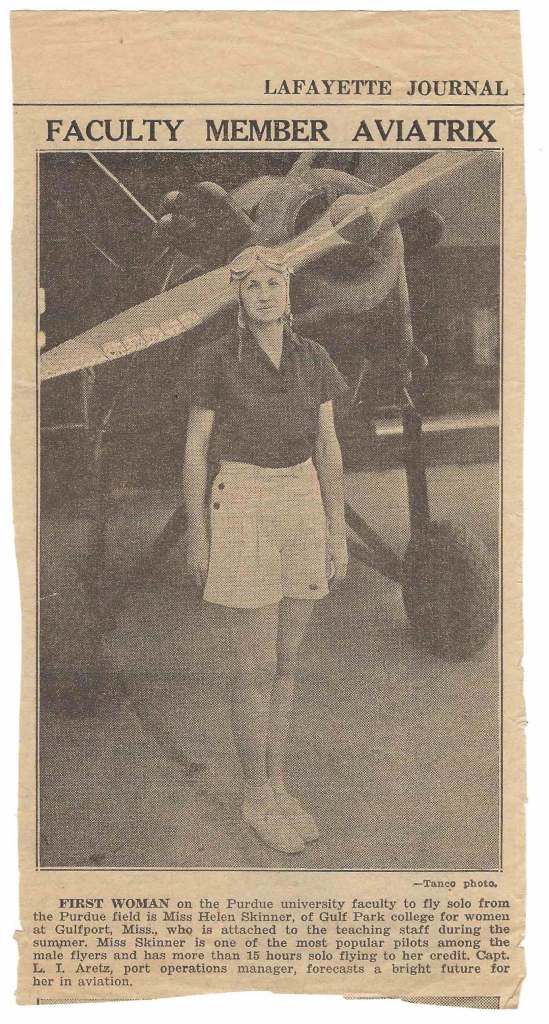
Helen, being cooler than most of us, The Lafayette Journal, 1936, Purdue U.

And now we transition back to Singapore and February of 1938….

...American movies cantor in "Ali Baba Goes to Town', to be specific...the Don Cossack Russian Choir was there, too....good ice-cream (for the first time since New Orleans)...a wish for a fortune to spend on Chinese silks and linens, magnificent hand work at iniquitously low prices....tea at the Raffles Hotel, and swimming at the Singapore Club and dinner afterward at the home of friends.....

Side note: Ali Baba Goes to Town (that link is the trailer and I suggest a look see) is a 1937 musical comedy with Tony Martin, featuring lily white Arabian Sultans and, not surprisingly, blackface. Hollywood certainly did its best at exporting American-branded racism to theaters around the world.

Sadly, two people were killed in a flying carpet incident during the making of the film.

The Don Cossack Russian Choir were exiled Cossacks who started a choir in an interment camp in Turkey. They performed over 10,000 times. By 1938, they’d been at it for 15 years. Here’s more of their music and it’s quite lovely.

...and a strange night of "blackout" during British manoeuvres, when every light in the city was out, and all night long we watched the fingers of fifteen searchlights make patterns across the sky, pointing at squadrons of planes as they flew high overhead, trying to evade the anti-aircraft batteries. War seemed very near, and the demonstration was too realistic for comfort.

Side note: The British colonial government’s Air Raids and Bombardments Precautions Sub-committee in Singapore had started doing test air raid blackouts in 1936. In 1941, Singapore was indeed hit by the Japanese and eventually fell to their army in 1942.

Like the Dutch East Indies, the Japanese left when they surrendered, but unlike the Dutch, the British came back and stuck around Singapore for a few more decades. Singapore would become fully independent in 1965 after a few years as one with Malaysia.

The Day-to-Day Journal 

Helen’s day to day journal from the same time period as the letter above adds context and quite of a Helen-style detail (costs, weights, conversions, measurements, timelines, routes, schedules, distances….). She has detail for everything EXCEPT the juicy stuff with Shag.

Here is most of it, with a sprinkle of commentary:

Thru. Feb. 3: 

Woke at 3:00 am. when the anchor went out, lights of Singapore all around. Up at 6:30 harbor full of British battleships. Pilot came on just before 7 a.m.

White ships on green water against pink clouds in a gray sky.

Money changers, vendors of all kinds on deck before breakfast.

To Chinese and Buddhist temples, thru Malay villages, Singapore Swimming Club, airport (mud flats filled in, one of most beautiful airports in the world, very modernistic) saw a few planes, but none in the air.

To a pineapple canning factory (Sin Heng & Co.) still celebrating Chinese New Year, it was not in operation. Cut and slice, wash, add sugar, cook, can, label, ship. Very clean, white tile tables.

Goodyear Rubber Co., 2 young men from Akron, Ohio — showed us around. Rubber sheets weighed, sorted, graded, repacked, pressed (bound with steel straps) into space not to exceed 5 cu. Ft.

Side note: Later in life, Helen would be involved in an industry that relied on rubber, and would be back in this part of the world, but you have to read on to find out more.

Dropped me at the ship, lunched, Shag's watch changed. Beastly hot. Steak dinner for 50 ¢ (Sing.) at Café de Luxe (with the case of Javanese carbine, silver, batik in the window). 

White ships on green water against pink clouds in a gray sky

Fri. Feb 4: 

To botanical gardens, fed the monkeys. Past the Eng. & Chinese homes in the best residential section.

Into the grounds of the Chinese whose "Tiger Balm" has made him enormously wealthy. The most unique gardens - pools and gardens, pagodas and houses and people in miniature, exquisitely done.

Stop at a rubber plantation, saw the latex oozing and the process involved before it goes to the shippers.

Into Jahore over the quite new causeway. Saw Sultan's Palace (his Scotch wife divorced him 2 mo. ago.) At the Mosque to hear the Muezzin's call to prayer. Watched the parades of the police, the soldiers. No women worship in a Mosque. Took some movies which I shall probably never see.

Side note: Singapore: exquisite gardens, oozing latex…

The Tiger Balm guy’s was known as The Tiger Balm King. And his gardens are called the Tiger Balm Gardens. His name means tiger, hence the product name. His story is most definitely worth a look see.

Sultan Ibrahim of Johor (not the Hollywood Sultan), would soon head to Europe to help with his gout and also, since he happened to be in the region, meet with Hitler and Mussolini. He also got briefly detained on suspicion of being a spy.

Shag and I took a rickshaw ride, then sat on the jetty until midnight. At 2 a.m. the generators were shut down, a great silence came over the ship. The city lights went out. Blackout for war maneuvers, Plane roared thru the sky pursued by searchlights. Eight fingers of light making patterns on the black page of night. Signal lights flashed — I caught on in time to get ._._. (end of message). Wandered all over the ship from one vantage point to another until 5:30 a.m.

Side note: I want a picture of those two cuties on a rickshaw!! I just asked an AI thing to create one and it would not. It could have looked like this and how perfect for their ongoing meetcute.

Sat. Feb. 5: 

Hot! Struggled up after 2 1/2 sleep, shave legs, get bathing bag from trunk which was behind the last box in the store room. Kept the gang waiting while I dressed.

Uptown with our driver to Adelphi Hotel, Mrs. Reed picked me up at 10:00 a.m. with her Dick (8) and David (4) and 2 girl children of a Methodist Missionary to the Singapore Swimming Club. A breeze, salt water just the right temp, felt marvelous. To the Reed home, no windows, open on all sides with shutters instead of glass. Closed only to keep out rain (rain 360 days a year), everything mildews, cloth, floors, cloisonne even. She lived 11 yr., he 16, in China. Both speak the language fluently, loved China. Three yrs. Dick has been twice around the world, at 8.

Side note: The Reeds might be with the YCWA or another athletic organization. I suspect Helen was job prospecting at some of these ports. She had not planned on getting distracted by a certain Mr. Shag.

Had a ma mee for lunch, a hybrid Chinese dish — noodles, chopped cooked egg, prawns, crab meat, nuts, raisins, soy sauce, very delicious. American cake, good coffee, Eskimo pie!, Pomolo, mangustein. 

Side note: Very adventurous with food, that Helen. Some people in the family (me) are not. I envy that.

Heavy rain as we reached town, took me to Tang's on Middle Valley Road, one-price Chinese store, beautiful things, but I'd spent too much money. She dropped me in High St., found H.D. in the café with Chief who had rescued her when she'd almost fainted (touch of the sun, no doubt). 

Back to the ship for 4 p.m. sailing, to find we'd sail at noon tomorrow. Our crew from Shanghai under the domination of the Bos'n, a petty racketeer (the Shanghai agent takes all the 1st mo. wages, the Bos'n $9 (Shanghai) a month, asst. Bos'n another tong. One group would not work for the other. Some wanted to go home, so in the end all went at 5 p.m., under police escort to jail.

Will be repatriated in a couple of days and sent back to Shanghai. Shag & I walked and talked until 11:30.

Side note: I cannot find anything on this corrupt Bos’n (ie Boatswain, ie guy in charge of boat things), but I did find this extra cool video of Singapore from 1938. It features just about everything she mentions above, except what the flip she talked about with Shag.

Sat. Sun. Feb 6: 

A new crew, Cantonese from Singapore, came to inspect the boat early this a.m.

To the ship for noon sailing. Under way at 2:30, very narrow entrance to the wharf, rammed against the jetty as we were towed out, small dent in ship's side. In the harbor the bos'n let the boom down on a sailor, cut off the ends of two fingers, gashed his face, chest - a gory sight. Put him off in the pilot boat not a very auspicious start.

Side note: My goodness if that happened in front of me my journal would be filled with screams in all caps, but no, for Helen it’s another list: 2 missing fingers, 1 gashed face, 1 gory chest. I’m envious again, as I can’t even watch someone administer a shot on the television without getting woozy.

Visited Shag until 9. Early turned in, very poohed. Heavy rain every day in Singapore, showers 2-4 p.m. often. Keeps air fresh, grass green, but not very healthy, disturbs metabolism, women go flabby very young.

Side note: Remember that Helen has a Master’s in Physical Education so she was no dope when it came to women’s health and fitness. But is this ‘young women go flabby in rainy places’ sounds fishy. So is she right? Yes, but it’s not just women. Everyone gets an equal chance at going flabby quite young in rainy humid places, says Scientific American.

And there we shall end for now.

Next up: War and Peace (literally and figuratively). Stay tuned for that! (And also eventually, why Helen was back in these parts decades later, and how it involved rubber.)

Shag and I took a rickshaw ride, then sat on the jetty until midnight. At 2 a.m. the generators were shut down, a great silence came over the ship. The city lights went out. Blackout for war maneuvers, Plane roared thru the sky pursued by searchlights.

32. Raucous Rickshaws and Temple Bells, Burma, Jan. 23 – 30, 1938

The After-the-Trip Letter

It was good to be clear of the dirt and the muddy Hooghly River (I thought Calcutta was a seaport, but like New Orleans, it is 150 miles from the Ocean) and to have blue water under our bows again. 

Side note: This is her first time back at sea since January 7, when she first got to Cocanada, India (now Kakinada), and then spent shore leave touring to the Taj Mahal, among other things.

In Rangoon there was a rickshaw ride one evening I'll not forget...through Chinatown...it was like being a spectator in a play...then out of the lights and din and clamor of the bazaar to the quiet of the Royal Lakes. 

Across the water lay the reflection of the flood-lit golden spire of the ShweDagon pagoda, and from over the hill came a soft dissonant jangle of temple bells. We were truly "out East". 

Side note: Cinematic, no? I wonder who she was with on this ride?? You’ll have to read on to find out!

For the quiz later: Rangoon is now Yangon, and Burma now Myanmar.

And ‘Truly out East’ is even further east of what the British had deemed east.

In Rangoon there was a rickshaw ride one evening I’ll not forget…through Chinatown…it was like being a spectator in a play…then out of the lights and din and clamor of the bazaar to the quiet of the Royal Lakes.

The Day-to-Day Journal

Sun. Jan. 23: At 5 a.m. the anchor chains began grinding and three hours later we were out in the river. Anchored in less than an hour to wait for the tide. Up anchor at 12:30. 

The rest of the a.m. with Shag, tho I did unpack first -- and oh the dirty clothes.

Visited topside as we sailed down the river in the afternoon -- same jupe mills, brickyards, bathers, hay boats with no freeboard, sail way up on top. Nothing close enough for a good picture.

Anchor again at 6:30 p.m. with only 14 ft. under our own draft of 23'.

Ate too many cashew nuts to be interested in dinner. With S. and J. until 9 and turned in at once.

Side note: Astute observers will remember she went to the market in Calcutta specifically to purchase these cashews.

[Present location:] Lat. 14° 48' N; Long. 89° 40" E; Dist. 111 mi.; Av. Speed 15.46 mph. 

Mon. Jan. 24:

Clean blue sea water again — so good to see it! Writing in a.m. — so impossibly much to put down.

Shag ordered to change room today. Capt. very chipper after lunch. Saw the chart of the Hooghly River. Sounding all the time, continual dredging.

Shag, bearded Capt. in his den after dinner, may get a room alone. Chatted Morton.

Side note: Not to be gossipy, but a room alone… OOoo.

[Present location:] Lat. 15° 45' N; Long. 43° 54" E; Dist. 340 mi.; Av. Speed 14.54 mph 

Tue. Jan. 25: Wash and iron. Write journal — busy day.

Wed. Jan. 26: Anchored at midnight off the pilot ship. Pilot came on at 6:00 a.m., started away at 7:00.

Slowly up the Rangoon River - no bathers, the whole country side looks cleaner than India.

Customs and immigration officials on at 11:30, we are anchored off Lewis St. jetty. Passengers ashore in silver launch at 3:00 p.m. to Marine Club (swankest in East) for information. Ruth and I shopped, saw some exquisite Chinese things.

Shag came over at 5. It was terrifically hot I felt very washed up. Had tea.

Shag and I took a rickshaw ride (12 As. per hour) saw extensive markets, an enormous Chinatown - some strange sights.

Side note: The rickshaw ride was with Shag!! There are some pictures from the era here.

It was a weird feeling riding in the midst of it. Out to the Royal Lakes, where it was quiet and the night was very dark and beautiful. Got down and walked along the water's edge and listened to the temple bells and in the distance saw the gold spire of Shwe Dagon. 

Burma -- there was a magic about it!

Back to town for tea and toast at the Strand. Return to the S. Willow in a sampan, in spite of wild tales we've heard of treacherous current, lives lost, women attacked and robbed, it was a quick safe journey.

Side note: S. Willow, for those new is the Silverwillow, the boat she is traveling on. A sampan is a small boat and she sounds snarky about it, like she expected a ride that would give her a story.

Thur. Jan. 27: Passengers ashore at 8 a.m. after early breakfast, in two cars for a drive around the city. Saw umbrella manufacture, went thru a rice mill, saw Shwe Dagon and Sule Pagodas, drove around the lake, stop at sacred fish tank (eels in slimy green water), Ko Dad Gui Pagoda. It is a large city, very clean -- no castes as in India. 

Got the curse — feeling very blah. P.m. in bed, but hot, interruptions, I got no sleep. Couldn't go ashore, Shag and I had a peaceful evening in the hammock watching the swift moving reflections from shore lights in the strong current of the Rangoon River.

The clamor of the rice loading games seemed an overtone far away. Acres of clothes hung on lines at the laundry, very colorful, most startling. When the tide turned every boat spun around like a top, never saw such a violent surge, faster than turning with a tug.

Fri. Jan. 28: Took pictures of harbor craft - very glad didn’t go ashore. It was very hot, still feeling punk. Away at 2:00, past teak saw mills where the elephants work when they work.

Ship vibrating badly, we're drawing 26' and there are only a couple of feet under that. In hammock on port side, gale of wind, finally went in to bed - no sleep. Evening with Jim, who began asking questions.

Side note: QUESTIONS! I suspect the questions are about Shag and the amount of time the two of them spend together, for instance in ‘the hammock watching the swift moving reflections from shore lights in the strong current of the Rangoon River…’ and other things together.

Also, this link I believe shows the sacred fish tank, though it doesn’t look much like a tank.

I don’t have the pictures she took, but here’s a picture of the boat, The Silverwillow, she was on whilst writing this
[Present location] Lat. 11° 57' N; Long. 96° 53" E; Dist. 277 mi.; Av. Speed 14.81 mph  

Sat. Jan. 29: Very hot and sticky, did a little washing and was ready for a bath. Letters and reading. P.m. off for Jim. Wrote at his table while he studied. Boat drill 4:00 p.m. Showed Capt. my Indian purchases. With Shag until 9:45, much later than I intended, slept out, warmest night we've had.

[Present location:] Lat. 5° 38' N; Long. 99° 36" E; Dist. 362 mi.; Av. Speed 15.08 mph

Sun. Jan. 30: Cooler toward morning. Up at 6:00 when the Chinese started washing decks. Writing letters, slow job. Jim cleaning deep tanks this p.m. Aft With S. later.

Side note: Things are heating up with Shag it seems as they head to sea once again. The next stop is the Dutch East Indies, which would soon-ish be Indonesia. The Dutch, like the English, often used a direction based naming scheme for lands. These were usually relative to the homeland, which can make total sense in a country or town or street or anything with boundary, but not in a big round world.

31. India, Part VI: Calcutta, the Races & a Glimpse at the Future, Jan. 18 – 22, 1938

Helen is back in Calcutta after an eventful 10-day shore leave to the Taj Mahal, a saga that took up more space in her journal than a lot of the rest of the world.

The After-the-Trip Letter

Back in the city, a round of lunching, driving, tea, movies, a formal dinner and dancing afterward at a lovely private club as the guest of a dear friend who has lived in India ten years, gave me insight into quite another facet of life there...low lights, soft music, beautifully gowned women, gracious living.

Side note: Helen was likely job prospecting in Calcutta (and other places she had prospects, like Madras). Up until she got on the Silverwillow, for over 10 years, she’d been teaching Physical Education around the U.S. Gleaning from her shore activities on this trip though, she seemed ready to take her work overseas.

At the time, the YWCA had outposts around the world focused on women’s health and P.E. She had connections there, and in the future she would indeed work for one, but presently Shag was distracting her. You can’t blame her, I mean look at them!


Helen and Roy (Shag) Shadbolt, being cute (not in India in 1938, but still)

Shag’s life plans were shifting too, for similar cutesy reasons, but a looming war would make most plans moot. That’s for later.

Our ship's Captain, who was very partial to me (I don't complain, but the other passengers might) took me to a race meeting.

Side note: She was super flirty and, by all accounts, appreciated high quality flirting in return.

I was equally fascinated by the horses running in a clockwise direction, and by the people....Indians in native dress, uniform of Scottish regiments, Europeans in sport clothes, Mahara-jas with their retinues in gala attire.

Side note: I searched about if horses still run in different directions in certain places and one of the top results was someone in a forum asking, “Why do horses run in different directions in Australia”, and someone responding, “Because they can”.

So horses still do run in different directions, if they want to.

We were glad to be back on the boat, and cleaning our teeth in water instead of tea. In India you eat no raw vegetables unless you KNOW they have been dipped in potassium permanganate water, and you don't drink water unless it's so hot you can be certain it has been boiled. 

The Grand Hotel, second best in the city had seventeen cases of typhoid just before our arrival. And since we left we hear it had another epidemic, and had to fold up and sneak out the back way. (Moral: don't go abroad without a typhoid, shot)

The Day-to-Day Journal

The above is all from her letter after the trip, likely carbon copies to friends and family, as one would do in the day.

So below we have the personal journal of the same time frame as above. It starts when she is reuniting with the boat crew after her 10 day trip away.

Tue. Jan 18: 

Shag and Jim came while we were at breakfast, good to see them. Showed them pictures and purchases, chatted until noon.

Shag came back in the p.m. and then I had a grand scramble to get ready, had to wash my hair — still feel filthy from the train. Jack looked perfectly beautiful in a dark wine chiffon. After the guests had left I was persuaded to stay to dinner (not too difficult).

We were five, and it was delightful. Back at the hotel Capt., Capt. Streets and H. Dreyer were beering. I joined them and went upstairs at 10 to be very ill.

Side note: That all just sounds grand. Except the ill.

Jack, I believe, is her friend in Calcutta. Dark wine chiffon for the win!

Wed. Jan. 19: 

Morning with Shag.

Lunch at Great Eastern and then to the races. The course is on the Maidan, looking across to the Victoria Memorial.

The track is turf, 1 1/4 mi. long (3 tracks, really, for the various monsoons), the stands are enormous, and in the center inside the track enclosure, hundreds of Indians may see the races free.

This was one of the best opportunities to see a multitude of types: every shade; style of costume; all endlessly fascinating.

The horses were good, and one race was for 5000 Rs. My first look at a race run clockwise. Picked horses in the last 3 races that won Rs. for Capt.

To Firpo's for a bottle of soda. Spent the evening with Jim.

Side note: I’ve looked up more about horse racing directions. One part of the Internet says that races in the U.S. (be it horse or human or car) are counter-clockwise as an middle finger to the British. Another part says that it makes sense to be counter-clockwise because of right handed people. My theory was that countries race in the direction they drive, but no. Germany has clockwise AND counterclockwise tracks.

What everyone should agree on, I think, is that the horses are the best and should be treated as such.

Thru. Jan 20: 

S. and I had the morning together. 

At noon rode out to the ship which is still in a dreadful mess. Pressed evening clothes in Capt.'s room, had lunch with him. 

S. and I made back to the Grand and then out to look at Calcutta. 

At 8:00 Tombazi's car came for me. Delicious food, charming people. Later to the 300 Club for dancing. All good dances, the club small, intimate, excellent piano and drums, indirect lighting, beautifully gowned women (Pellegrino water, no drinking, slot machine). 

Fri. Jan 21: Shag and I saw the stone slab that purports to cover the black hole of Calcutta — a washout as a sight. We drove around, lunched at the Grand, rode some more. Packed after he left, paid our bill, distributed annas — three were standing outside our door, another half dozen climbed on the taxi step. I bargained for a cab for 1-8, very cheap, for Garden Reach Jetty. 

Came aboard loaded to the gunwales. No running water, (glad I bathed at the hotel), but the cabin very fresh and clean. Pressed an evening dress, and at 8 Captain and I taxied uptown to dinner at Firpo's and to the metro to see Joan Crawford in "The Bride Wore Red", a stupid picture, but I enjoyed the evening.

Side note: The Black Hole of Calcutta story is not for the claustrophobic (like me), good lord.

Apparently the role in The Bridge Wore Red was not written for Joan Crawford, but after she replaced the original actress, she insisted on playing it as Joan Crawford, and it didn’t work. So says the Internet.

Sat. Jan. 22: Shag and I to town on the bike, bot scarves at the good companions. 

Had tea at A.A.B. To the market for cashew nuts — 2 Rs 9 As. for 5 lb.

Back to the boat at 3 for medical exam, which was a farce. A Chi-Chi woman felt the pulse (to see if the heart was beating, I suppose). Those without vaccination certificates have it done. Couldn't leave the boat afterward, and the ship must sail within 24 hours.

Pooped out, slept.

Side note: The A.A.B. was then the Automobile Association of Bengal and is now the Automobile Association of East India, and I like that they served tea. While Helen had her eye on P.E. teaching gigs overseas, Roy (Shag) Shadbolt had has eye on racing cars. After World War II, the two of them would go on to a run race car shop in Vancouver, Canada, known as Shadbolt Cams, which was open until just a few years ago. They even had a Facebook page.

They did trade with parts dealers in various parts of the world, like with the A.A.B.

Roy would go on to also race cars around the U.S. and Canada, and was well known in those circles.

More about all that later though! First we must finish getting around the world. Next up, the Bay of Bengal.

27. India, Part II: Awe at the Taj Mahal: The Letter Home, Jan 1938

With ten days of shore leave at hand, Helen embarked on a complicated, multi-day side trip inland — traveling over 1,200km each way — via boat and train. She reflected upon it all quite colorfully in both the after-the-trip letter and the day-to-day journal. So much color in fact, it will take two posts.

First, the shorter after-the-trip summary…

The After-the-Trip Letter

(I mentioned in the last post about the unfortunate state of things for many in India at the time. That state of things is reflected in her observations below.)

The ship went into dry-dock in Calcutta, and while hundreds of coolies swarmed over the boat day and night, riveting, hammering, scouring, repairing, and refurbishing, the passengers had ten days "on their own”. 

Three of us, Lysol bottle in hand, braved the so-called perils of travel by train.

“You must travel 1st class, and you MUST take a bearer (servant)", everyone said, so we went 2nd class, without bearers -- you have to take your own bedding on Indian railroads...we rented bedding rolls from American Express for one rupee ($.38) a day...the natives steal everything on the train that is not securely fastened, so the comforts thereof are negligible, if not non-existent.

We found the trains unbelievably dirty, the sleeping accommodations thin (the berths were 2 in. thick, and the mattress...well, to be generous, maybe one-half inch...these came with the roll of bedding), the beggars persistent, the station platforms crowded with squatting Indians surrounded by their luggage, and innumerable peddlers who urged us in all the dialects of Hindustan to buy knives, bangles, brassware, guavas, betel nut (one walks the streets of India mentally holding in one's skirts, for chewing betel nut is the national pastime, and you never can tell from where he sits how far the chewer is going to spit the bright red juice whose spots give India's pavements a perpetually gory aspect). 

We wouldn't have missed the experience, and we learned to bargain, and to accept only good rupees (about half the currency is counterfeit, and you have to “ring" every coin before you take it, or they will "take" you…) and how to get off a train without tipping six porters and their uncles and their cousins and their aunts. 

Side note: She was warned! By ‘everyone’! But see… up there she says she wouldn’t have missed it.

Oh, and ‘we’ in his passage of the letter is not about Shag, but instead about her two female traveling companions on this side trip. They are both fellow civilian passengers from the boat. Which two right now I cannot recall, but they will appear in the next post in some detail.

And lastly, a public service announcement: The betel nut, like many consumables that are fun and/or frowned upon, can be addictive and harmful to the health.

In Benares we sat in wicker chairs and were rowed up the Holy Ganges River past the spectacle that is the sacred city of the Hindu (for a Hindu to die in Benares is to assure his salvation, and they come in countless thousands, pilgrims of every age, to bathe in the holy river -- pardon me while I hold my nose). It is the bath, the laundry, the medicine, the chapel, the lavatory and the crematory AND the drinking water! UGH! 

Side note: Here is a video of what she might have experienced, taken in 1937. I found some photos that aren’t all Benares, but there are great photos from India in the 1930s.

Let's escape to Agra. I'd heard so much about the Taj Mahal that I expected to be disappointed, but that evening has a page all its own in my book of memories. The setting sun shed a rosy glow on the white marble as we saw it first...then it was almost dark inside the mausoleum when we entered, and I had a momentary feeling of stepping into the past...a voice called 'Allah, Allah, Allah', and ages later the echo came back hollowly. By candle-light we examined the exquisitely carved marble screen surrounding the sarcophagi, and the wall panels inlaid with lapis-lazuli, carnelian, jade, jasper, in delicately wrought patterns. 

Side note: The Taj Mahal was built in 1631 (!) in honor of the emperor’s favorite wife. I don’t know when I thought it was built, but that is older than I expected.

And did she just know the names of those inlaid rocks and how to spell them? As a child in Colorado, I used to go to a rock and mineral shop almost weekly with my mother — each for our own reasons — and I’ve never heard of lapis-lazuli or carnelian.

Our companion, a young Indian professor of Physics from Ahmedabad, lighted our way with a dim pocket torch up a circular staircase to the top of a minaret. We had not long to wait for the moon to cross the river. It touched the marble with a caress, softening the lines until the Taj looked like a rare old ivory carved by a master craftsman. 

In Delhi we saw acres of marble buildings inlaid with semi-precious stones, built by the Mogul Emperors five hundred years ago.

Our eyes stood out on stems and our chins rested on our chests. It was so gorgeous we lost the power to react to it. 

Side note: We’ll talk more about this young professor in the next post, but for context, at some point her little group ends up in First Class on the train and there she meets a young professor who is headed to the same place they’re going. And the four of them then travel to the Taj Mahal together.

Another side note: The bit about the phrase, ‘Our eyes stood out on stems…’ evokes old cartoons, no? And it’s fitting. The art and architectures that humans build for their myriad gods are some of the most eyes-on-stems and chin-on-chest inducing of any, even for non-believers.

“Our eyes stood out on stems and our chins rested on our chests. It was so gorgeous we lost the power to react to it.”

The trip back to Calcutta is a volume in itself, so don't get me started on our compartment mates with their 14 suitcases, the garden flowers, the lunch hamper, the tepees, tennis rackets, basket of vegetables, raincoats, birdcage and catch terrier. 

Side note: Tepees?

26. India, Pt I: Cocanada, Budge-Budge, and the Hooghly River, Jan 7-9, 1938

After the round-the-world trip ended, Helen sent a three-page, airmail letter to family and friends to summarize it all. Word count and word choice were important back then — each ounce mattered — unlike now where we can just plod along forever and then absentmindedly click send and a typo-laced missive instantly transmits to the nearby and/or far-flung.

Almost one whole page of her three page letter was devoted to an overly complicated in-land side-trip to the Taj Mahal.

  • Two of the three pages consisted of: colorful descriptions of all of the world that she saw except the part about getting to the Taj Mahal.
  • One of the three pages consisted of: getting to the Taj Mahal.

She did other things in India though that don’t get covered in the letter, but do in the journal, where there was not a word or weight limit. And we can’t miss the whats and whos of Cocanada and Budge-Budge back in early 1938, can we??

The Day-to-Day Journal

Side note: We start here while still on the Motorvessel Silverwillow and we are forging ahead towards Coconada, India (now Kakinada — both of these similar sounding names came from the British and Dutch). This port town, like so many, has long suffered the deeds of those looking to stake claim and/or pillage — land, resources, women, men, jewels, crops, minerals, power, etc.

Fri. Jan. 7: 

Capt. up at 4:00, not long after the engines stopped (we'd been creeping along on one most of the night so's not to arrive too soon). With dawn came barges sailed with lateen rig, from Coconada, 4 miles away.

On one barge breakfast was in progress, process of washing plate with water from a small glass jar, wiping it off with dirty hand, scooping white meal from common bowl, pouring on some water, eating with hand, plantation, betel nut. Four fires kindled in the bottom of boat, iron pots boiling water, cooking rice, spoons of coconut shell with bamboo handle, drain in large mat baskets.

Side note: The above is a window into colonialism and the caste system at work, with the former taking advantage of tenants of the latter (we’ll see more of this, in much more detail, in the next post). The people on the boat were likely Labourers, which is the lowest official caste, but there are countless others who don’t get a caste.

[Present location:] Lat. 20° 22' N; Long. 87° 22" E; Dist. 341 mi.; Av. Speed 14.44 mph. 

Sat. Jan. 8: Study in a.m., boat deck at 2:00 for a lesson on "Day's Work". Hooghly River pilots have a very handsome yacht, they're a snooty crowd. Came on board at 4:00 and we start towards the Ganges River, 30 miles away.

Side note: the Hooghly River is a tributary of the Ganges and they are heading up it to Budge Budge on their tug tug. And they are meeting some puffed up yacht snooties along the way.

BUDGE-BUDGE 

Sun. Jan. 9:

At 2:30 a.m. woke when the pilot took over my hammock saying, "You shouldn't be sleeping out here, it's the best way to get malaria" — then clutched me in an embrace.

H [a pilot] stayed until 4:45, sitting on the floor talking. He's a fool and an overbearing braggart, if this is the Englishman in Gov't service abroad, heaven preserve us. At breakfast he appeared again — to tell us of the 23 glasses of champagne at the Governor's ball.

Side note: This was all between 2:30am, 4:45am, and breakfast? If this ‘pilot’ is all the same person, we don’t like him. Handsy, overbearing, braggart. There might be more than one pilot being mentioned though, but we definitely don’t like English Pilot H.

“The helmsman stands like Hosea draped in a long robe and standing high above the oarsmen at the stern, makes a strange solitary figure against the sky.”

Went ashore at Budge-Budge when finally we got alongside (it took 3 hours) to the customs house to phone to the city about rooms, with not much success. Wild wind and rain storm while we were there.

Side note: I just learned that Budge-Budge got its name from the sound Portuguese boots would make in the local marshes.

Shag and I walked in Budge-Budge: squalid huts, innumerable people in sanitary arrangements on whatever spot is convenient at the moment. We did find a moon shining on the water off a lagoon. 

Mon. Jan. 10: Out in the stream at 11:00 a.m. after three hours getting away. 1/2 is carried aft and we are made fast to the wharf chains by them, a very slow process.

The helmsman stands like Hosea draped in a long robe and standing high above the oarsmen at the stern, makes a strange solitary figure against the sky. Men come down from inland villages and live on the boats and work on the river for months. There are no women on them.

River channel narrow with dangerous shoals, sharp turns, quicksand's (the James and Mary) necessary to wait for tide. Directly to dry-dock. So we had to get off at once. To Grand Hotel on Chowringee, high ceilings, marble floors, dingy, eccentric plumbing — Lysol!

Out to see about travel in India.

Side note: That is the Royal James and Mary, thank you very much. It is also my name reversed. We’re going to ignore that Royal James and Mary refers to quicksand, because I am afraid of quicksand and pretend it doesn’t exist.

Instead we will imagine how wonderful it must have been to stay at a hotel after the months on the hammock.

But she wouldn’t be comfy for long, as soon she’d be on her way to the Taj Mahal, where she’d make a misstep or three….

24. Ceylon For Good Tea (and Frangipani), Jan. 3-4, 1938

The After the Trip Letter

Across the Indian Ocean to the garden city of Colombo, on the beautiful Island of Ceylon. A harbor teeming with shipping, for here the vessels of all the world stop to refuel, and most visitors have only a tantalizing breathless glimpse of it.

Side note: In 1972 Ceylon was renamed The Republic of Sri Lanka*

*Sri Lanka has had many names over the centuries. My very favorite is Serendip. Was it found unexpectedly, or perhaps… serendip-itously??

The Day to Day Journal

100 cents = 1 rupee
Mon. Jan. 3: Woke when the anchor chains started clanging, my first daylight sight of the island was a huge neon sign -- Ceylon for Good Tea. 

Out for a look at the harbor, a mass of boats: British, a French gunboat with a seaplane that buzzed about all day, German, the President Pierce of the $ Line, a Chinese ship that was flying the Japanese flag when she sailed in the p.m., twelve large freight and passenger ships at the mushroom buoys at 7 a.m. Continual arrival and departures. 

Had our passports stamped and harbor police examined them at the head of the gangway. 

Side note: That very day, Roosevelt spoke of the troubled world. Soon, many of those boats and planes buzzing about the harbor would be at war.

Tourist agent came on board, made arrangements for a 3-hour ride at 1£ for the car. Ashore in the passenger launch for a rupee. The first picture was the quay swarming with bullock carts. Thru the customs gate to a wide plaza flanked by the Grand Oriental Hotel and business buildings, in a 7 passenger touring Chrysler, out past the lake, the handsome race track to the Cinnamon Gardens. Leaf and a twig from the cinnamon, rubber, ebony, acacia, mango, frangipani, coffee, cocoa, coconut (here they use the yellow ones for milk, the green for oil, copra), banyan (the shoots hang down and take root, so the tree has a huge trunk and a maze of small trunks), giant bamboo, papaya, bread / fruit, the rain tree. Huge canna, coxcomb, bougainvillea in rosy red and pink and orange, much prettier than our purple. Hibiscus - not a very large flower, gardenias - not in blossom. 

Out to Mt. Lavinia, large mansions in luxuriant tropical setting, Colombo is like one large garden. 

Side note: It all just sounds so perfectly colorful! I had to look up half the plants she mentions… and what they all have in common is color.

Speaking of, frangipani is not only fun to say, it is also the lovely and fragrant flower that is known, among other things, for its use in Hawaiian leis (which I’ve just learnt). Personally, when I think of tropics, I think of that flower and its extra aromatic fragrance and delicate curly bits. It always was frangipani! Stupid me never asked what the flower was called.

And the banyan, not only is it a magical canopy with a trunk maze underneath, but also it is a badass, resilient old-soul kind of tree. The famous one that recently burned in Lahaina, Hawaii, is showing signs of growth just five weeks after the fire. Don’t mess with banyans!

The Grand Oriental Hotel is still around and was built in 1870s. And Cinnamon Gardens is a fancy neighborhood, not a garden of cinnamon.

Here’s a British-y video about Ceylon from 1940, just two years after she was there. Watch it, but imagine it’s in color.

Stopped at a gem store, watched the ebony carvers chipping elephants with a chisel. Bot some straw bags, a tortoise shell cigarette case. Back to town thru the Indian Bazaar, past Buddhist temples, Moslem mosques, Church of England, Methodist church. 4 million people on the island: 3 million are Buddhists (the shaven headed men in the bright orange robes are Buddhist priests), 1 million live in Colombo. Very dark-skinned, bare-footed, the men wear wrap-around skirts belted at the waist, even when they wear European coats. 

Side note: Diospyros ebenum, or Ceylon Ebony was/is highly sought after. The harvesting of it is now super restricted, because the usual suspects over did it.

The women bright colored sarongs, or a tight blouse like our old fashioned corset cover, leaving some skin exposed above the gay skirt. The men (from Madras) wear long hair hanging to the waist, or knotted in the back of the neck, often held by a tortoise-shell comb. In the native quarter we see the history of transportation on a single street: men carrying huge baskets on their heads, other pulling primitive carts, diesel trucks, bullock carts, Buick cars, bicycles, motorcycles, and from one shop comes the shrill piping of oriental music, from another the tinny bleating of ‘I can’t give you anything but love, baby." 

Side note: Observation mode! Close your eyes and imagine shrill piping on one side, tinny bleating on another, and in between the whole history (up until 1938) of transportation in action.

Celluloid toys from Japan mingle with glass dishes from a Woolworth fire sale, and luscious oriental silks are separated by a single wall from a market where the flies drone over tracks of uncovered meat. It's a heterogeneous confusion, but fascinating if you can stand outside looking in. 

The old Dutch fortifications are 300 years old and descendants of the Burghers, are very - shall I say sunburned. The marine drive (Galle Dr.) has some attractive hotels, might be resort hotels inside South U.S. 

To the boat in the Silver Launch, at 4:00, to find the last oil would not arrive before 6 and sailing at 9: and so much to be seen in town. We didn't go back, tho, we stopped here only for fuel oil for our engines, 2700 tons. 

Shag in a boiling rage about today.

Side note: I don’t know if Roy Shadbolt (aka Shag) was wheeling and dealing at this port on this trip, but many decades later, Helen would find herself back in Colombo, and her reason was related to Shag and rubber. But she would not travel there with Shag. Stay tuned for more about that!

Was Shag in a boiling rage about ship stuff… or perhaps over rubber dealings??

The M.S. Silverwillow would push off from Colombo after the last bit above.

Then, just five months later, a small group of Nazis, on a racially motivated research expedition, would arrive on that same lush, frangipani-scented shore. Ceylon was a stopover on their way to India, where they were looking for the origin of the aryan race. The Nazis wanted to stay a bit in Colombo, probably to measure heads, but the British stopped them, and they continued on their fools’ errand. How has Werner Herzog not made a film about that trek??

23. New Year! Time at Sea is for Magnetism and Dead Reckoning, Dec 28, 1937 – Jan 2, 1938

We have nothing from the after-the-trip letter this time, as we are back at sea. Lots is happening though.

For context, we have just left Mombasa and we’re headed east and a little bit north to Colombo in what was then known as Ceylon, now known as Sri Lanka.

Day to Day Journal

Tue. Dec. 28: 

[Present location:] Lat. 2° 35' S; Long. 49° 54" E; Dist. 383 mi.; Av. Speed 16.23 mph. 

Went topside to study, but was sidetracked writing up the past few days. 

After lunch called on the invalids, Bath who has a touch of the sun, Jim who has an infected foot. 

Evening with Shag. 

Capt. bot finches in Lourenco Marques and Mozambique for an official of the Co. who is a fancier in San Francisco. Twitter, twitter, they are pretty little things, but the mortality is high. 

Lourenco Marques 100 Centavos = 1 Escudo; 5 Escudos = 1 Shilling 

Side note: On a ship with no medic, I wonder if the remedy for the sun-touched and the extremity-infected was whiskey.

I just learned that if the Mozambican finches were young and made it through the voyage, they could live another 15-20 years, which leaves plenty of time for twittering!

Centavos and escudos sound of Latin origin, but shilling, that’s very Anglo-Saxon-y sounding, no? Oh, maybe she’s talking exchange rates? Can you exchange between and among these ports in Colonial times? Like between the Dutch and British?

ChatGTP says sometimes yes, sometimes no. So there you have it.

Wed. Dec. 29: 

[Present location:] Lat. 1° 46' S; Long. 55° 52" E; Dist. 356 mi.; Av. Speed 15.00 mph. 

Lecture on magnets. Ship has magnetism lying in field in which boat was built. Very strong when boat is sailing in that direction, partially overcome when sailing another direction several days - varies with every change of course. 

The ship's compass is corrected by vertical and horizontal magnets to overcome magnetism of the ship and by balls on either side which gather oblique magnetic paths so they will flow straight thru the center of [the] magnet. A piece of soft steel forward the compass overcomes magnetism of ships funnel which changes from + to - as the ship crosses from N to S hemisphere. A new ship is swung on the points of the compass and its deviation noted and its compass set. This changes with the change of course, cargo - may be affected by any metal - a knife, bucket, chipping hammer near the compass, the list of the boat. 

Shag, Jim and I read "The Nile" in p.m., chewed the rag in the evening.

Side note: Doesn’t a magnetism analogy work here? Helen might be more right brained, Shag more left…their path might have been oblique, but their connection is magnetic. Get it??

And my goodness the amount of science in those paragraphs. Like a semester of it. I do recognize those words above individually, but certainly not strung together.

Thru. Dec. 30: 

[Present location:] Lat. 0" 55' S; Long. 62° 12" E; Dist. 383 mi.; Av. Speed 16.33 mph. 

Satisfied with a good morning's work. Worked 15 problems on setting courses (true to compass) from the Masters and Mates' book, and no mistakes. 

At noon Capt. gave me the sextant (1st time since Capetown) and I didn't even know where to look for the sun. Found it and derived a latitude, to Capt.'s surprise and my own, it was identical with the one on the bridge! 
Visited the chartroom, couldn't find Koilthotham, bottle of Lion's. 

Crossed the equator about 11 p.m. a lovely balmy black night with myriads of stars.

Side note: Remember last time when she crossed the equator, two of the crew had her pulled in two directions so she could be in both at once? Just a mere five weeks before. The atmosphere is still novel and frisky now, but in different ways.

Fri. Dec. 31: 

[Present location:] Lat. 0° 21' N; Long. 68° 18" E; Dist. 374 mi.; Av. Speed 15.85 mph 

Many more problems with no mistakes - so pleased. Found a Lat. Again -1 min. off. 

Finished reading "The Nile". 

Saw the New Year in with Shag on the boat deck. Ships bell rang 16 time, 8 for the old year, 8 for the new. 

The horn bleated once - that was all.

Side Note: “Saw the new year in with Shag on the boat deck,” sounds like a fine ole’ time. Bleat bleat!

Sat. Jan. 1: [Present location:] Lat. 1° 35' N; Long. 73° 36" E; Dist. 327 mi.; Av. Speed 13.83 mph. 

Happy New Year. Wrote Mary. Slept most of the afternoon. Good dinner. Aft with S.

Side note: Mary, remember, was Helen’s baby sister, eight years her junior. Mary was also my grandmother (and namesake). On January 1, 1938, Mary was three months pregnant with my mother, who would, some 23 years later, go to visit Helen. And then stay… for 15 or so years. During which, voila… me!

But back on January 1, 1938… there was much more about magnetism to learn, in the literal and figurative sense(s).

Sun. Jan. 2: [Present location:] Lat. 3° 16' N; Long. 77° 55" E; Dist. 341 mi.; Av. Speed 14.38 mph 

Spent a very busy morning working on my notebook and just at lunch time Capt. Started me on "Day's Work" (i.e., dead reckoning courses). So interesting I went back up after lunch and worked another couple of hours. 

Aft with Shag in the p.m. Sat on the new deck paint with disastrous results. 

Aft until 10.

Side note: Sitting around with paint on their afts!

Dropped anchor at Colombo at 11:00 p.m. Brightly lighted P&O boat passed. Bright lights. All of our lights on, so light I had to go in to get any sleep. Today to learn there's a lookout on the fo'castle head all night, standing 2 hour watch, he rings the hour bell and 1 bell for a light on port bow, 2 bells for light on starboard, 3 for light dead ahead, 4 if any of the ship's navigating lights is out. He reports to Mate on watch before he goes forward. The 16 sailors rotate the watch.

Side note: I am surprised she hadn’t been up there ringing bells all this time.

22: Mombasa, Kenya, A Slow Motion Rescue, and Time at Sea, Dec 26-27, 1937

The After the Trip Letter

Mombasa: the harbor rimmed with verdant tropic foliage...lush mango trees, grace of coconut palms silhouetted against the sky. The Island reeks with history..for 500 years the Arabs and Portuguese pillaged and massacred to hold the key-port for the ivory and slave trade. Since Britain has made Kenya a crown colony they live peaceably enough...English, Arabs, Hindu, Greek, Mohammedan, Portuguese and Goans (from Portuguese India). The native children learn 5 languages in school, and charming modern European buildings rub elbows with native bazaars. 

Side note: A ‘harbor rimmed with verdant tropic foliage…’ likely has a salt and sea-breezy odor; the reeking comes only from the savagery of the ivory and slave trades.

And speaking of things that are glossed over in history, I’ve just learnt (or relearnt) what a crown colony is, versus a regular colony. And as it implies, it is a colony directly represented by the crown and there is a governor for it. Whereas a regular colony doesn’t have that. Also, Mombasa was the first captial of British East Africa. Lesson complete!

The Day to Day Journal

Sun. Dec. 26: Munitions factory at Nairobi working overtime shipping arms to Ethiopia during the war. 32,500 pop, 6 sq mi island, Arabs, Indian, Turks. Brazil coffee shipped here, mixed with Kenya (some of best in world). 

Side note: Ethiopia was defending itself against an aggressive Italy (Mussolini era). Kenya was helping Ethiopia.

And blended coffee even back then!!

The ringing of coins everywhere, so many rupees are bad it is necessary to test every one before accepting it. 

The red teeth and spit of betel nut chewers. The children beating on their tummies, ‘no mother, no father, hungry, backsheesh m’sab’ [backsheesh = small sum of money]. “Help the poor blind man, please, m’sab”. ‘Chota Hareri’ the pre-breakfast breakfast. 

‘Water for hindus’ - ‘water for moslems". The bedding rolls the brass bowls. 

The bathing in the water, then drinking it. Sleep in the streets. 

The honking of rubber auto horns.

Side note: The above is what 500 years of pillaging and massacring will get you.

Shag got the bike off, we toured the island, bot oranges in the Indian market, ate them under a mango tree. Took the road to Nairobi and got a thrill over travel inland in Africa.

Side note: Remember in the last post, on December 23rd, she said they were going to ‘see less of each other’, but now on December 26th they are back on the bike. Maybe he got in trouble for being late for his watch so they’re just being more chill? And it’s not something big and dramatic?

What happened to Christmas, btw??

Capt. and apprentices sailed in ship's boat across to mainland. Tide went out and left them high and dry, could see it thru the telescope. Agent went in launch, brot Capt. back, pilot (in whites, with shorts) took us out to anchor in stream, Capt., 14 natives went in a launch, with ropes and shovels to take the boat off. Return of very sunburned tired apprentices with coconuts, bananas and maize.

Side note: I feel like this ‘ship’s boat’ was mentioned before? It’s a mini-boat, aka a ‘tender‘, that lives on a boat and is used for small jobs.

That particular day, the tender went out for errands and got stuck in the med. Then enter the ‘launch‘ boat, even smaller than the tender, that fits just a few people, and its job was to unstuck the mud-moored tender. But to do that, the tender needed the right men on board. So the launch goes out and picks up the captain and pilot, who don’t do mud. They are returned. Then it heads back to the tender with natives, hired to do dirty work.

It goes back and forth until everyone – including the tender, the launch, the men, and the loot – are back upon the Silverwillow.

Remember that riddle about the small boat and getting the corn and the fox and chicken to the other side without anyone/thing getting eaten? Reminds me of that.

[Present location:] Lat. 3° 35' S; Long. 43° 41" E; Dist. 238 mi.; Av. Speed 15.29 mph Mon.  

Dec. 27: Back to work on navigation, started on my notebook.  

At dinner learned that a misunderstanding resulted in no invitations, no sandwiches for party! Some speedy maneuvers, changing to evening clothes and with a calm front we receive the guests, who have no previous engagement, in spite of the lateness of the invitation. 

Side note: I imagine there aren’t many other engagements on a ship with only nine civilian passengers. And what are they celebrating on December 27 when there are holidays on either side of it?! Belated Christmas?

Capt. starts the ball rolling with plenty of liquid refreshment and some songs. Bill comes to the rescue in good voice, and the evening is saved. Capt. relieves Norfolk and Chief arrives to carry on, which he does with gusto. 

Milian sings lustily, James' voice swells in song, eventually it is midnight (by setting the clock up 20 min.) 

The party buys a ticket on the Irish Sweepstakes. Grand National Mar. 21, "Willow Party", XP02905, 02906. 

Marconigram from Capt. Cross of the Silvercedar!

Side note: Liquid refreshments, crooning, gambling, and radiotelegraphy!

Waving palms, emerald green grass, huge baobab trees, brilliant shrubbery, all under a cool African sky — that is Mombasa: an enchanting coral isle washed by the waters of the Indian Ocean, swept by cool sea breezes. Mombasa is called by the natives, "Kisiwa Cha M'vita" — "The Island of War". 

Side note: Such an enchanting place should not have that nickname. Below are Helen’s notes on the history of Mombasa, and it helps explain the unfortunate ‘Island of War’ moniker.

In 2786 B.C. Egyptian King Sankhhara sent an expedition to Land of Punt, probably Mombasa. Later came Arabs, displaced by Portuguese in 1498 with arrival of Vasco da Gamma. In 1500 Portuguese sacked the town, came under Portuguese control 1528 when Nuno Da Cunha attacked and destroyed it. 

* 1585: Ali Bey, Turkish pirate drove out Portuguese
* 1589: Return of Portuguese, capture Ali Bey, massacred people 
* 1592: Erection of Fort Jesus
* 1630: Yussuf Bin Hassan, King of Mombasa, had all Christians on island put to death 
* 1631: See return to control by Portuguese, who ruled cruelly 
* 1696: Muscat Arabs set siege to Fort Jesus, stormed it 33 months, thru 2 reinforcements, broke in to find only 11 men, 2 women, who they killed (Dec. 1698). 2 days later a Portuguese rescue fleet from Goa arrived too late to help
* 1699, 1703, 1710, 1728: other Portuguese expeditions, the latter captured the town, but again driven out by Arabs in 1729 
* 1823: First British ship, Arab Sultan asked for British protection, was refused
* 1887: Imp. Brit. East Af. Co. began administration of Kenya and Uganda
* 1896: British Capt. took control. Slave trade flourished until 1896. 44,000 pop. (1100 Europeans, 11,000 Indians, 6,600 Arabs, 1,500 other nationalities, 24,000 Natives). Island 5.5 sq. mi. - principal port of Kenya Colony finest harbor in East Africa: Kilindini Harbor, also name of main st. 

Side note: Whew. Storming for 33 months sounds pretty tiring for both sides.

Here is a cool picture of Kilindini street from the 1930s.

And study all of the above because there will be a pop quiz later!

21. Lourenço Marques & Beira, Mozambique, Dec 17, 1937 (featuring a snake lady AND A TWIST)

The After the Trip Letter

Lourenço Marques, Beira, Mozambique: Portuguese...tropical...apple-green water over coral shoals...coconut palms against blue sky and puffy white clouds...lacy-leaf’d royal poinciana trees topped by masses of flame-colored blossoms...the ancient fort whose gates sagged open on rusty hinges, tho it's used as a jail...a prisoner lolled in the doorway of his cell at the noon hour drinking lukewarm tea from a battered "Flit" can! 

Again: slamming doors, swirls of dust, window panes crashing to the yard below, and we dashed for shelter as a brief but violent "shower" whipped in from the sea and drenched us before we could find a roof. 

Side note: You can kinda smell the rain, huh? The internet and my husband confirm that ‘Flit’ was an insecticide, not a beverage, which would make the exclamation point make sense.

The Day to Day Journal

Fri. Dec. 17: 6 a.m. docking at Lourenço Marques. 

Side note: Lourenço Marques was a Portuguese explorer, who, in 1544, explored a land he would creatively call Lourenço Marques. I say, if you land at a place with people already there you should not get to name it after yourself. In 1975 though, the city became Maputo. It was and is the capital of Mozambique.

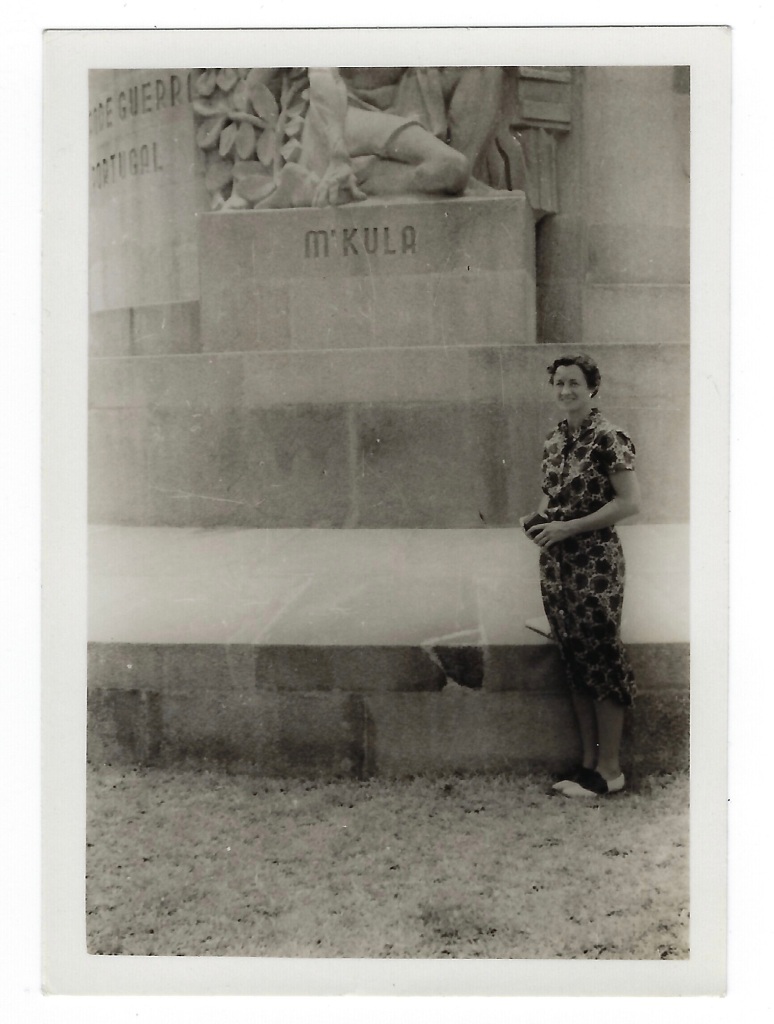
The back says “Mozambique, Lourenço Marques, At The Foot of the War Memorial”. Also, look at her cute shoes.
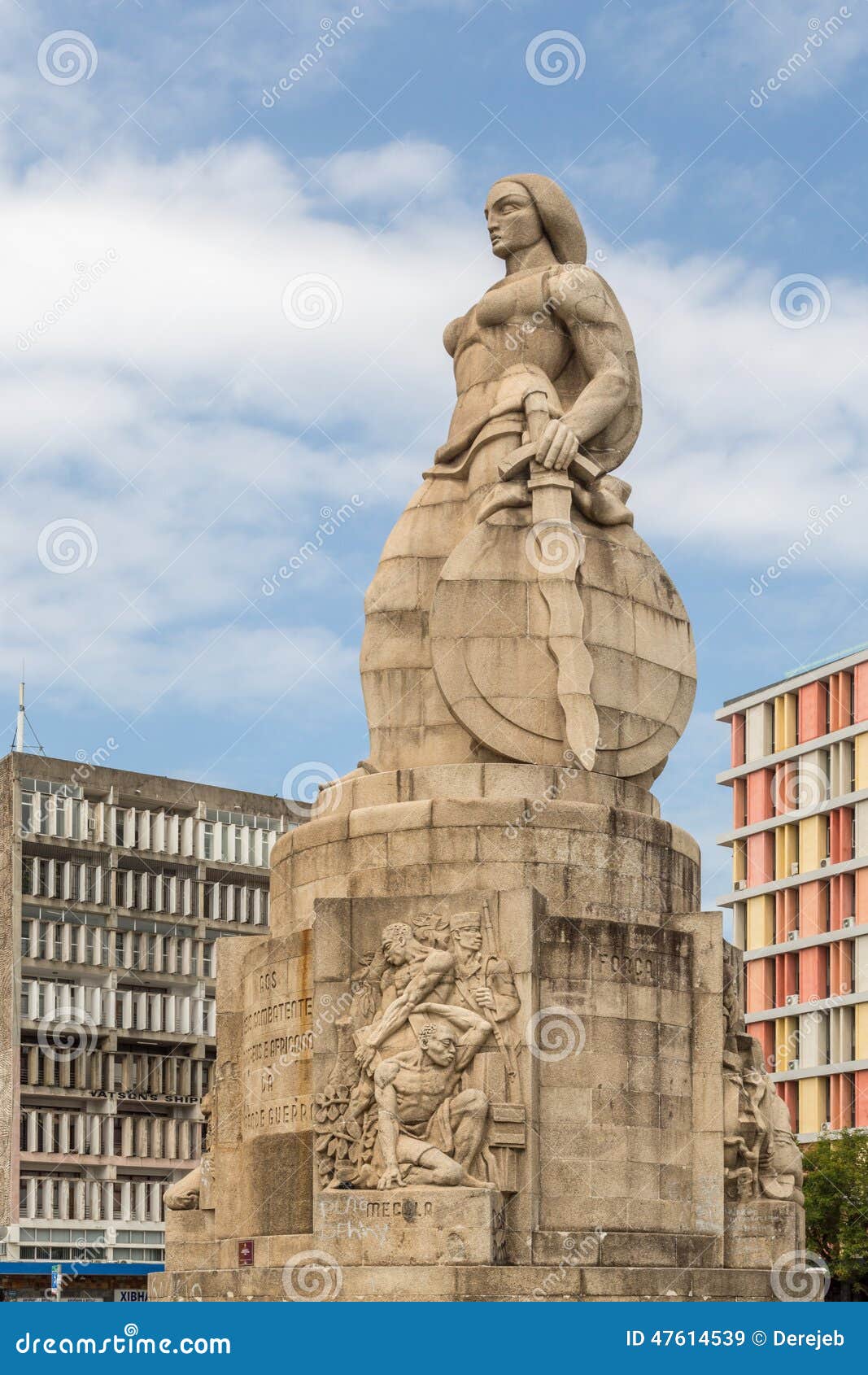
Shag and I to town - the war memorial across from the R.R. Station appealed to me as no other so far. An heroic figure of a woman on a round base with 4 fine plaques. 

Side note: The war memorial had its debut two years earlier, in 1935. Though a heroic figure of a woman indeed, it represented the Portuguese fending off Germans, and not struggles of the local people.

It was to be demolished as the city shed colonial relics, but it turned out too fortified, so it stayed. But over time, its significance changed to represent a strong woman fending off snakes in order to save locals, and she was deemed ‘The Snake Lady’, where she fends to this day.

The streets are wide, 3 flank-columns of red plumed royal poincianas standing at attention down the avenue. Most shops have roofs over the street - they're needed, for shade. The workers are prisoners, two men with ankles' chained together - clank, swish, clank - makes an ominous sound.

Side note: Mozambique had horrid colonial history and though slavery was abolished, prison labor doesn’t seem much different.

At 5:00 Shag and I taxied to the beach, made arrangement to be picked up at 11. Thunder and lightning and a full moon! Tropical rain. Shelter under a tin roof at a picnic table. The taxi did not come back - we walked back in 1 1/2 hours! - most amusing. But Shag was an hour late for his watch.

Side note: That beach date sounds like a plot for a romantic comedy, maybe even one with dance numbers in the rain?

Sat. Dec. 18: Lunch at Polana Hotel, high overlooking beach: prawns (like large shrimp, lobster flavor, delicious).

Side note: Her first prawn! I was also in my 30s the first time I had a prawn, but for different reasons than her.

Big wind blowing up as we drove back along the beach, and wavy as we returned to the ship. Up anchor at 7:00 p.m., got into swells that made us roll. 

Boat deck with Shag. One wave caught athwart boat deck spills over engine room ventilators. Bottles and dishes rattled back and forth all evening.

Side note: Athwart is a good word

Sun. Dec. 19: Read pages of "The Nile" to Shag.

Side note: Now she is reading The Nile TO Shag. A book about Egypt… where they want to motor off to together. So cute.

Beira

Mon. Dec. 20: Dawn in Beira. The anchor is swung from the bow and the anchor chain fastened to an enormous buoy. 

Took a tattered bus for sixpence over bumpy roads. Poked into several unattractive stores and just then the heavens opened, a deluge descended, wind blew, doors banged, glass broke. Shelter in a store until a taxi rescued us, took us to the Savoy Hotel. Lunch back to the ship, very wet - afternoon in Shag's room, reading. Typed cargo lists topside this evening, fascinating - timber, refrigerators, Ping-Pong tables, apples, wax, paint.

Side note: Her love of lists is endearing, and it has been passed down through the generations.

Tue. Dec. 21: a.m. on the boat deck, reading "The Nile" with Shag. I read him yards of figures: r.p.m., per day, per hour, generator, valves, etc. Reading in the hammock, a lovely day, wore shorts for the first time. Peered down #2 Hatch while rolls and crates of paper came swinging out on the lighters.

Side note: When I first read the second sentence above, I thought she meant she was reading to Shag the ‘…yards of figures’, like as pillow talk, which for them, could very well be. But then just below she says ‘more figures for Chief’ so most likely she was studying for Ship Shop (get it? like Wood Shop or Metal Shop in school, but about ships?). Whichever way, it’s cute.

And for our trivia for today: define ‘Lighters’ (in relation to shipping).

[Answer key: Lighters = a mini boat used to move stuff back and forth. Maybe its name derives from it being lighter than the boat it resides on??]

An amber moon cut off on top, sliced its way up thru clouds to sail off majestically into the soft black night

Sailed 6:00 p.m. More figures for Chief, then Shag. An amber moon cut off on top, sliced its way up thru clouds to sail off majestically into the soft black night. 

At Sea 

Wed. Dec. 22: Very hot in the sun. Engines stopped 1/2 hour during Shag's watch. Paced deck with S., wrote numerous cards, typed more cargo lists. Reading more "Nile" in p.m. with S. 

More abstract for Chief at 4:00, first scotch & soda visit topside after dinner - heard the news Frank Billings Kellogg is dead. 

To the boat deck, passed a vessel, saw the Morse light work for the first time, could read it, which was a bigger thrill. 

Another moon rise, a soft glow swelling to a crescendo of light, lines of cloud-like sooty brush strokes across the sky, the moon-path so bright as to seem elevated from the water. Slept out tonight with the moon in my eyes.

Side note: Frank Billings Kellogg helped usher in a bill (named after him) that would stop wars from being waged. You can ask the year 1945 how that went. But the bill was used to charge people responsible for the war with a Crime Against Peace (or Crime of Aggression) which was, ironically, punishable by death.

And that moon rise she watch from her outdoor hammock, I wish she’d bottled that so we could all live it.

Mozambique 

Side note: She’s been in Mozambique this whole post, but is now docking in Mozambique?? I, too, was confused. But it turns out Mozambique is the name of the country and a town in it. Welcome to Mozambique, Mozambique!

Thur. Dec. 23: Katy, Dreyer, Shag and I went ashore - 2 shillings round trip, paid a penny at the gate. The town different from any we've been - no motor traffic, narrow streets, phaeton hooded rickshaws, everything looks clean and newly washed, no wind to stir the dust. Buildings mostly built in long rows, houses distinguished from one another by the color - lovely sun-mellowed shades, crushed raspberry, dull gray-green, terra cotta, mild yellows. The triangles where streets come together with green grass plots and young flamboyance. The yellow wall and the palm trees against most glorious puffs of cumuli. The brick church with its white spire. 

Side note: Pottery Barn must have a color called ‘sun-mellowed’, no? And ‘crushed raspberry’? But maybe not ‘dull gray-green’. She was on a tear in that paragraph — the ‘young flamboyance’ of the street corners. ‘Puffs of cumuli’ clouds.

The walk along the beach, the avenue of tall spreading trees with poincianas in between. Looking up thru the lace patterns of the leaves and the flame-red blossoms toward the sun. The marble war memorial "Aos Mortes da Grande Guerra", the ancient bullet scarred fort (1502) its iron gates swung open. Inside-barred doors hanging open while prisoners scarcely guarded carried plates of black beans and rice form the line at the mess hall door some patch of shade for lunch. In one corner of the hot open square a small chapel, one door for "Europeaos", the other for natives. 

Side note: Separate doors in a church?? How so very pious of you, Europeaos.

Back to the ship, the P.O. closed 11:00 — 2:00 for siesta — "for only mad dogs and Englishmen go out in the noonday sun", and it was hot! Not humid, like Beira, but blazing white heat — the Portuguese wouldn't let me go ashore without a toupee, borrowed one of Shag's. Under way at 1:00 p.m. along the beach the most vivid apple green water I've ever seen, over coral reefs and dark green water until we'd cleared the bay. Most gorgeous banks of cloud and on the water the exotic touch of lateen sails. One running before the wind like an enormous bird, wings spread. On a coral reef right off the light hangs a freighter much like ours, abandoned last October. S. and I decide not to see so much of each other. 

Side note: So first… WHAT!?!? I’ve read all this before and kind of remember that last sentence, but don’t remember it being so matter of fact. It even has the same measured handwriting as all else (her handwriting is tidy, to say the least). My journal would have had one of two things woven into that sentence: a weak, pained chicken-scratch or an heavy-hearted bold. And in both cases, a splash or two of wine. Maybe she was doing the breaking off and Shag is off somewhere with a wine stained journal?? Stay tuned!

Lastly, that song lyric is from by Noel Coward and is about traveling near where she is traveling, but oooh boy the lyrics are a lot dated.

20. More Durban, South Africa, Dec 11 – 16, 1937

In 1937, for most civilians on a freight boat, docking meant wandering the port town, or, at more touristy stops, perhaps embarking on an organized tour. But on this freight boat, a certain crewman has a motorcycle, and on it, he and this story’s heroine skip the docks and zoom off where the roads take them.

The after the trip letter

"...there was a hair-raising ride on the "rumble" of the motorcycle miles out of town, off the main road on a more goat track, into the "Valley of a Thousand Hills”. 

Side note: The first several times I read that sentence, my brain saw ‘rumble’ and thought she meant their ride was rumbly (like bumpy, because of goat tracks and such).

But no, she is ‘on THE rumble…’ and ChatGTP says this was a folding seat added for extra passengers of cars and motorcycles. And the person often sat backwards (but how on a motorcycle??).

I bet her trip on the rumble did indeed feel rumbly (both meanings!).

And the goat tracks… I’m no goat expert, but they jump around aimlessly a lot, not making road-like tracks (at least on Instagram). Goats make rumbly tracks, I’m going to guess.

The blow by blow journal

Traffic in Durban directed by microphone from a balcony above the street “Hurry along there, don’t cross when the light is red.” 

There is to be a drive for less traffic noise, starting with ‘hootless’ Fridays.

Side note: From the “Hurry along there…” realtime traffic scoldings to ‘hootless Fridays’, British Durban, at least how she paints it, seems a bit Monty Python (that is a compliment).

“Traffic in Durban directed by microphone from a balcony above the street, ‘Hurry along there, don’t cross when the light is red.'”

Helen Skinner, Durban, South Africa, December, 1937
Sat. Dec. 11: 6:45 a.m. — To the customs with Shag while he cleared the bike. Wide streets, attractive window displays, numerous tall buildings, many modernistic. Charming English type houses set in lovely gardens, a profusion of flowers in bloom — glads, snapdragon, morning glory, jacaranda, hibiscus, royal poinciana, stopped at a tea garden run by a Dutch lady Shag knew, had scones, hot chocolate and honey. 

Side note: They were able to somehow coordinate a scone meet up with Shag’s friend in 1937!? Maybe she said, “Shag, do stop by my tea garden near Durban next time you travel around the world…” and then she just happens to be there. I lived for half my life without phones, but the latter me cannot recall how the former me got anywhere. Please ask my husband about when I arranged for a dinner date at a restaurant we like, and he found me waiting for him at a different restaurant, annoyed that he was late. This was in like 2016.

To the Valley of a Thousand Hills — like nothing I've ever seen — round, green and treeless, and surrounded by mountains in an endless succession of plateaus. Off the main road (where the native dwellings are like the shacks in Southern USA except that they're made of corrugated iron -- and the costume is fairly citified) headed for Zululand. 

The going becomes precipitous, don't look now but it's 500 ft. to the bottom, we're on a narrow path cut with a chisel out of the cliff, and momentarily I expect to slide forward over the handle bars.

Side note: “Bond…. Helen Bond.” And this is where goats come in handy… the craggy rock stuff.

The road narrows to a wagon track, then to a foot path, and we are in the midst of Zululand. The native kraals are built on a circular spot of ground, the huts are round, made of mud and thatched. Sat and feasted our eyes on the valley and on the plateau beyond. 

Numerous Zulu passed, asked for cigarettes "ticky", the men are handsome stalwarts, the women sturdy, costume varies. Most wear a cloth draped around the waist, falls below the knees, all bare footed, naked above the waist. Some have bustle-arrangements that wag when they walk, babies carried in a sling on the back. 

Probably covered 75 mi. today. 
“Helen and friends” Zuzuland, 1937

Side note: Wouldn’t you think these days a ‘children as scenery’ should seem dated? Sadly, it’s still all too common.

Sun. Dec. 12: Drove in the Reo down the South Coast. Hiked down another 300 ft. thru jungle growth — wild bananas, cactus, palms, to the beach and on down to a special cove. Beautiful rock formation, gorgeous surf. Stayed until 11:00 p.m. (and I had date with Shag for the evening — visited with him in the engine room a bit).

Side note: Jungles can have cactus. I just looked it up. And ‘visit… in the engine room a bit’ oooo. Note the time! She was at the beach until ELEVEN pm. Also, ‘a bit’ is still a classic ‘mention-but-minimize’ technique that remains contemporary. No?

Mon. Dec. 13: Ruth and I to town at 9:30, bot decorations for the Christmas party, noise makers for all. 

Shag and I drove out into the sugar plantation country, miles of it, like Iowa corn. S. and I were going dancing, but at the last moment decided on a bike ride, instead, wonderfully exhilarating. Out to the beach, sat and talked, listened to the roar of the surf.

Side note: So much roaring (she uses that word more than once) adventure for these two. Can one absorb so many core memories in such a short time?? All the senses at once. I hope so.

At 2:00 Shag and I went in on the bike, visited the Royal Auto Club, listened for two hours to plans for a trip from Cape to Algiers. He discouraged trying Cairo, too much swamp to go thru. Stimulation of the imagination to the boiling point, it almost sounds feasible. Think of seeing the mountains of the moon at the headwaters of the Nile.

“Think of seeing the mountains of the moon at the headwaters of the Nile.”

Side note: Remember talk of the 10,000 kilometer road trip from a few posts ago? It’s sounding like more than just a pipe dream. Being a race car dude, Shag can likely name drop and such and have a bit more leverage than the average guy on port leave.

Strung up my hammock and chewed the rag until 10 and I was so sleepy I couldn't hold my eyes open. Unloading went on until midnight, lumber and asphalt coming out. Stevedores had a chant which rose and swelled like some of our great Negro choruses.

Side note: I’m not sure what choruses she had seen/heard, but some lovely ones existed then. Beautiful and haunting.

And chew the rag, we learned before, means talk; while chew the rug means dance.

Wed. Dec. 15: Motor bike to the airport, several Gypsy Moths. Tariff: 10 min flight – 10 shillings each for 2; dual instruction – 3£ per hour; solo – 2£ 9/ per hour. Result: we stayed on the ground, rode across to the Durban Air Station, saw a Junkers take off – ugly things on the ground, corrugated metal like the old Fords. An S.A. flying boat flew over. Airport Adm. Building attractively modern, field small, bumpy.

Side note: she doesn’t seem too upset that she didn’t get to fly. The ship, the ports, the motorbike, and most probably Shag, seem to be giving her an equivalent rush.

At 5:00 walked with Shag to the "Pommern" 4 masted barque (Clyde 1903) from Finland, much smaller than the "Viking", dirty, cramped quarters, shouldn't want to sail on her. A French gunboat, the "Bouganiville" tied up near us. A sleek, slim ship, carrying a seaplane. Jaunty costume of the French Navy, striped blue and white vests, red pompom on flat-top white caps.

Side note: jaunty is not really what the military goes for in a look.

Thur. Dec. 16: Bed about 2 a.m. Woke at 4 a.m. and couldn't get back to sleep. Dressed and went for a walk on the quay – rosy sunrise. At 6:00 swung my hammock and read until 7. Wind blew in blustery fashion all day. I was very lazy. I visited Shag in the morning, heard about his brother Jack. Tried to sleep in the p.m. but was nearly blown out of the hammock.

Side note: Shag’s brother, Jack Shadbolt, was Roy’s older brother, who was still younger than Helen. The scandal! Jack was a well known artist and we will hear more about him later.

More about everything later! But for now, over and out.