After five+ months of zigzagging the planet, Helen is back on U.S. soil.
A longshoreman's strike gave us one day instead of the five we'd expected in Los Angeles. I was taken on a mad dash across county to see everything at once: Hollywood, the Troc, the Brown Derby, Wilshire Boulevard, the University (U.C.L.A.), the oil derricks, the beaches.
Side note: Unthinkable that a person could mad dash anywhere in Los Angeles, especially to so many places in one day. That, and they first had to get to LA from the port in San Pedro or Long Beach, and then go back to the ship (about 25 miles each way and in 1938 cars didn’t go very fast).
Dots are all the places Helen visited in and around LA, in one day, in 1938, back when traffic wasn’t hell
Here’s a cool aerial view of UCLA in 1938 and look how tiny it was! Also look at the creepy oil derricks she likely saw. Their more recent iterations are no less creepy though, as oil derricks are creepy by nature.
Day-to-Day Journal
Sat. Mar 19: At 6:00 a.m. the anchors groaned up and we went inside the breakwater. I got up and pressed some clothes before the doctor and immigration officer came aboard. Everyone keyed up at being back to U.S.A.

At 8:30 we were piloted in to Long Beach. Ruth's husband, Mr. MaGuire's son, the Dunhams were waiting on the quay. There was a gardenia corsage for me with instructions to get in touch with Virginia Lyon.
Side note: To alert people that you would be arriving from across the sea in 1938, did you send a letter or telegram from your last stop (in this case Manila, some 20 days earlier) with a guesstimate of your arrival? Maybe the recipient could call some ship whereabouts number to find out if it was on course? Or maybe there was a ticker? The internet won’t give me a straight answer.
Had my bag packed to leave the ship when the word came around that on account of the strike we would stay only long enough to take oil, and would leave for San Francisco tonight. Gnashing of teeth! What to do?
Drove, can I begin to say where, places whose names had become very familiar during 5 months among Californians. Santa Monica, Wilshire Blvd., Sunset Blvd., Hollywood, Beverley Hills, Ventura Blvd, saw the Troc., Grauman's, The Brown Derby, Clara Bow's "It" Café, Westwood, some Africa-ish looking hills, an observatory. Lunched at a curb service place - chefs salad bowl and a tall glass of milk.
Side note: Perhaps the observatory she visited was the famous Griffith Park Observatory… the super-cool art deco dome, perched up in the Hollywood Hills, that had just opened three years prior?
The curb service she mentions was likely a drive-in restaurant.
Called George Bunyan and found him home. To a dentist to have my tooth cemented back on the plate. Away again to ... marvelous food: thick steak, real vegetable soup, stewed tomato, deep dish apple pie.
Side note: After 5.5 months away, I bet even the most worldly traveler would miss some food from home, if only for the familiarity. In 1938, you could not yet sneak off to a McDonald’s whilst traveling, and then pretend you didn’t.
George Bunyan was Betty Bunyan’s (Helen’s cousin / bestie) younger brother. As children, his family and hers lived side-by-side, first near Albany, and later, in Brooklyn. George was about 8-10 years younger than Helen and Betty so likely a pest.
Below is a picture of George in his Flatbush, Brooklyn backyard, circa 1914. The picture below that is of what looks like two grandmas flanking George, Betty (scowling), Helen (about 12 years old), Mary (my adorbs grandmother), and then below that it’s the same folk, but rearranged and minus one grandma.
George Bunyan, Flatbush, Brooklyn, New York, 1912ishAbove: Grandma, George, Betty, Helen, Mary, Grandma; Below: Betty, Grandma, Helen, Mary, George
Dash back to the ship for 6 p.m. sailing, to learn it would not leave before 10: Took Shag uptown to get a haircut, came back to the "Pussywilllow", chatted with Sam. Brot oranges on board, super colossal's for 25¢ a dozen ... the man had large, jumbo, mammoth, colossal, and super colossal sizes! Stayed with Shag until sailing at 1O. Mrs. MaGuire learned her 2nd son died in Feb. Helen D. found her oldest sister dying. Sam gave me some advice.
Side note: Helen noted earlier that Mrs. MaGuire was a widow from Portland who had three sons. And one of them was there waiting for her at the dock. How horrid.
Large, jumbo, mammoth, colossal, and super colossal are a very American range of sizes.
Sun. Mar. 20: At sea again, the 1st day, chill breeze, salt spray, California hills on our starboard side. Spent all off watch hours with Shag. Wrote 5 business letters and a long one to the family. Everyone dead as dodos, lolling around all day. Kept in the air as much as possible. Jim came over at 10:30. Anchored early in a.m. and rolled all the rest of the night. Had a toothache to help matters.
Side note: I wonder if the long letter home to family is the one I’ve been transcribing. That one doesn’t end on March 20th, but she could have added more later. Oh, I bet she was drafting a letter, like by hand. People used to do that. For college papers, too. Olden times.
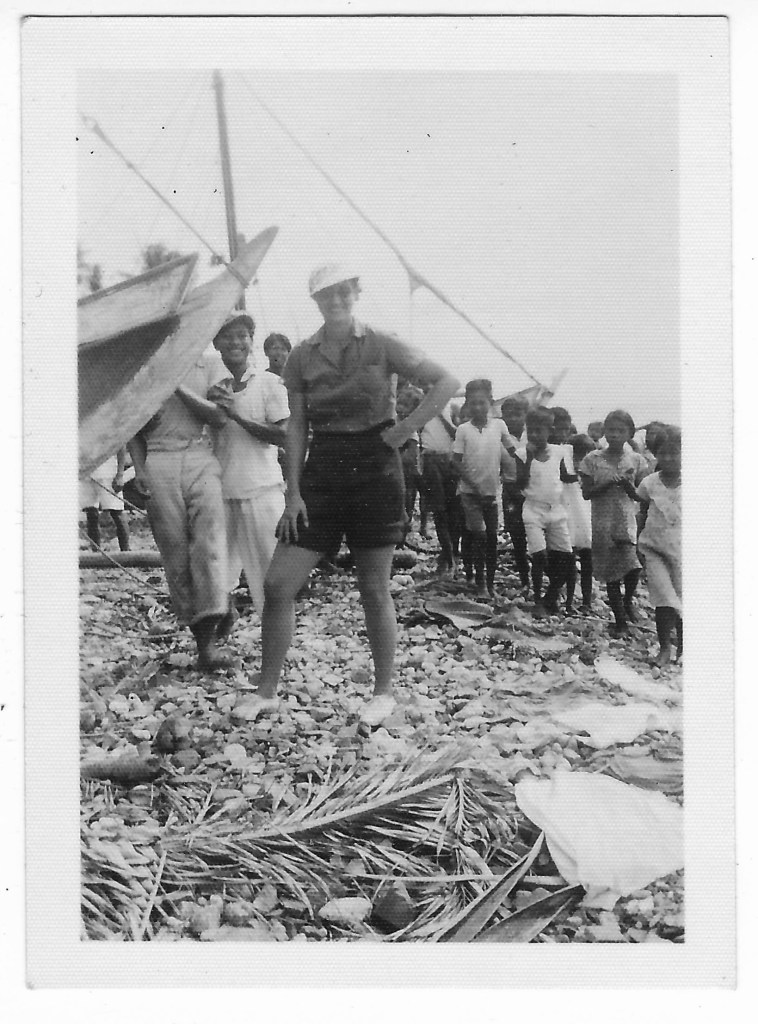
Shall I say we "browsed" through the Philippines, loading sugar, palm and coconut oil, copra and copra meal at several of the islands.

We saw the spot where Magellan was buried, or where what was left of him was buried after the cannibals finished with him...we thumbed rides on native outrigger sailboats, went fishing, went ashore in native villages...
Side note: Magellan died by poison arrow, in Lapulapu, Philippines in 1521, at the age of 41ish. I’ve just learned (or maybe relearned) that ‘The Magellan Expedition’ was indeed the first expedition to circumnavigate the globe, but Magellan himself did not complete the voyage, because of the arrow.
...the bamboo huts are raised high on stilts..that helps to keep out some of the “varmints", and then it rains so much they would be awash most of the time. Normally the space under the house provides shelter for the pigs and chickens. The floors of the hut are made of split bamboo, rounded side up, and they seem to sleep comfortably on woven bamboo mats spread on the floor. A bed is such a novelty...there isn't much furniture of any kind, but I located the inevitable Singer Sewing machine.
Side note: A whole paragraph about stilt houses is a lot for a three page letter about a five month trip. I bet the houses were (and are) striking for just about anyone used to seeing houses on the ground. They likely looked like this and the bamboo mats like this.
The Day-to-Day Journal
Lighters came from Victoria Refinery across the bay. Catamarans came swooping down on us from all directions. Unbelievably narrow craft of various sizes with sloop rig and great bamboo outriggers.

At 1:00pm the starboard forward life-boat went overside and sailed across to the village. We were met on shore by the population, followed about, a few spoke some English.

Perhaps 60 bamboo huts on stilts, pigs underneath, almost no furniture, occasional magazine pictures on the walls, a few potted plants, one sewing machine.

Some of the girls quite nicely dressed. The boys swam, Jim and I wandered up "Main Street". Passed the "Bay-Ang Barrio School", kept very neatly. Water buffalo sloshing about in the puddle in back of the town.
Side note: The link above shows a very different style of stilt house than the first one I shared. The quality would depend on who you were, but whomever, you’d be on stilts.
Sun. Feb. 20: Off for Manila soon after. Sam is going to do violence to Daisy in the cause of "I have a friend". Two people have a basic understanding for marriage.
Side note: Miss Daisy Mount is one of the civilian passengers about whom Helen said early into the trip: “Sweet little old lady, dainty, birdlike movements….”.
And then Daisy said to Helen, “I have a friend”. So maybe that was Daisy’s thing… to make friends; and now Sam is getting the treatment. A rugged sailor hitching what he thought would be an easy a ride on a freight boat for a few stops through Philippines, and a sweet dainty little old lady who wants to be his friend. I hope we hear more.
But before we move on to Manila, let’s look at Helen in the Philippines for second:
The Dutch East Indies was (and now Indonesia is) made up of 17,000 islands, I’ve learned. The Dutch had been taking up space on them since 1600. Their time was almost up though, not that the local population would benefit, as they were next occupied and indentured by the Japanese. After World War II, an independent Indonesia was born, free of colonizers and occupiers.
In February 1938, while countries in every direction fortified their armies, Helen slipped into her boat deck hammock and cracked opened War and Peace.
Anchor at 5:30 a.m. — everything very damp. Wrote all a.m. Hot and muggy, no one went ashore — usual round of visits on boat deck. Started Tolstoy's "War and Peace".
Side note: What a book to be reading as war is percolating. I mentioned the Napoleonic Wars in the last post, since they were the reason the Dutch East Indies briefly had an English governor.
So Napoleon is the ‘War’ in War and Peace, but though I minored in (Russian) literature, I never read the book, and I don’t know what the ‘Peace’ is. My husband read it last year (I harbor both jealousy and pride for this feat) so I could ask him, but will instead suss that ‘Peace’ is the class of those mostly unaffected by (at least the combat and blood of) ‘War’.
Anyhow, Helen’s gonna be reading A LOT about the Napoleonic wars.
Semarang’s volcano purplish against a graying sky, at sunrise beautiful cloud masses with just the suggestion of light shining thru
It was decided we'd drive to the Borobudur, but the agent changed our minds. Said in the West monsoon it is liable to be very rough in the afternoon and we'd have to be prepared to go on to Sourabaya by train.

Sigrist frothed at the mouth, but wouldn't risk the expense, so we went in to Semarang on the Agent's launch. The driver took us up on the hills into the residential section, charming homes, grand view out over palm, banana, acacia, flamboyant trees to the ocean.
Side note: This frothy Sigrist, mad because of a monsoon, is a 72-year-old widow whom Helen liked at first, but now does not, and she’s probably only currently traveling with her because of limited options.
I’ve mentioned that we do not learn much about the other few civilian passengers on the freight boat (eight total I believe) because Helen is focused on the ship and its men. But she does give her impression of the passengers for the first few weeks of the trip. Here are Helen’s journal notes about Sigrist:
Nov. 10 - Stolid, but spry for her age, widow, rises very early, reading Shakespeare, walks on Engnrs. deck an hour after each meal. White hair, stooped, a strong, kind face.

Nov. 12 - has traveled much, keen, fine sense of humor, widely read.

Dec. - stubborn, dirty, rude, determined to have own way, does not know how to play, is mad if she does not win. Am in doubt about sense of humor. The engineers have dubbed her "Old Corrugated" and it fits her like a glove. Mrs. D. calls her Queen of Sheba all the time. She's a hag out of a Dickens novel. Would rather walk a mile than spend a nickel.
Side note: The December note doesn’t even get a date. Sigrist is just a plain old pain by then. Moral: rudeness trumps your good qualities so don’t be a Karen.
Stop at a Batik factory — under a shed a man drawing designs on white cloth in pencil, freehand, two women squatting waxing the intricate patterns with a tiny brush. Bot 2 pieces of hand block work @ f2. each.

Read all afternoon. At 5 to listen to Shag's radio and again in the evening (it rained cats and dogs), best music in months.

I wanted to dance and Shag was inspired to draw a charcoal stage setting for it.
Side note: When I search about radios on boats in 1938, most of the hits are about War of the Worlds and how Orson Wells would scare the bejeezus out of people later that year.
But Helen and Shag would have been listening to offshore radio and I bet it sounded something like this, but all staticky. I don’t know if young men commonly learned to dance in 1938, but even if they did, I bet Helen was leading. She taught dance as a P.E. instructor, as it was part of physical education for women then. She also notes in her timeline that she attended dance seminars and conferences over the years. And dance doubled as a flirting mechanism and tripled as a way to judge men.
But back to the boat, the dance, Shag, and charcoal drawn-stage… ballroom dances were Helen’s favorite. Those tend to take up quite a bit of room, but I’m quite sure they made due, dramatically dipping in front of the chalky stage outline. Let’s remember how cute they were.
Thot I was back in Calcutta when I came along the starboard alleyway. Packed like sardines with sleeping figures — the stevedores stay on board here until the job is finished. They were sleeping on bamboo mats on the iron deck with rain pouring in on them.
Side note: We are back in the real world now, witnessing more of the ravages of colonialism.
Sat. Feb. 12: Capt. and the male passenger went ashore today, while the rest of us stayed aboard and I for one enjoyed just sitting on a beautiful green sea, reading, writing. Sat in Capt.'s new chair all a.m. The hammock was most comfortable in the p.m.

Jim had cut off a pair of white ducks that had worn out at the knees, I did a little hemming and there are now shorts.
Side note: White Ducks still are around. They were and sometimes still are very wide leg dungarees that sailors/navy men wear and imagining them as shorts is fun.
SOERABAJA - MALANG

Sun. Feb. 13: Pilot came on at 5:20 a.m. and we were alongside by 7:30.

On to Malang — 95 km. Distant volcanoes and mountains all around us — a resort town, Tretes, on the volcano on our right.

Here the rice fields are in every stage, much of it like seas of green grass, some of it headed and ripe.

Passed some carts carrying rice shocks. Teak trees blooming, creamy white plums. Miles of sugar cane, several sugar factories (work 8 mo. in the year). Kapok factories, and many coolies carrying big baskets of kapok pods.

Numerous Durian markets, the fruit tied in banana leaves, baskets of tapioca root and several tapioca factories. An unfamiliar plant growing like tapioca which the driver said was used for color for Batik.

Off the main road to look at two stone Buddha's and a Hindu monument. Saw ducus, pomelo, oranges, papaya growing, mango trees, first I've seen to recognize them since Burma — much smaller than African tree.
Side note: She keeps mentioning durians but does not mention the smell. All I know about durian is that they smell and are banned from Singapore markets (or were in 2015).
To a park in the heat of the day to feed the monkeys and strikes me as being too too ridiculous — were almost overwhelmed by a dozen girls with bananas and peanuts to sell who climbed all over the car and shouted for us to buy.

Into Malang, quite high and very new and modern, a beautiful town. Resort for people from the coast, soccer, hockey fields, tennis courts, race track.
To Palace Hotel — Dutch, tile scenes of Jaye around the dining room. Had my first ricetafel, a typical Dutch dish of the country: a soup plate of rice, followed by seventeen dishes (some places use 17 waiters), some go on a side plate but most go on the rice, then stirred up in it. Prawns, fried chicken, bamboo shoots, bean sprouts, onion, fish. All of it very hot, topped by a poached egg - delicious. For dessert avocado pear mashed with coffee extract poured over it. Must have some more one day. Coffee in the lounge — coffee extract, hot milk. During the drive back it poured a deluge — got quite wet.
Side note: The Palace Hotel is still around and looks very fancy.
In Soerabaja to a Batik shop, but found nothing I especially wanted. To a wood carving, silver, etc., store, bot nothing. Saw several things I'd like if I had money and a home. Return to ship at 5:30. Shag and I found a grassy bank in the moonlight on the canal. Saw strange boats with queer sails.
Side note: Helen is right that she doesn’t have a ‘home’ home, as she likely lives in teacher housing during the school year, and at various summer camps, where she also teaches P.E., during warm climes.
Her timeline doesn’t have an address for her between when she first goes to college 1919 and 1938 (that’s foreshadowing…) and she fully appears to have wanted it that way. She was scouting for jobs on this trip after all, which woulda meant a lot more temporary housing.
Helen would get a home soon though (I kept you in suspense after that foreshadowing!), one where she’d have a place for all her travel trinkets, and someone to admire them with.
Is that someone with her now ‘…in the moonlight on the canal’ on the grassy knoll? Read on to find out!
To recap, Helen was just recently in the Dutch East Indies for Chinese New Year (1938 = year of the Tiger), then took a tour through a brink-of-war Singapore, with its air raid drills and harbor full of battleships. And now, though she keeps her forward momentum, she is back in the Dutch East Indies.
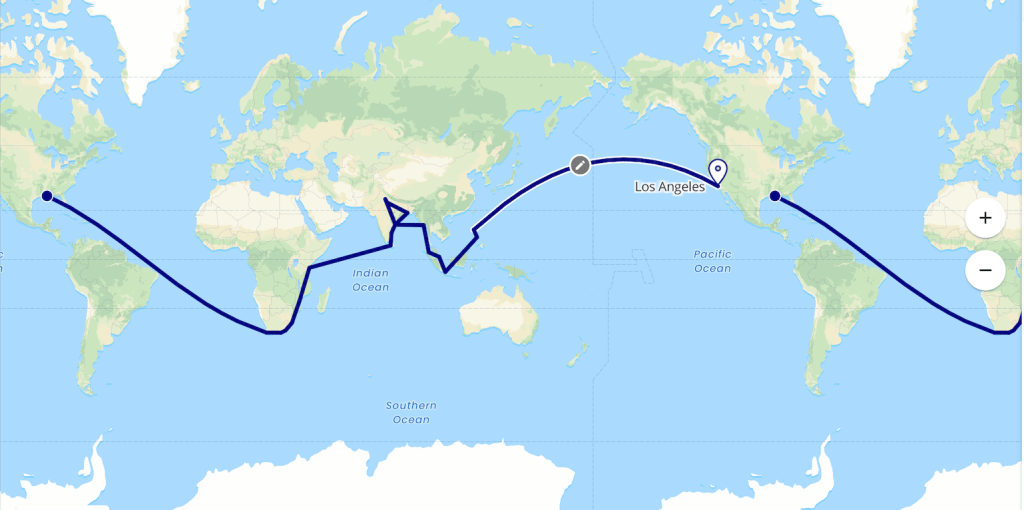
To visualize the geography of this, I have created a map of all the places she stopped on the five month trip around the world (the loop-de-loop is her inland visit to the Taj Mahal). There are some zigs and zags, but no backtracking.
The M.S. Silverwillow started its voyage in New Orleans in 1937 and ended (at least Helen’s leg of it) five months later in Los Angeles, in 1938
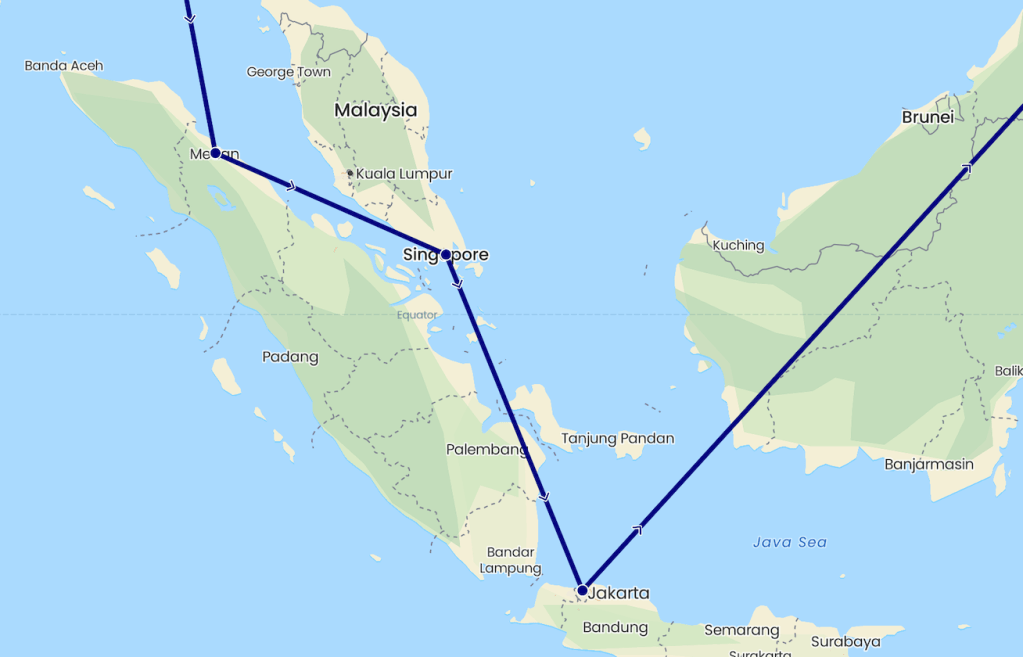
A zoom-in on the map might not show the exact seafarers’ route (but never doubt that there could have been some Fitzcarraldo-esque boat-over-a-mountain stuff going on). Even if it weren’t a crow’s fly map made with a free app, you can still tell, geography-wise, how a boat might visit the Dutch East Indies (now Indonesia) twice, before and after a stop in Singapore.
Helen’s exact route, via boat, through South East Asia, 1938.
Now that we (I) understand the trajectory, we snap back to a world simmering in war.
Day-to-Day Journal
Tue Feb 8

Up with the anchors at 6:00 a.m. into the harbor of Tandjong—Priok past two rows of warships, 3 French, 2 Dutch. Still wind blowing, came too close to the Dutch Navy for comfort as we made two passes at the mooring buoy.

Silverteak came in just astern of us, did not go alongside as we expected.
Side note: The Silverteak survived World War II. The Silverwillow (the boat Helen was on) was used by the British navy, and was destroyed by U-Boats on October 30, 1942. Several men died.
To Batavia (8 mi.), a canal runs alongside the road from Batavia to the New Batavia Centrum (no Europeans live in the old city now (malaria)).

Took pictures of the laundry being done in the canal.
Side note: I wish I had more pictures. There are barely a dozen of the whole trip, and most from the early time at sea. The canal might have looked like this.
Fine stores, we went in only one, having no more time. Thru Batavia museum, beautiful dignified building with white columns, filled with Javanese work: carving, silver, models of types of houses, costumes, implements, Batik, musical instruments, boats — a fascinating place to spend days.

Outside were many Hindu and Buddhist Gods from Borobudur and elsewhere.
Side note: Most if not all of these artifacts survived WWII, but the local population did not fare as well. The Japanese occupied the Dutch East Indies in January 1942. They were welcomed at first at liberators, after hundreds of years of Dutch colonialism, but ultimately four million people died there during Japanese occupation due to forced labor and famine. The gory details can be found here.
Saw sacred cannon decked with flowers, incense burning. Pony carts like Sumatra, but with flat tops, called a delman - with ponies from Bali. Buffalo hides drying (use for fans, belts, lampshades, etc.) thru the country. Opium factory (control by Gov't.) next to medical college.

Everywhere along the road coolies in big hats carrying baskets. Hundreds piled high with rambutans (fruit with red soft-spiny shell — hang in great clusters on the trees), mangostein, pomelo, banana, ucus (like small pale lemon, inside formed like a pomelo, has a tinge of banana flavor), also vegetables, tinware, all manner of household articles.
Side note: By ‘ucus’ I believe she meant ugli, which is an unfortunately named fruit. It is also known as uniq in some circles and Jamaican tangelo in others. So much learning.
Goodyear has a large factory, produce 6,000 bicycle tires, 600 truck tires per day. (Gov't. collects 1,000,000 in fees from the bicycles in Java). A large market-looking place with hundreds of people around it proves to be a pawnshop, one of sixteen Gov't. operated ones in Batavia.
Side notes: The government had its hands in pawnshops, opium factories, and salt. Also, remember my hint in the last post about Helen being back in this part of the world decades later, and that it would be related to rubber? Here is another hint.
Acres of rice fields, tapioca (use root), rubber, sugar, miles of kapok trees, sago palms, pith used for making sago-like small tapioca beads, also ground for bread flour — leaves dried to make thatch roofs for houses, juice makes vinegar and a native alcoholic drink.

Indigo plants about 3 ft. high have white blossom, plant soaked in water 15 days, crushed, extracting juice, water left to evaporate, indigo powder remains. Tamarind trees growing along road, from them a hot extract for flavoring salads. The palm with the red stem is sealing-wax palm. Betelnut tree a tall very straight-trunk palm with a tuft of leaves at the top, clusters of nuts like the date betel leaf, in which natives wrap the nut comes from a small shrub-like tree, is chewed like chewing gum.
Side note: Sago palm does just about everything, doesn’t it? Puddings, breads, roofs, boozes, and last but certainly not least… BOBA TEA. The also magical indigo powder is used to regrow thinning hair AND to cover grays. In India, she complained about the red betel nut chewing spit splats everywhere, if I recall. The betel nut was more like a cigarette in effect than chewing gum though.
In Buitenzorg the zoological museum, then the Botanical Garden (largest in the world) many thousands of trees I never saw before — trees with trunks like concrete walls, cannon ball tree (fruit the size and shape of c-ball), pandanus, from which Panama hats are made.
Side note: The Panama hats she saw might have been called Tamsui hats, from Taiwan. They are the same looking. I don’t think the actual Panamanian Panama hats were made from pandanus, as it didn’t grow in Panama. Those (at the time at least) were usually made from the Carludovica palmata plant, indigenous to the region.
Lily ponds with enormous pads, pink lilies, lotus flower — monument to Mrs Raffles.
Side note: Sir Thomas Stamford Bingley Raffles built The Lady Raffles Memorial for his wife. He was a Colonial governor in the Dutch East Indies in the 1800s. Helen mentioned a Raffles Hotel in Singapore. And I know I’ve heard of Raffles whilst traveling in that part of the world. It’s all the same guy, but the latter without the Thomas or the Bingley. Why is a British dude the governor of a Dutch colony? Google says because of a capture, for number of years, of Java by the British during the Napoleonic Wars. Then it went back to the Dutch. Maybe the monument was nice so they kept it.
Houses in Java are made of bamboo matting, for there is no good building wood here except teak, which is very expensive and a Government monopoly. Bamboo house lasts about 20 yr.
Side note: Teak was not indigenous to the region, but had been growing there since the 16th Century. Excellent building material (rugged stuff used for floors and boats and furniture) was available locally, but the colonial government hoarded it for their own use and profit, and locals got to build bamboo houses that last for 20 years. Cruelty and greed.
A new passenger on our return — youngish, male, married, from Sacramento. Daisy nabbed him.
Side note: Daisy is ‘Miss Daisy Mount’, who Helen described as, “Sweet little old lady, dainty, birdlike, speech a bit breathless as tho people wouldn’t listen. Pioneer stock.” But here she is ‘nabbing’ a youngish married man. In a post several months ago, Helen said that Daisy, “had an acquaintance”, and she also was involved in some gossip, telling Helen there was “axe in the offing”.
I think I may have found her! Sarah Fisher ‘Daisy’ Mount was born in 1867 in the San Francisco Bay Area. In 1938, she would have been 71, so that tracks (Helen was 34, so 71 would be quite old). After docking in Los Angeles, Helen traveled north through California, visiting Daisy in SF on the way.
Helen also mentions that Daisy has ‘pioneer stock’ and pioneers were settling all around the Bay Area in the 1860s. And now here was Miss Mount seeing the world and nabbing young men. Go Daisy!
Miss Mount passed away in SF in 1945 at age 78.
Why we know so little about the few other civilian passengers on the boat is because Helen was focused (people-wise) almost exclusively on the men that worked on the boat.
Wealthy Chinese own much of the land in Batavia.

Started sleeping out, hot and humid — coughed for hours in spite of Jim's toast at 10:30 — paced deck, slept in for a couple of hours.

Ashore in a boat with a port oar and a paddle in the stern. -10 Java cents each way. Quite something to see our passengers climb in and out.
Side note: Sleeping ‘out’ probably means that she is back in the hammock that she helped measure, cut, sew, and hang on her way from New Orleans to Cape Town.
And regarding people climbing in and out of the boat… I think she is poking fun at the more elderly of civilian passengers, who mostly have at least three decades on her.
Wed. Feb. 9: Dropped the pick in the early dawn at Cheribon. Tug with 7 lighters came alongside. Unloading gunnies from Calcutta, taking on a few tons of Sago flour.

At 11:00 Capt. asked if we wanted to go ashore. H.Q. & I went with him. Stopped for a beer at Hotel Cheribon, Then 30 mi. south to Lingga-Djati, to Hotel Rustoord, beautiful drive. Rice fields and rice fields, men, women, and children working in them — every separate shoot planted by hand. Mt. Cheribon — 10,000 ft. volcano shrouded in clouds most of the day, extinct for 200 yr., became active last year. Sandwiches, milk, fruit for lunch (my first glass of milk since Capetown and this was boiled).
Side note: I cannot find anything about the Hotel Rustoord, but the word ‘rustoord’ means old people’s home in Dutch.
The Mt. Cheribon she mentions is indeed a Mt. near Cheribon, but it is actually named Mount Cereme (or Ciremai or Ciremay).
There is so much Dutch East Indies that we must cut this one in half… but stay tuned because next we have more war, but also some peace.
In the Islands of the Dutch East Indies we stopped at many ports, unloading rice from Burma, picking up spices, tapioca flour, tea, kapok, rubber.

We drove inland at each stop as far as we had time to go.

There were mountains, volcanoes, miles of terraced rice fields, and an endless procession of coppery brown Malays going to market, carrying two baskets hung on a bar across the shoulders: pottery, sugar cane, durians, mangosteens, kapok pods...we couldn't carry the loads, but they've developed a peculiar jog to balance and distribute the weight, and as days pass it becomes hauntingly familiar to watch, until, for the visitor it becomes a part of the memory of the scene. Gay, colorful in face and dress, clean, cheerful, the Malays seem a happy people.
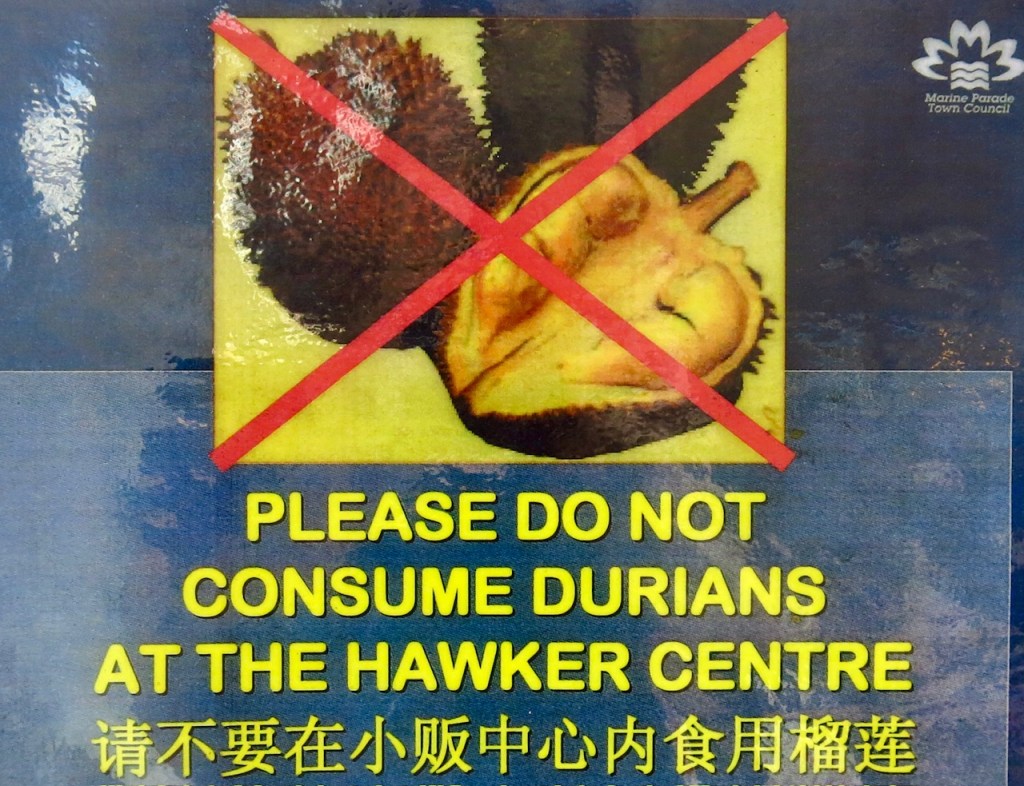
Side note: Durians! Below is a picture I took in Singapore, where they are banned for smelling bad.
A picture I took in Singapore where durians weren’t allowed in most (if not all) markets due to smells. Circa 2015.
The Day-to-Day Journal
Belawan-Deli — Brastagi - Indonesia

Mon. Jan. 31:

Off the ship at 9:00 a.m. in a 7-passenger car thru Medan and up 4800' to cool mountains.

Gorgeous scenery - thousands of coconut palms, dates, bananas, tobacco barns of palm thatch, tobacco fields protected by thatch sheds, tea plantations - the white flower resembles a syringe, paddy fields, coffee. Hair-pin turns, good driver.
Side note: These are likely some of the lovely lush locations she looky-looed. Imagine exploring those sights though while driving in a 1930s vehicle on 1938 roads. A seven-passenger car back then did not look very agile and probably didn’t have the best shocks absorbers.
It is the Chinese new year, fire crackers every where, many Chinese in Belawan, Medan, dressed in holiday clothes, horse back riding, riding in the curved-top pony carts, on the streets.

Thru the town of Brastagi with its market, pagoda, pony carts, trim lawns, to the Grand Hotel, Dutch, very plain exterior, set in rolling hills at the foot of a volcano (Sibajak), and looking off toward a Berkshire-like range in the distance.

Our "Dutch" lunch consisted of "omelet americanine", filet mignon and French fried potatoes. An "Am. Ex." round-the-world party here.

Cool in the mountains, beautiful drive down, steaming hot when we returned to the ship.

Learned that Princess Juliana had given birth to a girl.

Shag and I for a walk, then boat deck until 11.
Side note: 1938 was the year of the Tiger.
The new Dutch royal was Princess Beatrix, who went onto become queen, and who is still kicking. Due to the impending war, little Beatrix would soon flee the Netherlands with some of her family, and settle in Canada, where they were treated like royalty but purportedly were nice enough not to act like it.
Tue. Feb. 1:

In bed until 10 a.m. — cooler than being out on hot smelly deck.

Capt. took me to Medan at 11 — drive around the town, very fresh and clean looking. Sultan's palace and office, the bright colored Mosque, the public garden with enormous pink water lilies, the trellis with frangipani, bougainvillea, yellow hibiscus, two long-legged cranes. Saw betel nut trees (like date palms, with very slim straight trunks) Kapok - trees like telephone poles, sparse branches high on the top like 'T' with pods hanging like globules which contain the kapok.
Helen’s tiny rendering of a Kapok tree, sans globules, inline in her day–to-day travel journal
Lunch at Hotel De Boer. Excellent German beer, veal liver in paper thin slices — very good.

Blanc mange with orange sauce in honor of the House of Orange, stood up for the Dutch National Anthem, heard other Dutch airs. The public buildings decked with bunting, Dutch flags, orange streamers - the stork with crown and infant princess on the hotel top. Orange flowers on the tables, an orange streamer on the cloth.

Ate my first mangostein, round, tough shell, red inside shell, in center a small white section of fruit, very tasty, must be eaten fresh, cannot be shipped.

Shag and I on the jetty.
Side note: ‘…orange sauce in honor of the House of Orange…’ The word ‘orange’ appears five times in that paragraph above. I used to work for a Dutch company and everything was orange so none of this is surprising.
Shag and Helen on the jeeettttty! She has so much detail about everything else, even little drawings, but not about Shag and the jetty. We are left to wonder things.
[Present location:)

Lat. 2° 47' N; Long. 101° 02" E; Dist. 156 mi.; Av. Speed 14.18 mph.

Wed. Feb. 2:

Took on 1130 tons palm oil - orange color, unloaded rice. Cranes put a load on the quay, seven coolies lifted a bag on the shoulders of another who ran at a half-trot to the warehouse. Fine buildings on this wharf.

Away at 11:30 last night. Spent today topside writing letters. Visited Shag until 9:00, then up to see Capt. again. Washed my hair at 10:30.
Side note: Orange palm oil does track, but it is very much a coincidence that the palm oil of the region matches the favorite color of the Dutch. I’ve just found out that there was a Dutch royal named William of Orange and that is where the House of Orange name comes from. It does not come from the color. But William of Orange, of course, wore orange.
In a few years, the Japanese would invade, kick out the Dutch and their orange, and hold power until their surrender in 1945. The Dutch had been there since 1602.
Then Indonesia was born, free from colonials or occupiers, and they changed the color scheme to red and white, representing blood and courage. SIXTEEN OH TWO.
Additional side note: I just used a suggested AI assistant to analyze all the above text, and one of the tips is: – Review for repetitive phrases or themes, such as the frequent mention of orange.




 Flying Under the Radar