
The After-the-Trip Letter
In the Islands of the Dutch East Indies we stopped at many ports, unloading rice from Burma, picking up spices, tapioca flour, tea, kapok, rubber.

We drove inland at each stop as far as we had time to go.

There were mountains, volcanoes, miles of terraced rice fields, and an endless procession of coppery brown Malays going to market, carrying two baskets hung on a bar across the shoulders: pottery, sugar cane, durians, mangosteens, kapok pods...we couldn't carry the loads, but they've developed a peculiar jog to balance and distribute the weight, and as days pass it becomes hauntingly familiar to watch, until, for the visitor it becomes a part of the memory of the scene. Gay, colorful in face and dress, clean, cheerful, the Malays seem a happy people.
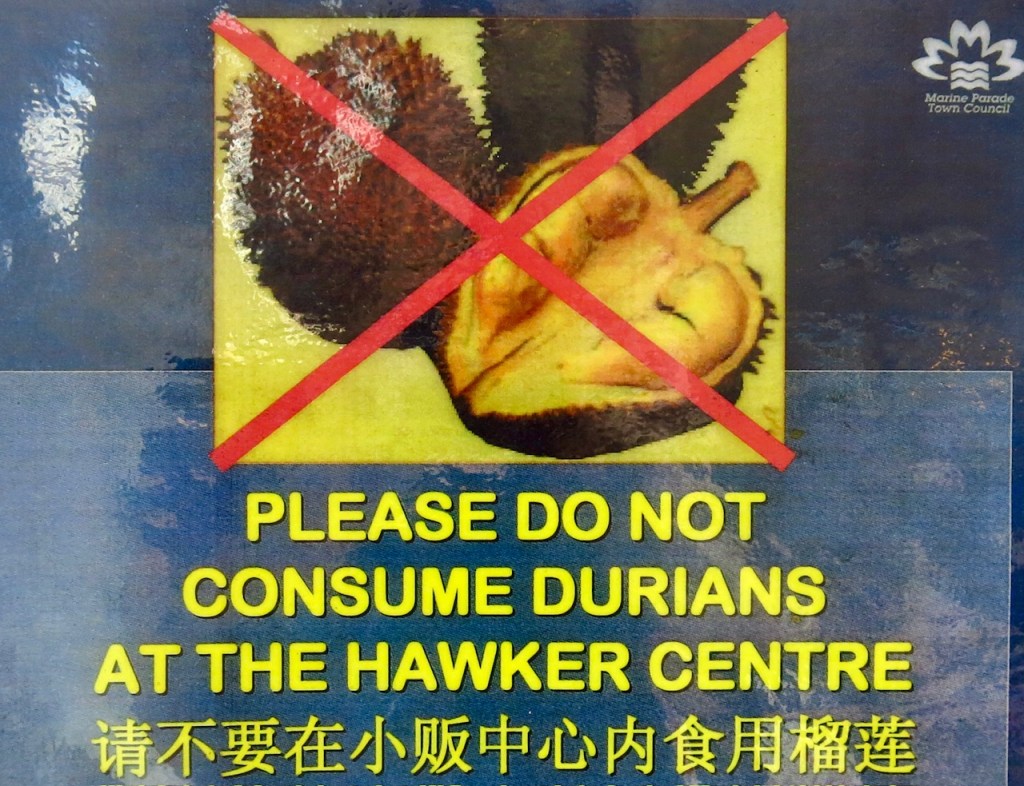
Side note: Durians! Below is a picture I took in Singapore, where they are banned for smelling bad.
The Day-to-Day Journal
Belawan-Deli — Brastagi - Indonesia

Mon. Jan. 31:

Off the ship at 9:00 a.m. in a 7-passenger car thru Medan and up 4800' to cool mountains.

Gorgeous scenery - thousands of coconut palms, dates, bananas, tobacco barns of palm thatch, tobacco fields protected by thatch sheds, tea plantations - the white flower resembles a syringe, paddy fields, coffee. Hair-pin turns, good driver.
Side note: These are likely some of the lovely lush locations she looky-looed. Imagine exploring those sights though while driving in a 1930s vehicle on 1938 roads. A seven-passenger car back then did not look very agile and probably didn’t have the best shocks absorbers.
It is the Chinese new year, fire crackers every where, many Chinese in Belawan, Medan, dressed in holiday clothes, horse back riding, riding in the curved-top pony carts, on the streets.

Thru the town of Brastagi with its market, pagoda, pony carts, trim lawns, to the Grand Hotel, Dutch, very plain exterior, set in rolling hills at the foot of a volcano (Sibajak), and looking off toward a Berkshire-like range in the distance.

Our "Dutch" lunch consisted of "omelet americanine", filet mignon and French fried potatoes. An "Am. Ex." round-the-world party here.

Cool in the mountains, beautiful drive down, steaming hot when we returned to the ship.

Learned that Princess Juliana had given birth to a girl.

Shag and I for a walk, then boat deck until 11.
Side note: 1938 was the year of the Tiger.
The new Dutch royal was Princess Beatrix, who went onto become queen, and who is still kicking. Due to the impending war, little Beatrix would soon flee the Netherlands with some of her family, and settle in Canada, where they were treated like royalty but purportedly were nice enough not to act like it.
Tue. Feb. 1:

In bed until 10 a.m. — cooler than being out on hot smelly deck.

Capt. took me to Medan at 11 — drive around the town, very fresh and clean looking. Sultan's palace and office, the bright colored Mosque, the public garden with enormous pink water lilies, the trellis with frangipani, bougainvillea, yellow hibiscus, two long-legged cranes. Saw betel nut trees (like date palms, with very slim straight trunks) Kapok - trees like telephone poles, sparse branches high on the top like 'T' with pods hanging like globules which contain the kapok.

Lunch at Hotel De Boer. Excellent German beer, veal liver in paper thin slices — very good.

Blanc mange with orange sauce in honor of the House of Orange, stood up for the Dutch National Anthem, heard other Dutch airs. The public buildings decked with bunting, Dutch flags, orange streamers - the stork with crown and infant princess on the hotel top. Orange flowers on the tables, an orange streamer on the cloth.

Ate my first mangostein, round, tough shell, red inside shell, in center a small white section of fruit, very tasty, must be eaten fresh, cannot be shipped.

Shag and I on the jetty.
Side note: ‘…orange sauce in honor of the House of Orange…’ The word ‘orange’ appears five times in that paragraph above. I used to work for a Dutch company and everything was orange so none of this is surprising.
Shag and Helen on the jeeettttty! She has so much detail about everything else, even little drawings, but not about Shag and the jetty. We are left to wonder things.
[Present location:)

Lat. 2° 47' N; Long. 101° 02" E; Dist. 156 mi.; Av. Speed 14.18 mph.

Wed. Feb. 2:

Took on 1130 tons palm oil - orange color, unloaded rice. Cranes put a load on the quay, seven coolies lifted a bag on the shoulders of another who ran at a half-trot to the warehouse. Fine buildings on this wharf.

Away at 11:30 last night. Spent today topside writing letters. Visited Shag until 9:00, then up to see Capt. again. Washed my hair at 10:30.
Side note: Orange palm oil does track, but it is very much a coincidence that the palm oil of the region matches the favorite color of the Dutch. I’ve just found out that there was a Dutch royal named William of Orange and that is where the House of Orange name comes from. It does not come from the color. But William of Orange, of course, wore orange.
In a few years, the Japanese would invade, kick out the Dutch and their orange, and hold power until their surrender in 1945. The Dutch had been there since 1602.
Then Indonesia was born, free from colonials or occupiers, and they changed the color scheme to red and white, representing blood and courage. SIXTEEN OH TWO.
Additional side note: I just used a suggested AI assistant to analyze all the above text, and one of the tips is: – Review for repetitive phrases or themes, such as the frequent mention of orange.
 Flying Under the Radar