By now I thought we’d already be to South Africa, if not further. But here we have just shoved away from The Big Easy’s decadent docks. There are just so many good bits to share.
From a distance, we are now steaming steadily ahead, eastward ho, on the three-week salt-water-y trek to Cape Town, South Africa. Shall we peek in?
The Letter
(As a refresher, we look at the passage from the nice and concise after-the-trip letter and then the corresponding bits from the day to day journal.)
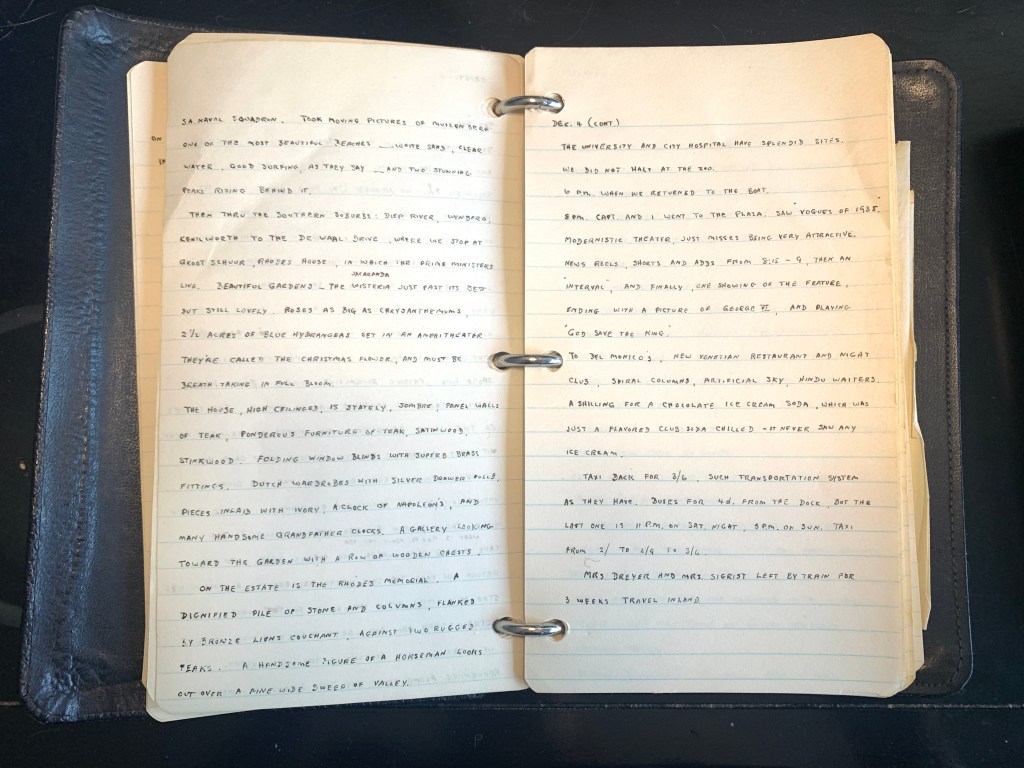
The passengers were left to themselves to get on as best they could. I chose to take part in the daily routine of the ship. During the 23 short days on the Atlantic I studied navigation with the Captain every morning, painted lifeboats with the apprentices, peered into the intricacies of the engine room, learned to send morse signals, sewed canvas with the quartermaster, made myself a sailors hammock and slept on deck under the southern stars.
End Scene!
Kinda like a movie trailer, right? Just giving the highlights. But then the lights go down, and we watch it all unfold, one morse signal at a time.
The Journal
Lights, camera, action!
[Present location:]

Lat. 26" 57' N
Long. 87° 52" N

Wed. Nov. 10:

8:30 — Breakfast — prunes.

Wander over to watch the apprentices work and get a job setting grommets in a piece of canvas that's to enclose the Captain's deck.
Side note: She did wait until after prunes to find the engineers and land a job, but this was her first morning at sea, so she certainly didn’t waste time.
The apprentices are the ‘clean, intelligent looking youths from Canada’ from the last post, mind you. We will get to know (at least one of) them plenty.
After lunch the Captain tells me he has discussed with the Mate my studying navigation — decided they'd experiment and see if an inexperienced person of normal intelligence can really learn how to steer a course in five months.
Side note: Normal intelligence. Pfft. Her two degrees from Columbia U would beg to differ! But maybe five months is a short amount to learn to navigate a freight boat? So if she could do it she was not just of normal intelligence, but extra?
Sadly, this was probably the only way she could learn ship navigation. Women weren’t navigating boats in 1937 (and barely even today). I looked this up, and a few women were ‘allowed’ to navigate when they got stuck at sea because the Captain became incapacitated or dead. And a few women disguised themselves as men and got to navigate… until they got found out. You may read more about it here.
But Helen got to learn while dressed as she pleased and while all the men on board were at full capacity. Good on you, men of the Silverwillow!
She was clearly meant to maneuver ships, as you can see:
M.S. Silverwillow, 1937, with its Captain and with Helen Skinner, learning to navigate with a sextant (this must be the Captain she went dancing with in NOLA??).
Listened to "One Man's Family" and the Chesterfield Program on the Capt.'s radio.
Side note: I love when she mentions movies, politics, radio. It puts a timestamp (era-stamp?) on things. One Man’s Family was a radio soap opera, that, like the soaps still do, ran forever (silly me didn’t know they had soap operas before TV!).
The ‘Chesterfield Program’ means ‘Chesterfield Time‘ radio variety show (named after their sponsor, Chesterfield cigarettes). And I’m listening now to Chesterfield Time, and I suggest you do too, as it is leg shaking, fast talking fun. Era-stamps are important.
And then note that she is listening to these programs ON THE CAPTAIN’S RADIO — I hadn’t caught that before. Nice mood music, too. Hm.
Weather: wind force 4.

Sun in a.m. It may just be the day, but there is almost no sensation of motion of the ship. The engines throb through your conscience, but unless you look at the water you can't be sure you're moving.

Inspection of after deck with Capt., the ship's potatoes are kept in a huge bin. News: Ramsay McDonald is dead. Brazil set up a dictatorship on the Nazi pattern.
Side note: a lovely thing about random journal entries is how they jump from topic to topic so effortlessly. From throbbing engines, to potato storage, to Nazis.
You can almost hear the staticky Walter Cronkite crackly type voice, more static, and then ***ATTENTION: We interrupt this programming with breaking news out of Her Majesty’s England. We have just learned that the former Prime Minister, Ramsay McDonald, has died. I repeat…***
Maybe they wouldn’t break in for Ramsay? But you can still hear the voice, can’t you?
And on November 10, 1937, Brazil’s Getúlio Vargas did indeed make for himself a new constitution and cancelled elections. Not good.
The bath procedure: Bucket of hot water, placed in rack in tub, sponge off or dump it in the tub. For a rinse fill the tub with sea water.
Side note: like I mentioned, a no frills trip.
Present location:

Lat. 22" 22' N
Long. 85° 04" W

Thru. Nov. 10

10 a.m. at the Captain's desk — I am set to work learning definitions for my first lesson in navigation. Study until 11:30.
Side note: For what she’s gonna be learning, this eighth grade level short on nautical navigation was way too much for my brain.
At dinner lettuce cooked with a fried onion and tomato sauce, artichokes.

Pacing the Capt.'s deck after dinner. Learned how the Dutch are displacing the English in South Africa, since all in govt jobs must be bilingual — Africans and English, and the English won't bother.

Capt. says I may follow the 'prentices — do what jobs I want, and he'll have them practice Morse code sending with me.
Side note: How about the Dutch and English just leave it all well enough alone??
And now the promising young men from Canada have been ordered to teach her whatever she wants, whenever she wants. And she wants to know everything.
Nov. 11 Foster taught me 4 knots: bowline on a bite, the knot used for handcuffs, hangman's noose, crown. Capt.'s wife expecting a second child momentarily.
Side note: The ‘prentices get right to work helping her do what she wants. And again, a married captain! Hm.
Notes from journal on ‘Capacity of Tanks’ and ‘Anchors’, perhaps taught to her by ‘prentices
Present location:

Lat. 20" 23' N
Long. 30° 11" W
Dist. 330 mi.
Av. Speed 13.95 mph

Fri. Nov. 12: I begin my pursuit of navigation this a.m., The Capt. explains the ecliptic and in a flash it is mine permanently.

After lunch — on the Engineers deck, had a try at Foster's hammock. It was a delightful sensation, mentioned it to the Capt. and he said, "why don't you make one?'. Within 5 min. the canvas was cut and ready. Service!

7:30 p.m. — "Not to be opened until Fri. Nov. 12" — so the box of candy Kay and Ann gave me made its debut in the Capt.'s room tonight.
Side note: The ecliptic is a navigational thing I just read about but don’t understand (not ‘in a flash mine’), so see the link from the beginning of this sentence.
And also, enter… the hammock! She mentioned it in the letter snippet above and here it is, happening, on day four.
Lastly, she is back in the Captain’s room, eating candy. Hm.
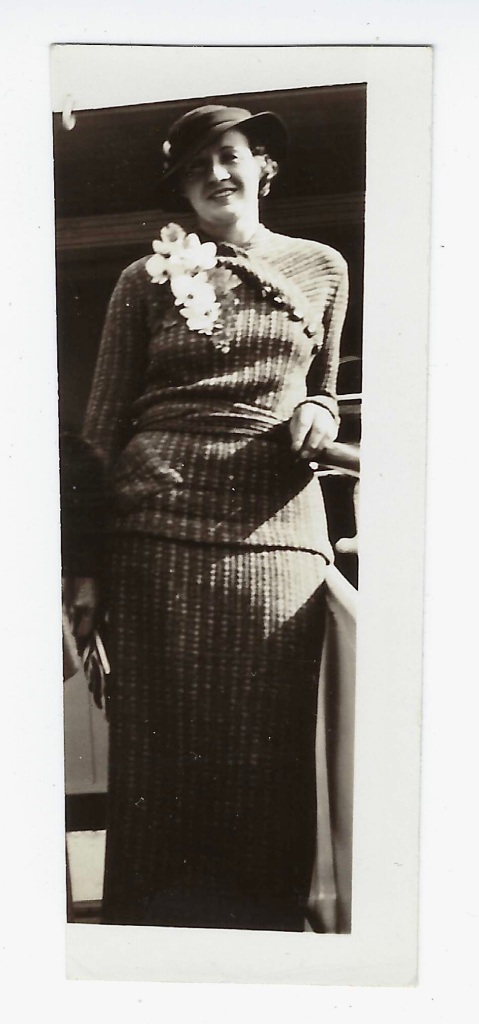
Helen (right) hanging out on the M.S. Silverwillow. (Yes, the woman on the left seems to be missing an arm, but I think that is a photo illusion, as Helen describes all the passengers, and with her level of detail, that would have come up).
Present location:

Lat. 18" 21' N
Long. 74° 48" W
Dist. 330 mi.
Av. Speed 13.96 mph

Sat. Nov. 13: Woke at 4:00 a.m. Up and had a look at the stars, they seem so much closer in these southern skies. Up again to see the sunrise and watch the boat come to life about 6 a.m.

In a haze off to starboard lies the mountain that looked like a cloud bank, but is Jamaica. Started figuring GMT, and am painfully dumb at it. Navassa Is. to starboard this a.m. and shortly after the beautiful slopes of Haiti loom up to port. Low banks of cumulus clouds give the effect of a volcano from the highest peak. Foster undertakes to give me some help in navigation, until tea time working problems.

4:15 — Worked on my hammock with one eye on the clouds. The last view of Haiti was a soft gray mist with purple shadows on the land as a peak shone thru here and there. This morning the water was sapphire, and the waves so smooth it seemed you could slide on the surface. At sunset: puffs of pink cloud all around the horizon, and the water almost motionless, a turquoise color with iridescent reflections.
End scene!
“This morning the water was sapphire, and the waves so smooth it seemed you could slide on the surface.” – Helen Skinner
And side note: if stars look close in a good way, I suspect her heart is full (she has her trifecta of machines, travel, and men). If the stars were close in a bad way, they’d feel claustrophobic, and that is gleaned nowhere in her writing.
I’m also sure she’s not dumb at GMT (Greenwich Mean Time). They are moving around the world, slowly, so the time is constantly changing. How, without Google, would anyone know the time!?
I am ending this one here, as I believe Haiti is the last bit of land she sees for about 20 days, and that seems a good place for an intermission.
Next up: latitudes, handwriting analysis, a tiny bit more land (oops), the backhouse trot, and engineer intrigue (not just the how of it, but some of the ‘who is this smart hot cute engineer’ of it?’). Stay tuned!!
While all the booze cruising and high flying was going on, Helen received a letter from her soon to be brother-in-law, Walter J. McLaren, a 31-year-old banker from Brooklyn (specifically, we think, Bedford Stuyvesant). Walt is about to marry Helen’s baby sister, Mary (my grandmother and namesake), who was 24 and had recently graduated from Skidmore College with a degree in Home Economics. Helen, like Walter, was 31.
Here are the best bits of the letter (with some commentary):
Dear Helen,

I received your letter to Mary today and write to accept my appointment as junior postmaster for the Skinners. Your handwriting on the envelope made me feel quite guilty so I hastened to make amends with my future sister-in-law by acknowledging with thanks your Christmas card and your welcome into the family.
Side note: Always good to start humble, with an ‘at your service’ vibe, all the while flattering (he offers to work for them and compliments her handwriting, which is, though tiny, impeccable).
It gave me a new thrill when I realized that in addition to having a lovely wife I am going to have a sister too. I have always wanted one and I look forward to really knowing you. Mary has told me a lot about you so that I feel that my new sister is not entirely a stranger but I must admit I stand in awe of your many accomplishments. I hope you will like me and feel entirely at ease and comfortable in our home. We hope to make it a place where you can breathe freely even though your breath should be scented with the enticing musty aroma of beer.
Side note: Her CV was quite remarkable already in 1935, so he’s correct to be in awe. ‘I hope you will like me…’ is about the cutest thing ever, considering they are peers. The home Walter and Mary would make was a cozy one in New Jersey, with their soon to be children — eventually three, including my mother. And if banking didn’t work out for Walt, based on that last sentence about beer, he coulda written copy for the ad business a la Don Draper.
If my writing isn’t legible or coherent, blame it on the pen which occasionally imagines itself a syringe and discharges its ink with a startling effect. Personally I think it’s ashamed of me and belches with embarrassment.
Side note: If he wrote ads for the pen industry, he coulda easily taken down a competitor.
Now that I have done the polite thing of introducing myself in somewhat stilted style, of making my apologies, of giving my thanks and explaining my eccentric manner of writing, I am free to devote the rest of this letter to my one subject, Mary.
Side note: SO CUTE!
As I think you realized I have been in the past no better than I should have been and posed as a professional cynic. I suppose that judged by strictly Presbyterian standards I am condemned to burn in the everlasting fires of Hell but instead it seems that I am to be warmed by happiness of a true perfect love. I shall always be grateful to Mary for teaching me a new way to view life and a promise of a beautiful future.
Side note: I’m not sure what that first part means. That he was on the wrong track until he met Mary? Not sure, but before seeing this letter, I’d only known my grandparents through pictures and tales of a quiet family home, with the three quiet children and a beloved cocker spaniel, CoCo. That Walt was so emotive about his bride-to-be is excellently sweet. ‘A true perfect love…’. It just makes me want to squeeze them all. And we don’t often squeeze.
I am writing to you of these things as I feel that you will want to know and I am sure that you will understand. I also realize that if the ravings of a love blinded boy bore you a perfect defense is open to you. I don’t usually warn my victims but I feel friendly toward you. I wish you could have seen Mary at Christmas you could then understand me. Mary radiates a halo of joy and love that causes people to look at her with a soft light in their eyes. Do you believe I love her?
Side note: I do! I do! He’s so gushy, but without hyperbole, I think. He just seems straight up smitten.
I do a great deal of thinking about what our life together is going to be. I want Mary to have a full life and her own life. I do not intend to imprison her with rules and restrictions and I am afraid that I shall resent outside interference with her choice of living. You no doubt can advise me about this point as my Mary is a poor diplomat I have found. That trait seems to be characteristic of the Scotch. I think I had better close this letter and reserve something for the future. I want to repeat my invitation to make our home your home and our garage your garage.  With hope for a genuine understanding, I am.

Your brother,

Walter
Walter McLaren (Helen’s soon to be brother-in-law) introduces himself in a doting letter, 1935
Too sweet. And bitter sweet. From what I know, they lived a happy life, raising the three children in Essex Fells, New Jersey. Walter was the Vice President of a local bank. Mary was a homemaker. I unfortunately never met her, as she passed away of heart disease at a far too young 58, and I had yet to come along. I was however named after her, including her middle name, Elizabeth). Walter I met once, if you call an adult meeting a two year old ‘meeting’. Evidence below.
What’s been told of them is that they — like the rest of us — were not timid or shy necessarily, but words were not wasted. But then in the Booze Cruise post, Helen is a social butterfly and this letter, my grandfather is being silly and emotive. So everything is topsy turvy. But in the best ways. We all have our moments.
I’m getting off track, as this is not about Helen, but you will see soon how I circle back.
Some visuals of Mary and Walter and fam to go along with all this:
The first picture, of the child in the white hat, fancy coat, and boots, is Walter. Hehe.
Then they grow up, meet, have kiddos, and then, in one of my favorite photos of all time, likely taken in the 1950s, they appear to be opening presents on Christmas morning (they look so perfectly disheveled in such a 1950s way).
Though I don’t have pictures of Helen and Mary together aside from when they were children, I found this from a letter Helen wrote in the 1980s about their relationship:
"Mary and I scarcely knew each other when we were growing up. I was away at school, or away teaching (U of Cincinnati, U of Kentucky, Smith College, U of Minnesota, Purdue, Gulf Park College (a junior college in Gulfport Miss). But from 1946 we saw each other more often. She and Walter came to Vanc and we went east and we became devoted to each other. She and Walter were very active in community affairs and were much revered and admired. In 1961 M had an open heart operation and she felt after that she was living on borrowed time. But she had eight good years after that and never stopped her activities."
Helen would outlive her baby sister by over 30 years.
III Olympics
And now a few final items I found from her teaching era, before we set sail around the world. I have framed on my wall two tickets to the 1932 Winter Olympics, in Lake Placid, New York. These were the III Olympic Winter Games, and they were the first Olympics held in the United States. The competing countries, not surprisingly, were mostly in North America and Europe. In attendance there were 17 nations, with a total of 252 athletes (21 of them women). Curling was played even! How very Upper North American.
Though the world was still suffering from a global depression, attendance was low and the games were almost cancelled, the show went on.
The top ticket (at double the price of the second one) was likely for the closing ceremonies. How fun.
Helen studied, lived, and loved athletics and I hope she enjoyed the games as much, if not more, than the did the Jai Alai game she attended in Havana a few years later.
Barometer Reader
Another item in my possession is a cool looking barometer. It resides next to our front door, and is always set as it appears below: Rain with a chance of Changeable. The mechanics inside the thing do not move on their own, but I haven’t fiddled with it to know if they might (not that me fiddling with it would help, but perhaps one of the many engineers in the family could help — and if they’re reading this then the pressure is on!).
There are two ‘hands’ to the barometer. The gold one moves around manually via the knob in the middle. The blue one is controlled internally (or would be if it worked). And what I probably once learned but had forgotten is that barometers measure atmospheric pressure, and that’s what they were used for in aviation. The webs explain it better than I can.
The little blue plane on top seems an add on. The back is engraved: Helen Skinner, Gulf Park A.A., 1933. Perhaps this was a gift after she got her pilot’s license.
May your days be forever Fair, my friends!
A Long Goodbye
The card below reads: “Dear Miss Skinner, may every hour of your trip give you joy and the fulfillment of your most roseate dreams. You deserve every cherished blessing and every supreme happiness. All of us here at Gulf Park love, admire and appreciate you. Sincerely, Elizabeth Maddox Cox.”
Roseate is a word I either forgot (most likely) or never knew. But it is my new favorite word. A nice sentiment, but Helen would certainly not need roseate colored glasses where she was going.
The note above isn’t dated, but we will be assuming that it was written from Gulf Park College to Helen before she left on her freight boat trip around the world. It would mean she was taking time off from teaching, as the trip would last five months. I am not sure if she resigned her position at the school before she left, but if she didn’t, she would right after she returned. The trip truly turned her life on its head, because afterwards, she’d never lived in the U.S. again.
So now, for reals, we’re gonna start the next chapter. Leave your roseate colored glasses behind!
In the last post, we established that Helen was way more foot loose and fancy free than her outward persona would indicate. My husband commented about the cruise post and how strange it must have been, in 1934, to meet a single, 31 year-old woman, traveling alone, who flew planes, wants to know all about boat engines and navigation, knows all about sports, has an M.A. from Columbia, is wearing slacks, and may or my not be perched on a railing of a freight boat, highball in hand — not to mention she is funny, flirty, and one sweet patootie to boot (that meant pretty back then, and I say that it is true, objectively, as an impartial Great Niece). Here she is:
Helen Skinner, circa 1934, Gulf Port College, looking good and hiding her cray cray side
Below are some additional flight artifacts from the 1930s.
Beep Beep, Aviatrix on Board!
I swear I posted this one already, but now I can’t find it. Helen taught Physical Education in summers at Purdue University in Indiana, and luckily they had an airfield (perhaps that is why she taught there Amelia Earhart also taught at Purdue at the same time, but it seems not in the summers. Helen logged many air hours there and got a nice shout out and photo in the Lafayette Journal.
High flying Helen, featured in the Lafayette Journal (which still exists)
Note it says she was the FIRST WOMAN on the Purdue faculty to fly solo from the airfield. And that she is popular (among the male flyers, heh). The Capt L.I. Aretz, who is mentioned in the snippet, has lots of press with Earhart. Not that it’s a competition or anything, but still, Helen was first to fly solo from their airfield and not anyone else.
DearSir Madam:
The below letter is fun if you look closely. Do that. You’ll see it is a template. There is preprinted text with salutations and addresses and such (the preprinted text is darker — look at the numbers after ‘license No.” for instance). Then look at the salutation and see the XXX typed over the word ‘Sir’ and ‘Madam’ is typed in after it. The 1930s was an era of Sirs doing official things that needed letterhead. So it made sense then that Sir was built into the template. But not for long! Here comes Madam Helen, swooping in after a perfect wing over! The letter uses both Miss and Madam, as seems appropriate for the time, since Ms. wasn’t around just yet.
(I just looked up the Mr./Mrs./Ms./Miss. history and it is a hoot. Google about it AFTER you are done with this post.)
Letter containing Helen’s Pilot License and ID, from the Department of Commerce, 1936
Now I am looking up details about the letter:
J. Carroll Cone, who penned it, or at least dictated it, was a bigwig in aviation and became an assistant director for the Air Commerce Bureau under FDR and others. Robert R. Reining was Chief of the Bureau of Air Commerce Registration. He’s named several times in a journal article from the The International Group for Historic Aircraft Recovery alongside picture of Amelia Earhart.
The enclosed license and ID are shown back in this post.
The address the letter was sent to in Arlington, New Jersey, was not Helen’s, but her parents, as Helen was a bit nomadic, especially in the summers, and this was August.
Ninety-Nine’s
The next artifact is the card in the image below. The Ninety Nine’s are female pilots, named after the number of charter members who first were licensed. Helen was not part of that original group and I can’t find the membership history outside of the charter members, but for what it’s worth, the group was started in 1929 and Helen got her license in 1934. I have in my possession one Ninety Nine’s membership club, good from September 1936 to September 1937:
Membership Card for the Ninety-Nine’s, Sept 1936 – Sept 1937
That is business card sized and would have been tricky to roll into a typewriter, but whomever typed it was skilled. Dorothy George, who signed it, is mentioned in this newsletter about the Ninety-Nine’s from 1938, which is all festive for Thanksgiving.
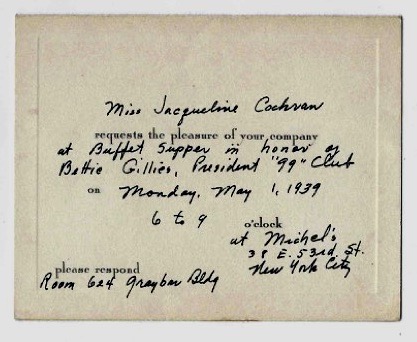
Then in 1939, Helen received an invite from a Miss Jacqueline Cochran (who at the time was busy setting airspeed records — I suspect she might not have actually penned the invite) — to a buffet in honor of Bettie Gillies (this is when Bettie became president of the club, when she was a wee 31 years old). I don’t know if Helen attended the event, because by that point her life had taken a loopdeloop and she was living in Western Canada, was married, and fiddling with motorcycles and cars.
The invite mentions the Graybar Building. That is still there and very art deco looking. And Michel’s on 53rd Street was fancy and formal looking.
A room full of female pilots in the 1930s musta been something to behold.
I keep finding more things! Like a personalized barometer, tickets to the 1932 Olympics, and a syrupy letter from Helen’s soon to be brother-in-law (my grandfather, who I have been told was not a bit syrupy). But those will wait until the next post, as I don’t want to extend the title of this one more. Until soon!
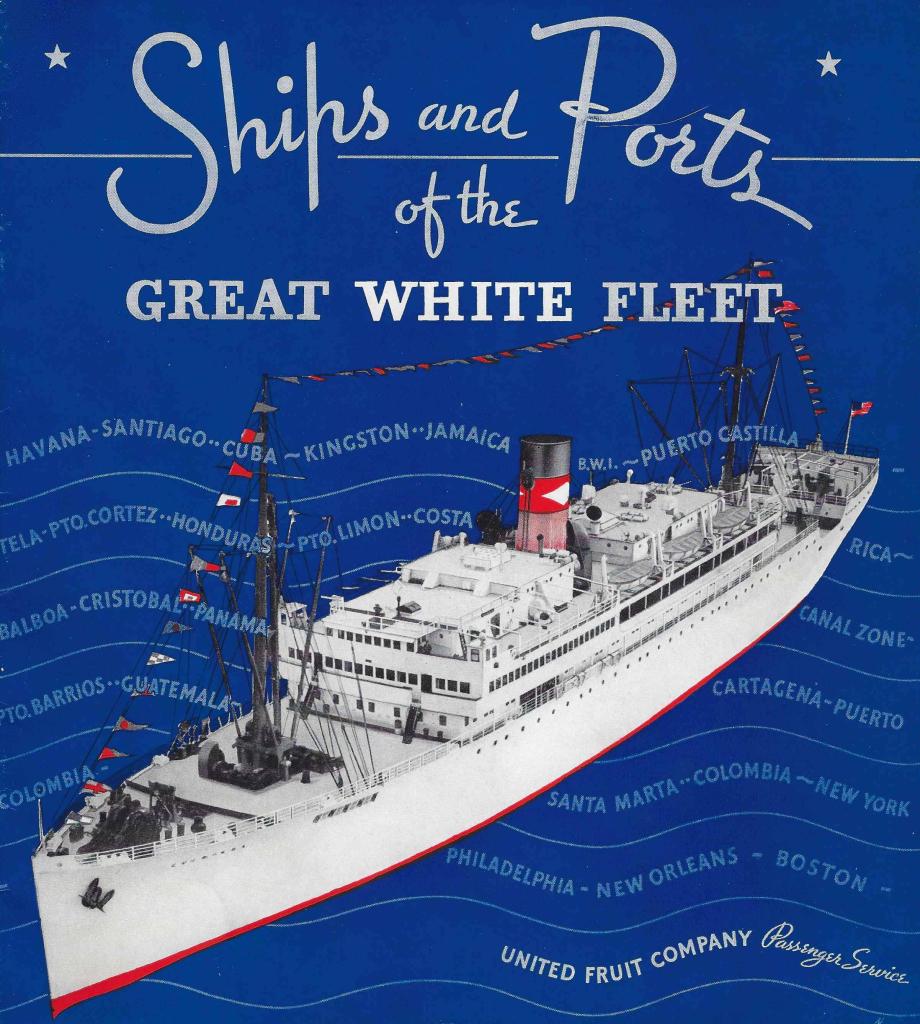
In December 1934, Helen travelled, most likely from Gulf Port, MI, to New Orleans, LA, to board the S.S. Sixaloa, a Great White Fleet vessel that was part of United Fruit Company (now known as Chiquita). Like with her subsequent boat travel, this ship’s primary purpose was freight. But unlike the next one she’d take, this one had a pretty swank passenger service. The picture below is the cover from a brochure (acquired from eBay) advertising the trip, one that speaks of smoking rooms, grand pianos, sound movies, and gay soirees. And also quoits (a ‘throw a ring over a stick’ game).
United Fruit Company, Passenger Service brochure for a trip Helen took in 1934.
Though prohibition had only ended a mere few months before her trip, she comes across quite comfortable with the booze. Not that she imbibed a lot, just that it seems like she was perfectly at home schmoozing, perched on the railing of a freight liner, in slacks, surrounded by men, at sunset in the Caribbean Sea, highball in hand.
Let us travel with her, from her first impressions, to her port adventures, to post-coup presidential drive bys, to courtships (more than one even!), to highballs.
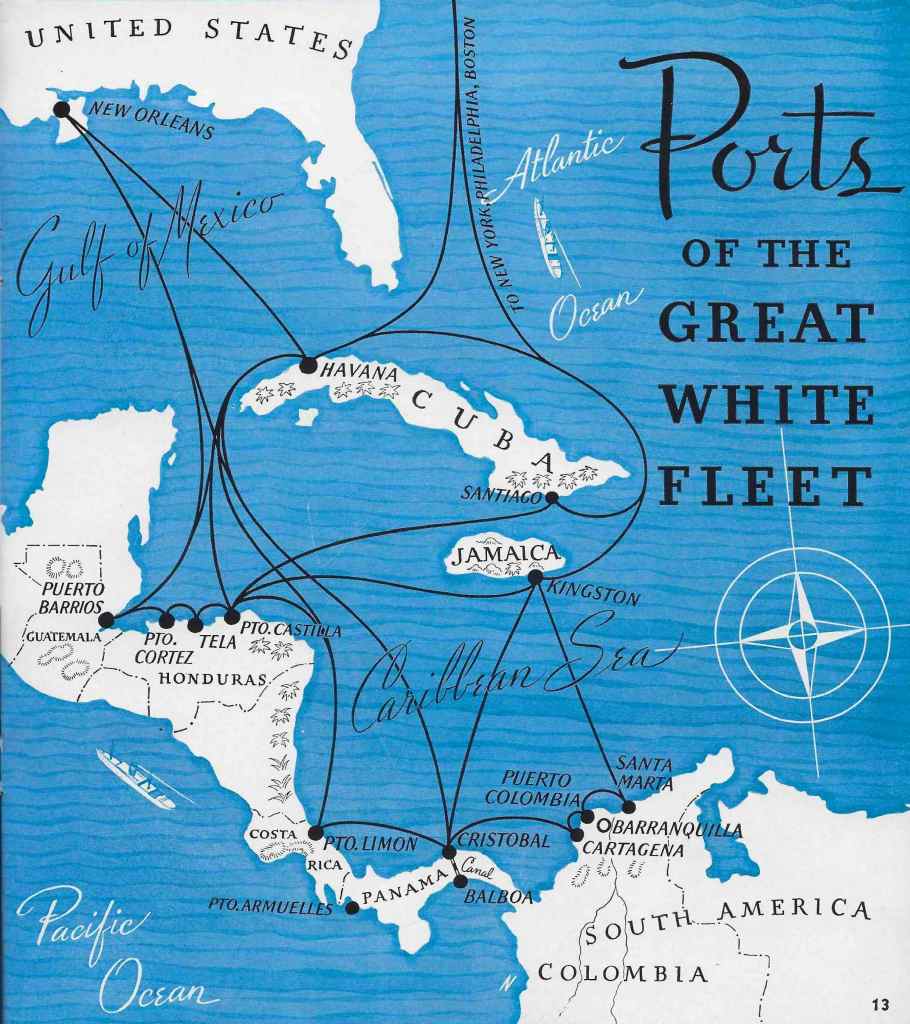
The illustration below, also from the brochure, shows her route.
Cruise Route, Great White Fleet, United Fruit Company, 1934
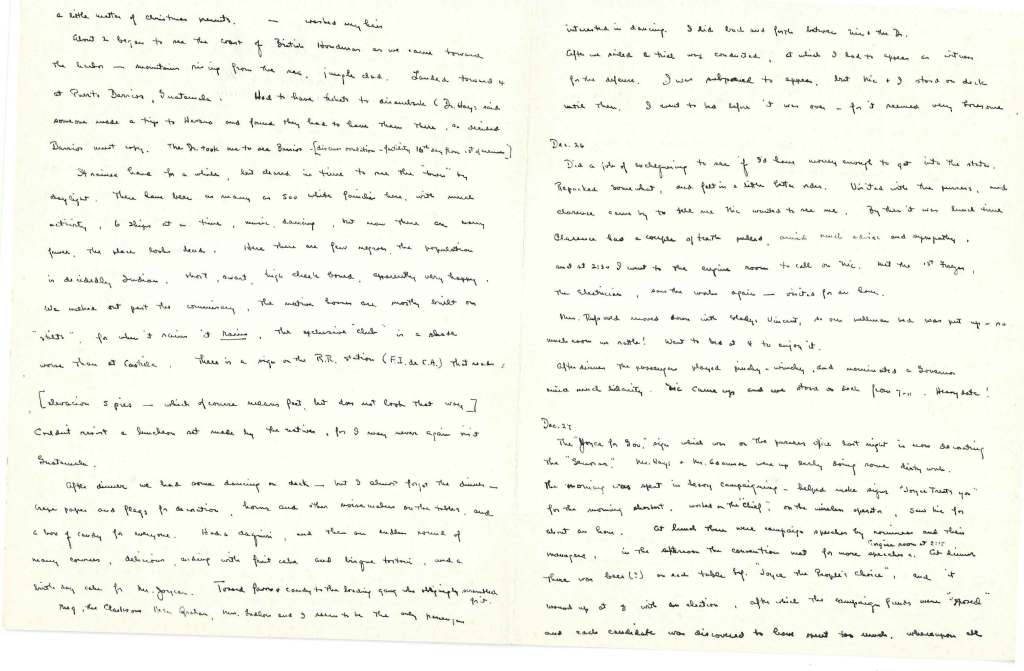
I should state that her notes about this trip are written in a tiny smushed cursive. All of her writing is tiny, but with most of it, if you scan it and blow it up big, you find the letters are fully formed. But with this, blowing it up helps some but not completely, so certain aspects of things will remain a smushed mystery, perhaps as they should be. Please see Exhibit A below. Also, there are several people named in her notes, but most aren’t really given much depth. Names can for the most part be ignored, except for Dr. and Nic.
Exhibit A: Helen’s ‘Cruise Log’ from 1934, on 7 x 5.5″ paper (a little taller and wider than a cell phone)
On December 15, 1934, the S.S. Sixaloa, “…slid away from the mooring at 11:15, in a shower of streamer confetti.”
Her first impression is that she is pleased her cabin has “…enough room to turn around.” Judging from my one boat travel experience, that is indeed a luxury.
She also mentions corsages several times on the opening page, and even the next morning, after they slid away, she says she is still wearing two of them. See photo evidence below.
Helen Skinner, 1934, aboard the S.S. Sixaloa, wearing two corsages
Boxed text is directly from her Cruise Log, and side notes are by moi.
Dec 16: The luxury of it. Chimes sound, but I need not pay attention to them. Had bath in warm salt water with pine scented soap, then breakfast in bed. Visited the Dr., who's been on a cruise with Mr. Cox.
Side note: Chimes to her are probably school bells, but her only jobs now are self-assigned. Also, the last part, about the Dr., is important, but not the part about Mr. Cox. Stay tuned.
_____
As they floated into Havana Harbor, someone handed her a “Pina Fria” cocktail (a pineapple and rum concoction). They cruised past Morro Castle and anchored at the Santa Clara dock.
We wandered off toward town, pursued by beggar children. Stop at Columbus Cathedral, started by the jesuits, and where Columbus remains buried. Past the President’s Palace to the Capitola. A vastly imposing structure, ceilings hand painted, the library paneled to the ceiling with mahogany. The senate chamber empty -- for congress has fled.
Side note: I don’t know if ‘for congress has fled’ meant they went home for the day or they actually fled. There had been a coup several months prior, and maybe congress wasn’t a priority to the new guy.
Side note: I hope she smoked the cigar (if she wanted to, that is). Also, Mendieta was installed that year as an interim president after said coup. He had been at it for 11 months at this time, and was still doing the slow wave drive by. This would make him far too busy to put together a new congress.
To the beer garden with tropical foliage around the brewery. Free beer for all and dancing, Havana has acquired a taste for beer, it is 5 cents a glass. Impression: a beautiful city, fascinating for its Spanish architecture, clean, a New Orleans polished and bright, exquisite patios even in the poorest districts, magnificent boulevards. The palm lined streets are royal indeed. Hundreds of touring-car taxis, skittering through narrow streets, with sidewalks wide enough for one person. A polyglot population, all shades, and the fewest possible Americans.
Side note: Prohibition had been over for half a year or so, so I doubt there were many beer gardens in the U.S. at this time, so this must have been a new kind of experience. And despite their possible lack of congress and political turmoil, Havana was super vibrant at this time, and would be for a few more decades (at least on the surface).
After dinner, very tired. To Jai Alai game. The guide explained the game, bot* a ball and basket for us to see. The court is 210' long x 50' wide. Saw an elimination 6 point game and a doubles match for 30 points. It is even more fascinating that I anticipated their form, coordination, strength, skill were a joy to watch - and the spectators - cubans who come night after night to bet. And the red beret-ed [word I can't read] were a spectacle to behold. We had to tear ourselves away at 9:20, feeling high and such not the least tired, feeling exhilaration from watching a game! The car was stopped twice en route - seems seven drivers had been discovered carrying dynamite today. Another "Pina Fria" and then back to the boat, sailing at 10. The harbor was glorious at night. Had a daiquiri to celebrate the day, turned in.
*Bot means bought
Side note: Remember she is a Director of Physical Education at this time, so very into athletics. Also, she uses exclamation points extremely sparingly, so she truly enjoyed the game. A little dynamite seems like nothing after the excitement of the day.
Dec 18 - Put on slacks, paced the deck, chatted the Capt, the Dr., the Steward, sat on the rail of A. deck in the sun. Dr. operated on my face. Goggle-eyes treated me to a glass of beer in the evening. Up until 1:30. Date with the chief to go below tomorrow.
Side note: At the time, women wore pants at home, at the beach, and for sport. And perhaps on cruises as well, unless she was trailblazing. She seems to be getting into schmooze mode now, balancing on railings in her slacks surrounded by several non-civilian men (captains, doctors, engineers).
I’m not sure if Goggle-eyes is a term of endearment. The Dr seems to be giving her skin treatment here as well. The true proof of the schmooze is the last sentence above. She does this on the next cruise as well… she talks the ‘chief’ into letting her tour the underbelly of the ship to document what makes it tic.
Dec 19 - Went to inspect the engine room. Triple drive engine, every revolution of drive shaft advances boat 20 ft. Oil burning, use 24 tons a day southbound, 30 tons northbound (on account of the refrigerating machinery). Temp 130 in furnace room. Saw the storage rooms for food, engineering quarters. Met the captain and invited myself to the bridge. Showed me the chart of our location and course. Sam at the wheel. Next inspected the wireless room. I think I have been in every cranny but the galley.
Side note: As confirmed in her next boat trip, her happy place includes flirting, travel, and machinery. This boat had all three.
Dec 20 - The first real seas we’ve had, I would chose this time to fall off the roof, with cramps. To the Dr after and an arsenic cocktail, otherwise ammonia spirits and Midol. Did nothing all day and the dose worked."
Side note: ‘Falling off the roof’ means menstruating! So it’s not like she was on a roof and got a cramp and fell off, but she got ladytime cramps. I like how Midol was already being used for these symptoms, but she’s still given booze (arsenic cocktail has absinthe). Ammonia spirits are smelling salts, used at the time to prevent fainting.
Dec 21 - Wakened at 4:45 as we enter the breakwater. First night of Panama by bright moonlight. Shortly after we docked, a good looking Lt came up the gangway, tipped his hat to me ‘Is this Miss Skinner?’ “I am Lt Burnett, aide of General Lytle Brown, Commander of Fort DeLeayer [?]. The general asks me to say that he has gone on an inspection trip this AM, that he had just received a cable asking him the average transportation across the canal. Of course women are not allowed to fly in army planes, but I am at your service, is there anything I can do?
Side note: A gangway, a good looking lieutenant, and a hat tip. Very cinematic no? News that she flew planes must have traveled, but a woman can’t even fly IN an army plane. Hmm.
The airways agent came on board and 5 of us made arrangements to fly both ways. Was driven to the general’s car, which was parked on the dock (forbidden to other cars). Drove us around Cristobal, Colon, New Cristobal, and put us on the plane. Transcontinental Seaplane flight. 1650 run, 1500 ft, 90 mile speed. It gave a perfect idea of the canal and surrounding territory -- the Atlantic and Pacific sides. Saw many boats going through in no time we were landing at Balboa.
Side note: It must be something to be greeted (in a nice way) by the local military, driven around in an official car (that can park wherever it wants), and to fly over the Panama Canal in a little seaplane. She must have done some good schmoozing with someone on board.
Drove to Old Panama, en route saw banyan trees, papayas, sensitive plant. Then it rained, a tropical shower. Dashed back to the car, drenched, and slithered back to town. Went to outdoor market. Spent all my money. There are Hindus, Chinese, Panamanians.

Then to Atlantic Cafe. Had rum, guava, and lime. Addictive drink. And then Atlas beer. Danced some to the Panamanian orchestra. The floor show was terrible, 3rd rate vaudeville, but the audience was interesting and I hated to sail away at midnight. The moon was full and gloriously bright. We bounced up and down and hither and thither all night. They drive on the left hand side in Panama.
Side note: Embedded in the paragraph above was a hard to read bit about a man who was a friend of a friend of a shipmate, a Reserve Officer who was an attractive blonde. I assume she got her flirting in with him (meaning likely talking about engines). Atlas beer still exists.
Dec 22 - I’ve never felt more exhilarated than I did today, simply loved the rolling. Land on the port bow, and shortly after noon we came close to the shore to see tremendous green headers washing over the point of land outside Bocas de Toro. The headland covered with tropical foliage, tropic huts on the shore. At ‘Mouth of the Bull’ we took on a native gang, went on up to Almirante. There we stayed for eight hours, taking on a load. 150 men in the loading gang. Took on 4000 stems of bananas, and 2500 bags (152 1/2 lb each) of cocoa beans. There are 23,000 acres under cultivation. Beans are shelled, let to ferment, then dried and shipped in bags. The crop is ten million pounds a year. Cost to raise and ship $.26. Watched the loading process. The stem is taken from the car, lifted to the shoulder of a laborer. One with a machete cuts all the ends of the stem, another picks up any banana that is not up to the grade of the rest of the stem. Moved on the belt and each stem counted as it drops into the hold. The dock is in a coconut grove. They opened up green ones and let us drink the milk. Not so good. There is just a small town with a commissary, and a bunch of native shacks. The language is English, spoken beautifully, for many of the natives are from Jamaica. 15 nationalities in the crew. The Dr. very attractive, watched the unloading at Bocas, stood on the promenade deck to see the moon up over the rigging, the surf, the salt air were unforgettable.
Side note: Her actual description of cargo was like three times longer than the above. But more importantly, it appears the sea has wooed her. And so has the allure of all mechanisms of global freight — from the physics of a boat, to the cargo loads, to the (sometimes handsome) people who make it chug along. With whom is she watching all this loading and unloading?? Drumroll… the Dr.!!
Dec 23 - To the writing room after breakfast to catch up on the log, but the Dr. up and camped, and almost immediately it was lunch time. Up on the bridge deck for a couple of hours in the sun and found the hurricane deck the greatest spot yet. Keno games in the evening. 30 cents was enough to lose, and it was hot on the port side, so I went around to the starboard, the Dr. followed, and we chewed a few rugs.
Side note: I thought ‘chewed a few rugs’ meant talking, as it would seem in this context, but Google gave me answers ranging from Hitler’s fury to dogs-in-a-time-out, but ChatGTP tells me, it might have been energetic dancing. So she (maybe) shakes it with the Dr on the starboard side.
Dec 24 - Much agitation about a Christmas Party. The great organizer, Mr Hayes, appointed committees galore. I was on the entertainment comm. Ladies shuffleboard tournament. First time I’ve played this trip and my score was 0. Dressed for dinner in outlandish costumes - I was a man in a short throw, long shoes, a straw hat. About 8:30 we docked at Castilla, Honduras. Santa Claus (Mr Hayes) gave out presents around the tree in the drawing saloon, there was hilarity galore, and each member of the crew was given a present, too (87 of them).
Side note: I love picturing this scene, each passenger scurrying around with a role making a party happen. A ship, silly costumes, noisemakers, shuffleboard.
It was announced that a dance was being held at the club, and that cars would take us over. We dressed in more mature looking outfits and set forth. The ‘club’ is a barny looking place, two huge rooms for dancing, pool, and a bar. Several people made it a party. Teddy had brought a quart of Bacardi. The music was over the loudspeaker, the records were recent, and Nic an excellent dancer, and just the right light. We had a grand time. One of the girls who was dancing sent word to tell me that she recognized me as her PE teach, and sure enough, a Davis was at SPC two years ago is married to a man named Cliff who works for the Fruit. She looked stunning as usual, says she loves it, life is just one cocktail party after another (and I imagine it is). So left before twelve, walked back along the waterfront under the coconut trees and a tropic mood - and Christmas Eve - wee! Nic came back on deck after he put on his working clothes, and we chatted until his watch came up, when we all discoursed until after 2. It was a 3 when the last elevator stopped and more than half an hour until we set sail. The lights of Truxillo [sp?] across the bay will always remain mysterious, for we came and sailed again in the night.
Side note: Regarding dancing… she doesn’t elaborate, but notes on her timeline show that she attended dance seminars and conferences over the years. So she knew how to cut a rug. And then this engineer, Nic, the wonderful dancer, starts showing up more in her notes. But what about the Dr.!?
Dec 25 - Christmas on the Caribbean. Slept late. Did a little letter writing. Cigarette day. After lunch the Dr came by cabin. The Chief Engineer came to visit. About 2 began to see the coast of British Honduras as we came toward the harbor - mountain rising from the sea, jungle clad. Landed toward four at Puerto Barrios, Guatemala. The Dr. took me to see Barrios [discuss ovulation - fertility 16th day from 1st of menses]. We walked out past the commissary, the native houses are mostly built on ‘stilts’ for when it rains it rains. After dinner we had some dancing on the deck - but I almost forgot the dinner - horns and other noisemakers on the tables, and a box of candy for everyone. Had a daiquiri and then ate endless round of many courses, delicious, ending with fruit cake and bisque tortoise.
Side note: She does not specify which cabin the Dr. came to visit, but I’m assuming it is hers. A check up? A flirt session? But then the Chief Engineer comes to visit as well (this must be Nic). So popular! And then to town with the Dr, where they discuss ovulation. Then more dancing, taking turns with both Nic and the Dr (this part is scribbly, but I’m pretty sure that is what is said). Then, not included above, there are some disjointed notes about a criminal trial on the boat, where she was supposed to be a witness for the defense. She says, “I was subpoenaed to appear, but Nic & I stood on deck.” Some weird role playing shenanigans among the passengers?
Dec 26 - Repacked somewhat, and felt in a little better order. Word came Nic wanted to see me. At 2:30 I went to the engine room to call on Nic. Visited for an hour. After dinner the passengers played a game and nominated a Governor amid much hilarity. Nic cam up and we stood on deck from 7-11. Heavy date!
Side note: More role playing onboard. Four hours is a long time to stand on a deck, no? And ‘heavy date’. Hm.
Dec 27 - On the wireless operator. Saw Nic for about an hour.
Side note: The game they played on the 26th seems to be spilling into events of subsequent days. This ‘Governor’ went on to have a full on campaign, involving treating the passengers sorbet. Then there was a speaker series or something and a finance scandal. I can’t read half of it, but it is going on while Helen is being courted by Nic and/or the Dr.
Someone was then thrown out of the election while Helen was visiting Nic in the bowels of the boat, in the wee hours.
Dec 28 - They woke us at 6 as we came into Havana Harbor, it took ages to get into the dock. Went then El Canto the Department Store. Bot liquor, went to the Bacardi plant and had daiquiris in the bar upstairs. To French Brothers. To Jigg's cabaret. Good orchestra, native and U.S. music, we danced and danced and he is good at that. Had to come start the engines at midnights, and we left shortly after 12. Watched an exquisite moon as we slid out past the Morro Castle.
Side note: That they had to go start the boat indicates that she was with Nic the Engineer, and they had to run back to the boat at midnight. Does Dr. know??
Dec 29 - Sunbathe. Saw many porpoises. Meeting of a committee to form an Alumni Association of the cruise. Had some rum with Doly (sp?) but he gives me a pain. Nic came up, but the Capt was on a tear, so he went down early.
Side note: More Nic, and he seems to even get in trouble.
Dec 30 - Glorious bright morning, but the officers are back in their blues. Sunbathed a couple of hours. Nic cam up at 11:30. He showed me a picture of wife and two children. Visited the doctor before and after lunch. About 3:30 we ran into fog. Blowing of horns. Dropped anchor. We were fog bound. A bell rung every 30 sec and a foghorn did likewise. Good food and noise makers. Clarence furnished cocktails.
Side note: Nic is married!! And now the Dr is back. Twiiist.
Dec 31 - 1 a.m., still at anchor. Fog horns blowing. "At anchor" bells ringing and they rang until after 7 a.m. Cleared as we went up the river - but dull life lorn scenery. Chatted the Chief on river currents, politics and religion. He's a dear. Visited with Nic an hour - to see the Dr, and after lunch finished packing. Quarantine at 3:30, the Dr. boarded, counted noses. Adieu to Nic. According to instructions, stood on the gangplank until we docked and the luggage got off. I dressed for the party which had been in full swing since dinner. Had several glasses of champagne and walked on the beach. The firecrackers went off, the bells rang, and 1934 was gone.
The end
But wait! So many questions unanswered!! And no hope for a sequel. Did she say goodbye to the Dr? What happened on thae ‘heavy date’ with Nic the Engineer?? There’s truly no way to know. So we can only absorb what we have, and that is that she visited dynamic ports, breathed in salty sunsets, chewed a few rugs, soared in a seaplane, flirted unabashedly, bot cigars, drove in military escorts, drank tropical cocktails, and more…. and it all likely influenced her future, as she’d do this again in a few short years. And the next engineer wouldn’t be married.
I was wrapping up the ‘The Early Years’ section, with Helen exiting the U.S. for the first time in the early 1930s to voyage around Central America, but then two things happened. One Google thing, and the other a weekend upstate where Helen was born and spent summers.
Posture Parades
While Googling schools where Helen taught, I found a write up by her in a yearbook online. It declares, “Miss Helen Skinner, Director of Physical Education, Gulf Port College, Gulfport, writes, ‘Sailing, canoeing, surfboard riding, boat trips to Ship Island for swims in the surf, bicycle trips, long walks on the sea wall, picnics on the beach, moonlight horseback rides — these are some of the activities that make the Athletic Association at Gulf Park one of the most popular and important organizations on the campus. We are proud of our 100 per cent attendance…at our third Annual All-School Play Day…competition was keen and colorful in tennis, golf driving, ping-pong, deck tennis, horseshoe pitching, posture parade.’*
*Posture parade!
The below looks like she is dressed for one of those moonlight horseback rides, no?
Helen Skinner, 1936, Gulf Port College, Mississippi
A Field Trip, a Binder Full of Family, & the 13 Colonies
Charlton, New York, where Helen spent summers, have an historical society. I messaged them on Facebook. They wrote back, saying they would look into the names I mentioned.
I wrote again about a month later when I was planning a trip, asking if I could say hi. Unbeknownst to me, they had been digging deep into the families and had surfaced with a boat load of facts and connections going all the way back to Braintree, England in the 1500s. And found that the Skinners were settlers in the first 13 colonies.
They researched, typed, scanned, organized, printed, and presented it in a binder. It has copies of census records, wills, cemetery plots, inventories, property records, bibles, birth records, death records, etc. Thank you to Erin Miller at the Charlton Historical Society!
From the binder, in short… back in Braintree, England, in 1560ish, William Skinner worked as a yeoman (either the owner of a small amount of land or a high ranking servant). A generation or so later, the Skinners traveled across the Atlantic to live in the new Connecticut Colony (one of the 13 founding ones). John Skinner is a FOUNDER of Hartford, CT. He is even buried in the Ancient Burying Ground in Hartford. And a relative from a subsequent generation has a headstone there that’s still legible.
The Skinners moved to Upstate New York in the mid-1700s and stayed until 1904 (at least Helen’s family line) when they moved to Manhattan.
Behold this:
This is a will or inventory from John Skinner dated 1690. If I were a handwriting analyst I might say he was a bit dramatic.
In Charlton, I toured an old one room school house and church that has been turned into a museum with many items from around the time Helen was growing up. Below are two of the transportation options.
The Old Scotch Church is where Helen was made to go on Sundays. The church there now isn’t the original, due to fires, but we can pretend it is. The church is where she pilfered candies in the summer with her cousin Betty back in and around 1910. There’s a vivid description of their time at the church by a relative here.
There’s a cemetery catty corner from it filled with family names. Helen’s parents, Frank and Gertrude are buried side by side. See below.
Above are the gravestones of Helen’s parents. Though they moved from upstate to Manhattan to Brooklyn to New Jersey, here they are together near where they met.
The Skinner house is no longer, and the Mead house (where summers were spent) couldn’t be found.
Helen told friends that she’d lived in a dorm once inhabited by Amelia Earhart. I Googled about this. Amelia Earhart, who was six years older than Helen, attended Columbia University in 1919-1920. Helen was first at Columbia in 1920-1924 and then again in 1931. So it would have occurred in 1921-1924 or in 1931.
Another coincidence is that they both taught at Purdue in the same year — Earhart from 1935 to her disappearance in 1937, and Helen in 1936. Helen flew planes at Purdue 29 times in 1936 between June and July. And Amelia was uber famous by then. It is possible though that they weren’t there at the exact same time — Helen might have just been there for a summer semester and maybe Earhart didn’t stay for the summers.
Here is Helen at Purdue in 1936:
The back says, Helen, Purdue, Lafayette.“Purdue University, Aerodrome”It was likely 1936.
The Early Years are broken down into two phases — Phase I is the ‘Going through all the documents in order…’ phase.
Exhibit I The Birth Certificate
Certificate and Record of Birth, Helen Grace Skinner, Born Sept 7, 1903 in Menands, New York
Helen was born September, 7, 1903 near Albany, New York. As you will see at the bottom of the document, this is a ‘true copy (photostatio)’ – I cannot find the word ‘photostatio’ even in Google, but the document looks to be an official mimeograph, ordered in 1935, with a raised seal and stamp on the back that says in red “New York State, Received 3 Aug 1904, Department of Health.” .
But Menands, noted above, is in Upstate New York near Albany.
The document says, at the time of her birth, her father, Frank Skinner, from Charlton, New York, was a 31 year old Civil Engineer; and her mother, Gertrude Skinner (nee Bunyan), from Saratoga, New York, was 27. Helen was their first child.
The tiny picture that accompanies the birth certificate at the bottom, which had become unglued, must have been part of a photoshoot that also produced the pictures below, as her shirt and hairdo are the same.
Exhibit II: Baby Photos
Gertrude and Helen Skinner, early 1904. Note Helen’s stylish middle part. It says ‘Age 5 Mo’ in the bottom corner.
A baby book, titled ‘Baby’s Red Letter Days’, also includes a picture from the same photo shoot along with lists detailing milestones and such.
Exhibit III: Baby’s Red Letter Days
A page from Helen’s baby book. They lived at the time on Brookside Ave in Menande, NY., very close to Albany (and close to both Charlton and Saratoga, where her parents were from, respectively)
A look inside the baby book:
Pages from Helen’s baby book, completed by her mother, Gertrude, 1903-1904
Some of the notes inside include (with punctuation/spelling intact):
Christmas Has Come – “Went to Ballston to spend the day. Verygood girl all day.”
Side note: It’s hard to be very good all day, even for adults.
Short Clothes – February 24, 1904 – “our Baby dons short cloths”
Side note: In the baby book, ‘Short Clothes’ has its own page like the ones above, but with illustrations that look like mini adult clothing.
Cute Sayings – “At the age of 19 mos Helen exclaims to the astonishment of Dady and Mother, “Oh, my sakes.'”
Side note: this is adorable, proper and intelligent, all with a hint of theatrics.
The more juicy stuff is housed in the back of the booklet in a section called ‘Mother’s Notes’:
Feb 15 – First played with rubber ball intelligently
Side note: my high standards theory, validated
At 7 1/2 months Helen begins to say da-da-da and ma-ma-ma-ma and ba-ba-ba
Side note: Google says this would give her an A+, age-wise
At 8 months Helen can get around on the floor quite well. She does not creep but hitches along
Side note: hitching, I learned, means kind of crawling but with one foot on the ground that is pulling the body forward, and it’s something that is corrected today
June 29 – I find my baby standing behind my chair
Side note: if worth noting it must have been a milestone and/or startling
Helen begins to be very orderly. At age of 14 1/2 mos she picks up her daddys slippers and shoes and puts them in the closet and shuts the door
Side note: an astrology minded person would say she was a Virgo through and through
18 mos – Helen gets loaf of bread and knife and comes upstairs and says ‘piece’
Side note: this might also be startling
What was the world like then, outside of Menands, New York? Some highlights: Teddy Roosevelt was president; the Ford Motor Company formed and released the Model A (also known as a horseless carriage); the first silent film was released; and, more apropos to Helen’s future, The Wright Brothers had their first flight on the Kitty Hawk. And refrigeration and electricity were not yet widespread. In other words, it was a long time ago (at least in American terms).
There are two pictures of houses in with the childhood photos.
Phase I, Exhibit III: House Pictures
Skinner Homestead, Charlton, N.Y.
The back of the picture of states:
Back of photo of Skinner Homestead, Charlton, N.Y. picture.
The house above was where her father grew up (and many Skinner generations before him). The Van Dam Hotel in Saratoga, Springs, N.Y. mentioned above, still stands, but under a different name.
The other house picture:
Henry Mead Home – West Charlton, N.Y.
The 2nd house was owned by some combination of different branches of her mother’s side of the family, with names such as Mead, Smeallie, Cavert, and Bunyan. The back of the picture (which is actually an unsent postcard), says “Helen Skinner (and later Mary), and Betty Bunyan spent summers on the farm until it was sold in 1918. Grandma Mead moved to Brooklyn and lived with The Skinner Family.”
Phase I, Exhibit IV: People Pictures
This is the only other baby picture of Helen, and it’s a cutey.
Back says: Helen Skinner. [This was likely 1904 in Menands, N.Y.]
Maybe the clothes in the picture above are Short Clothes, even though they are long? That little sweater looks quite sophisticated. I can’t tell what the black thing is to the left of her. I first thought a loom and then perhaps a croquet set stand.
Then jump forward a few years and there are three more pictures. The first one isn’t labeled except for her name, but she looks maybe eight?
Helen Skinner, circa 1911
I thought the above might be a school uniform, but nixed that idea after some Googling. But what I did find is that it was a sailor dress popular in around 1910, made by the designer Peter Thompson. So she was on trend.
Pictures of Helen, her sister Mary, cousins, and grandmothers – West Charlton, N.Y., likely 1913
Both of the above pictures were taken at the 2nd house in West Charlton, NY. The cute little girl with the bowl cut is Helen’s sister. Helen is the taller of the older girls (the one not in stripes). The other girl and little boy are their cousins, Betty and George Bunyan. The two women are Grannie Janie and Grandma Mead (one from each side of the family).
Betty looks unhappy in both pictures, but I was assured they were best of friends and partners in crime for decades.
And that was all I had from the childhood years based on chronology. Later I found a trove of additional detail.
One need not be a detective when a piece of notebook paper titled WHERE IWAS features addresses, dates, schools, and jobs, all with arrows and tiny bits of context written into the margins and in between lines. The sheet details her whereabouts from 1920-1938 (ages 17-35). Here it is pre-transcription:
Helen’s handwritten timeline from 1920-1938 of education, jobs, summer camps, etc.
Here are the main bits (with some commentary):
Education
1920-1924 T.C. B.S. Degree, Teaching Diploma, Whittier Hall
1931 T.C. Spring Session, Winter Session, 1931-1932, M.A. Degree
Separately, I found two poorly photocopied degrees from Columbia University – a bachelor’s and a master’s, folded up together in thirds, like a take out menu. Through wizardly sleuthing on the webs I discovered that T.C. meant Teachers College, and that it was housed in Whittier Hall, and that both were part of Columbia University. I found it a bit odd she didn’t mention it (or spell out Teachers College), especially if she was detailing important aspects of her life with extreme detail.
Bachelor of Science Degree, Columbia University, 1924Master of Arts Degree, Columbia University, 1932
As far as I can tell, both degrees are in the same program, so I’m not sure why one is in Science and one in Arts, but perhaps the curriculum changed in the intervening years.
Teaching
1924-25 – University of Cincinnati
1926-29 – University of Kentucky, Lexington KY
1927 – University of Minnesota (summer session)
1932 – Smith College
1932-37 – Gulf Park College for Women, Mississippi
1934 – Bennington College
1936 – Purdue
Side note: She was Director of Physical Education at these schools.
Labeled ‘U of Kentucky, 2nd Car’, she taught there from 1926-1929. Look at the cool car!
1922 – Pine Tree Camp, Pocono Pines, PA, Dickie Harper (Peter)
1923 – Spring and Fall Camp Saueo, Pittsfield, MA (at Camp Louvre) [?]
1923 – Camp Owaissa, Orleans MA, Cape Cod, “Mrs. Norman White’s camp for counselors”, head swim
1923 – Camp Fairway, Lake Garfield, Monterey, MA
1926 – Camp Kawajiwin, Minn, Head swim, canoe, Milla Kara Jacobson
1927 – Bac BC Ranch, Jackson Hole, WY
1931 – Camp Brooklyn, Narrowsburg, NY
1931 – Camp Kalmic (Girl Scouts), Blairstown, NJ
1933-1937 – Camp? Inn by the Sea, Pass Christian Miss (summer)
Side note: She was also Head of Physical Education at most of these camps. I Googled all these places some still exist and some are elusive.
Labeled: ‘Cape Cod Archery’, likely at Camp Owaissa, Orleans MA, 1923. Note the socks.Labeled: ‘AA Houseparty 1934’, and if this was a summer camp, it was likely ‘Inn by the Sea, Pass Christian Miss’. Note the uneven tan lines on her ankles :).
Most of the above was brand new to me, but this part I knew about:
1937 – M.V. Silverwillow, New Orleans, Nov 7, 1937 – San Francisco Apr 1938 to Vanc-Vict
Side note: this is the solo freight boat around the world from one of the big envelopes awaiting further exploration, but for context Vanc-Vict means Vancouver-Victoria, Canada
1938 – R & I concluded [word I can’t read] for marriage ASAP; June 22 Jean Eliz to Mary. July 3 – Mary had a ‘heart flutter’ in host. P.S. In 1962 open heart operation
Side note: R is Roy Shadbolt, her husband, who was a flirty engineer on the aforementioned boat. Jean Eliz is my mother, who was born June 22, 1938, and Mary (also Elizabeth, like me) is my grandmother and Helen’s sister, eight years her junior. The heart flutter, sadly, was a sign of health ailments to come.
Labeled: SW 1937 PM on the boat deck [Likely means Silverwillow, in the afternoon]. She looks happy.
Another large envelope, vying for size with the flight one, was Helen’s 1937 freight boat trip around the world. In it I found that my uncle had transcribed her journal – which came to 70 typed printed pages – without using a scanner, which must have been painstaking because her handwriting was smaller than the font on a side-effects label (see below) – like she didn’t want anyone reading it at the time. But she did later, when she got older, as she was the one who curated the notes and pictures, as all the envelopes had the same handwriting, but a half a font bigger.
Pages from Helen’s journal from her freight boat trip around the world, 1937. The pages are 4×7″ (my iPhone XR is 3×6″ so only a little smaller, to give you an idea of the size).
But before heading around the world, let’s look into her early years and what might have set her on such an adventurous path.
From the neatly labeled materials that Helen left for family, I started with the pilot folder. The items, mostly from 1932-1936, consisted of a training log, pilot license, newspaper clippings, a few picture of her in or leaning on planes, an invite to fly with a famous racing couple (Jim and Mary Haizlip, who are worth a looksee). But one item was older. On a scrap of paper seemingly ripped out of a journal, with handwriting and language were different than her usual writing, it said:
“Thursday 3/14/19
During school hours is too dry and dull to write here. For once I really didn’t go to the doctor’s. Instead I came home and ran over my Latin (literally) and wrote a composition on ‘Americanism’. At five o’clock I changed my dress and had my supper and I left the house at five-thirty to meet my father in New York at 6:15pm. When I got off the car at Park Row, New York, he was already there and we then took the subway to 23rd street station and walked about four blocks to Madison Square Garden (which is a building about the size of the Hippodrome in St Paul, only larger) and walked in upon the Aero Show!! No one could ever tell about all we saw there, it would be impossible! There were big aeroplanes and small ones, and flying boats, and planes that didn’t swim, and balloons and…”
Helen Skinner’s journal page from 1919, when she was 16
This was her at age 16, going with her father to Madison Square Garden to see an air show. She would have travelled to meet her father from Flatbush, Brooklyn, where she lived with her parents, Frank and Gertrude Skinner, and her much younger sister Mary Elizabeth (my maternal grandmother and namesake).
Bit of trivia: the current Madison Square Garden isn’t where it used to be, which is why she could get off at 23rd Street and walk four blocks and be there. It was where Madison Square Park is now.
She also mentions in the note, ‘For once I really didn’t go to the doctor’s.’ This refers to childhood health problems — seemingly mostly sinus in nature — that persisted well into adulthood. Those problems are also why she knew how big the Hippodrome in St. Paul was — she left Brooklyn for a while to live in the mid-west, where the air was supposed to be better (another theory is that she hated the aforementioned church and went to live with family friends to get away from her strict parents).
As the internet has absolutely everything, I found an ad for the air show on Ebay and purchased it.
Magazine ad for The Annual Aeronautical Exposition in 1919, which Helen attended when she was 16






 Flying Under the Radar