40. Popped Questions, Contraband, and Mr. X — Opon and Manila, Philippines — Feb 24 – 28, 1938

The day-to-day journal

Be sure to read all of this one, as it has some extra juicy parts. But they’re peppered about, so don’t skip.

Thur. Feb. 24: Talked to the new passenger — been mining engineering, new mining laws giving Gov't right to confiscate mines and equipment is scaring out foreign capital. Large gold mines, very large manganese and chromate (used in autos) mines, the former shipped to Japan. 

Says Quezon asked for independence to keep his bread buttered on both sides, is now afraid his bluff will be called. As soon as U.S. moves out, Japan will move in.

Side note: The Philippines was (and is) a land of mineral richness, and grabbing hands near and far have wrestled for it. This new passenger, the mining engineer, could be one of them. She could maybe find out by mining him for information. Get it??

When you Google ‘Quezon’, a place pops up first, but in 1938, Helen and the mining engineer were discussing a person named Manuel L. Quezon, who was the first Filipino president of the commonwealth of the Philippines, and who was very popular. And because of him, there is also now a place.

And Japan did indeed ‘move in’ a few years later, as they did a lot of places in the region then, but certainly not without a fight.

Sailed about 4:30. Had no escort like the Army transport that went out at noon with a bomber circling. Took some pictures of the harbor, warships, submarines. 

A U.S. sub came up asking who we were, were going (our 'not under command' signal was up).

Side note: I envision a Nessie like submarine scope slowly breaching the waters; its face slowly turning until it stops… and then zooms in on the M.S. Silverwillow, who is guilty of having a not under command light on. Wait though, how would an underwater vessel know if an abovewater vessels’s signal was up??

I don’t have the pictures she took, but the one below is from the same time and place.
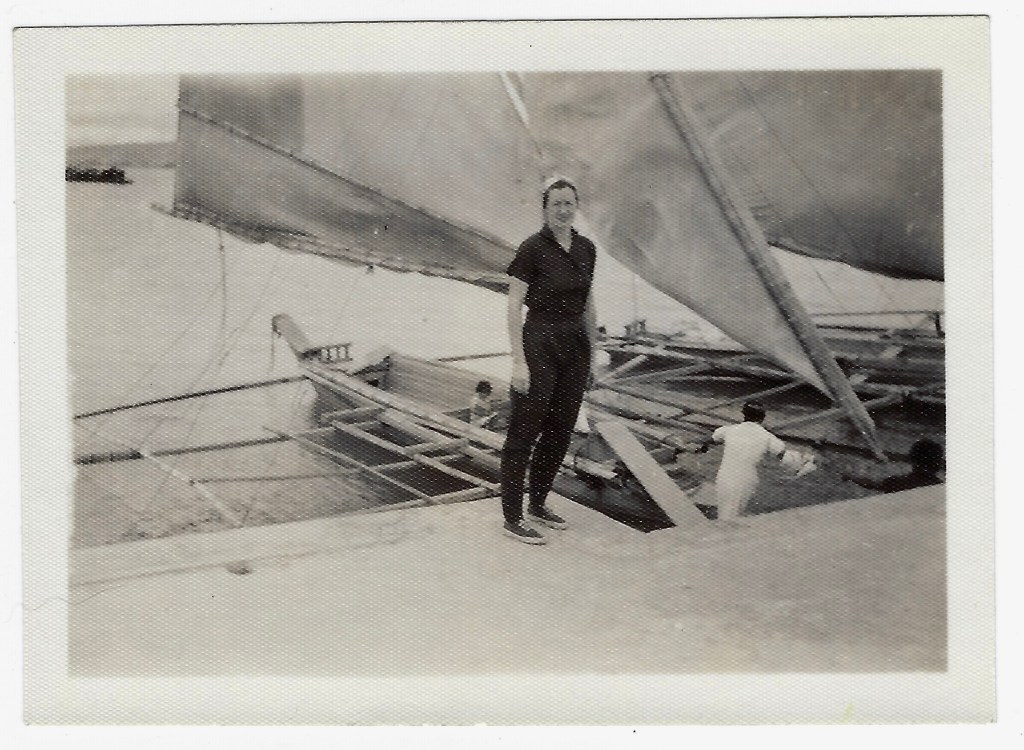
Helen in the Philippines, 1938. I have very similar shoes
Sat. Feb. 26 

Reduced speed last night to time arrival in Opon between boats, for there's only one wharf at the coconut oil refinery. Slid alongside before 8:00 a.m. Coconut oil hose into the deep tanks at once.

Serenaded before breakfast by native boys with ukuleles — who sat and played most of the day. "Milk from contented coconuts, I suppose". Uke's from Y 1 up.

Side note: Is the ‘milk from contented coconuts…’ lyric part of their serenade?? Or a saying of some sort? The Internet is not being helpful.

Shag and I went ashore between raindrops on a picture taking expedition. Opon is a small village (3 towns on the island — Mactan where the Magellan monument stands). 

Bamboo houses, coconut trees very short, got an orange blossom (much sturdier and larger than U.S. ones) from a 7th day Adventist Mission. Pony carts, the train of small boys, "Beautiful Lady in Blue", "Maternity Center and puericulture".

Side note: Opon is now Lapu-Lapu City.

The coconut refinery: take in 250T. copra daily, produces 170T. oil (storage tanks hold 340T.), 500 employees in 3 shifts year around. Buy whole nuts on % oil and water (by chemical tests). Climate here damp, 10% water, not millable. Kept under cover a month until lose 5% of water. Split nut, keep for month, crush twice, 2nd time to powder. Heated, oil pressed out in hydraulic press, refuse pressed into cakes, (removes extraneous matter & color) packed & shipped to Europe, cattle feed. For soap, oil mixed with 1% fuller's earth, 3% F.E. for white oil, shells for fuel. 

Side note: Coconut Refinement 301 (it’s like graduate level).

After lunch Sam, Ruth and I hired us to the town wharf, took an outrigger catamaran with blue sails (25 ft. long, 10 ft. outriggers, sail with 2 booms). Sailed across the bay to Cebu in an hour. Stood on the outrigger and dangled a foot. Grand sail. 

Side note: Dangling a foot off an outrigger catamaran whilst casually sailing off the Philippine’s in 1938 (at least the part before the war started) does sound grand.

To a club for some refreshment, shortly the Silverwillow arrived. First time I've seen her under way when I've not been on board. 

Sauntered around the town, saw the cross Magellan planted, the P.O., Int. Harvester Co., Shamrock Hotel, Colon St., the oldest in the Philippines, endless rows of shops with odds and ends of trash, narrow St's., Spanish architecture, iron grill work.

Rain, but not enough to delay loading much. Copra arrives on truck in bags in slings, dumped into the hold, is removed in port by suction. The whole town smells of it. Breeds flys. Chief says they eat all the oil out of the winches.

Shag and I went walking, found a bollard to sit on and talked for hours. He proposed to me again this morning. Sign on a movie house, "Nothing Sacred" and good added shorts.

Side note: Proposed AGAIN?? She failed to mention the first time. All this news and her handwriting, in her personal journal, remains the same as everything else… all measured.

A robust paragraph about coconut refineries, followed by seven words about a marriage proposal, all the same type height, width, angle, and pen pressure. That and she mentions it calmly, right after a story about smelly winches.

The below isn’t the same text, but it shows the same consistency.
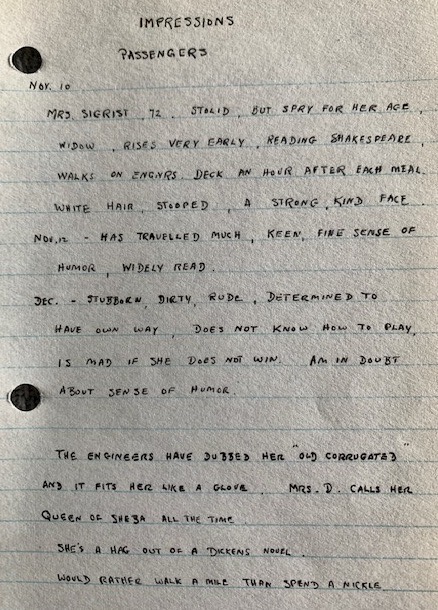
Alas though, we only have context as much as what’s in the journal, so nada about her feeeeelings about being proposed to AGAIN, so we must forge on… (but an element of romance and suspense makes for a Hollywood story, so thank you to Helen for keeping it coy).

Sun. Feb. 27: Walked ashore with Chief at 7 a.m. Very hot and glaring water and copra still loading. Lord Cochran, London, abaft us, has just been to Odessa under sealed orders. No pilot met the boat, "Mr. X" boarded when they landed, took on a cargo of guns, ammunition, planes, to Indo China, with each man receiving a bonus: Capt. $5000, Mate and Chief $4000, etc. thru each member on crew.

Side note: The USSR and China and Mr. X and guns and ammo and payouts?!?! The HMS Cochran (nee HMS Ambrose) was British. Just that year the boat went from being a passenger boat to a destroyer depot ship… one apparently up to shenanigans. Pirates??

Stopped at the race course — 8 a.m. to 6p.m. every Sunday — a dirt track in the stix, bamboo shelter for a grand stand, moth eaten looking ponies. 

Bridge of signs — natives brot out from the walls, dug their graves were shot so their bodies toppled in. The Spanish were full of tricks like that. The cemetery next to the hospital (for convenience, I suppose).

The house on the hill started by an American, blatant and ugly, Y 30,000.

Side note: Each port stop in this story could be a case study in why colonialism is absolutely a beyond monstrous endeavor. Yet almost 100 years later it’s still in the dialog.

Back to the ship at 10:20, and Shag got what for not being on board at 10, tho we didn't sail until after 12 — passed Opon during lunch, tho I went out in time to see the Nordmark from Berlin drawing up for some coconut oil. She's a big freighter, fine looking ship. Last look at tropical islands with sundown for tonight we go thru straits, the last land before Pedro. Toward dinner time we ran into rain and fog... and we crawled thru the night.

Side note: Pedro is San Pedro, California, which will be their next (and last) stop!

Mon. Feb. 28: Hard rain and rough seas. Capt. on the bridge all night, sleeping today. Knit and read. Stopped rain except for showers, but the jack staff wavered up and down all day and into the night. 

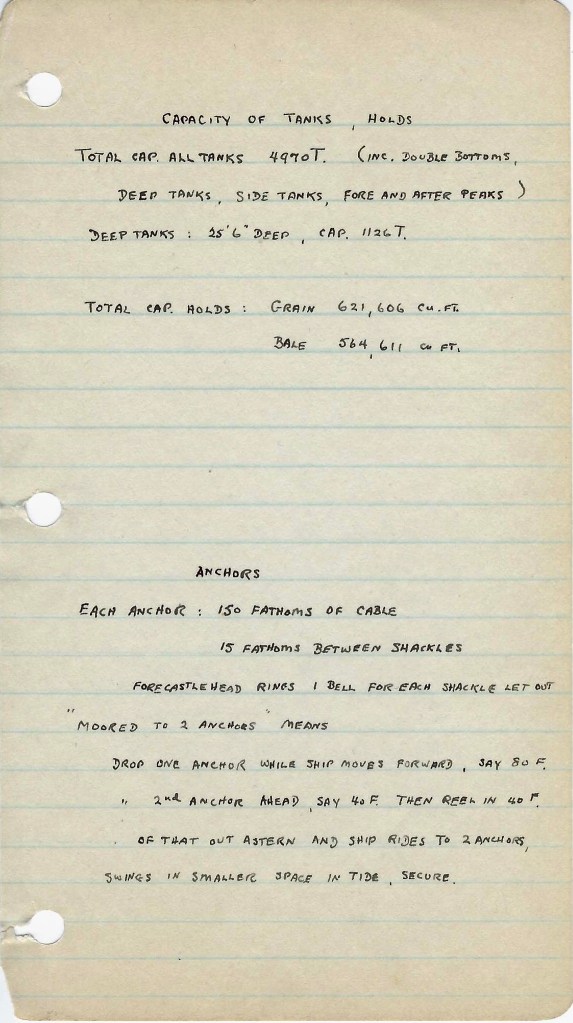
Jim had p.m. off, got some information about Lloyds Registry Pimsoll marks, capacity of various tanks, etc. Discovered a Wodehouse in the library and read some to Shag in the evening. During the hardest rain our canvas protector on passenger deck went up.

Side note: Ah ha! We have discovered the context to the notes and illustrations below. So it was Helen as student (that is her handwriting) and Jim as professor. But then she’s sheltering with Mr. Shag (the repeat proposer of marriage) later, during the hardest of rains.
Onwards!

30. India Part V: Some New and Old Delhi and then off to Calcutta, Jan. 18 – 22, 1938

This is all from the day-to-day journal. Helen takes in history and environs in Delhi before heading back to the boat. And we shall join her.

Thru the Kashmir Gate to the 1st city of Delhi, founded at end of 12th cent. by the slave dynasty — the Turk, Mohammad Ghori established Mohammedan Rule, having no son, he raised a slave to be his heir. Kutb-Din, the slave, built the Kutb Miner, used by Muezzin to call to prayer, 238 ft. tall. The iron pillar, standing for 1600 years. 

Humayun, son of Babar 1st Moghul Emperor ruled briefly, his tomb is red sandstone, used as model for the Taj.

Side note: there will be quizzes!

The Chatta Chowk, arcades of shops, one displaying the richest wares of the East, now ivory merchants, jewelry, carved wood. 

Diwan-l-Am, Durbar Hall, where Emperor dispensed justice, even the humblest might present his petition.

The inlay in marble, the canopy incrusted with gems and held by gold poles.

The Hall of Special Audience where the peacock thrones stood, the inscription, "If there is a paradise on earth, it is this, it is this, it is this".

The Turkish baths, the fountain of 9 streams for the pregnant woman.

Side note: That is an excellent quote, no? “If there is paradise on earth, it is this, it is this, it is this…”

Drove thru New Delhi — imposing buildings, beautifully laid out, but a come down after the splendors of Old Delhi. 

To the Chandi Chowk — to the Ivory Palace — magnificent carving, lovely textiles and brass.

Stopped at the Jumma Masjid — too weary of seeing white marble inlaid in red sandstone.

Had tea at the hotel, dashed to the station to find the train 1/2 hr. late on account of the wreck yesterday of the Punjab Mail. Found we had 1 lower, 2 uppers, 1 middle aged wife of a British Major, very sporty, a mousy governess-y looking person. Resigned to 36 hrs. of grit and dirt, we're off for Calcutta fuel on the hotel bill: 6 As.

Side note: Weary of white marble…

“If there is a paradise on earth, it is this, it is this, it is this” – The Hall of Special Audience

Mon. Jan 17: Our compartment companion got off at 6:00 a.m. at Allerabad. 

We three had tea and oranges, went back to bed.

Slept occasionally until two p.m. when enormous quantities of luggage arrived — 4 huge suitcases, 4 smaller ones, a wicker box, vegetable basket, birdcage, bedding roll, tennis rackets, coats, toupees, dog, widow with a sweet 14 yr. old child.

She was a fright, but she and Dreyer struck up an acquaintance and babbled for hours.

Side note: Dreyer is Helen’s roommate from the boat (at least when Helen is not in her deck hammock). Like the new train passenger, Dreyer is also a widow.

And again people traveling with toupees! I’ve looked this up on Chat GTP, and if it’s telling the truth, toupees or wiglets were quite popular before the 1930s, but we’re still being used for specific hair styles (I imagine these could be handy whilst traveling) or to add extra oomph or to cover problem spots.

The train was 2 hours late, and the last several hours were interminable. 

Dirty, wearying, and at every stop the inevitable bangles, dolls, brass, guavas and the everlasting "No-Go Away".

At long last we pulled in to Howrah Station. The Grand Hotel man got us a feeble taxi to the hotel.

Across the world's busiest bridge and certainly every type of conveyance is on it — autos, ox carts, horse drawn tongas, rickshaws, and many on foot with bedding and baggage piled high on their heads.

A seething mass of humanity and a hollow din of rubber bulb horns — honk, honk.

At 10:00 p.m. dinner in the grill with horrible bleating music.

To crown the day: a dirty tub taking an hour to empty. 

Trip Advisor: Two Stars.

28. India, Part III: Before the Taj Mahal: The Journal, Jan 11-14, 1938

“But we just left the Taj Mahal”, you say. And you are correct. But before we move forward, first we must circle back a little.

The last post presented passages from Helen’s post-trip letter to family, all nice and curated. But remember there is also a corresponding day-to-day journal, that was for her eyes only (at least until I came along)*, with fun detail and juicy context that doesn’t always make it into the letter. I’ll pare to the best bits.

*Helen gave all of her records to family, with the idea that someone might turn it all into a story and here I am doing that; I assume that she would have (and maybe did) pluck out bits she didn’t want anyone else to see.

The Day to Day Journal

Side note: We left the journal when Helen was luxuriating in a hotel (after over two months sleeping — by choice — primarily in a homemade hammock on a boat deck) before heading inland to the Taj Mahal with the ladies from the boat. But first, Helen networks a bit.

Tue. Jan. 11: Jack Frost came for me at noon, as darling as ever, to Ballygunge to her lovely home — high ceilings, airy, comfortable. Deep chairs covered in soft turquoise, a luscious Persian rug, fine silver and lined — a lawn tennis court, two dogs: Jack & Jill.

Sherry, then lunch: cold baked eggs with whipped cream & catsup, fish, peas, hot grapefruit, Kashmir English walnuts, figs, stuffed dates, Turkish coffee, Greek cigarettes.

Side note: I picture Jack & Jill as a regal, but derpy, long dogs, like Borzois. And I won’t comment on the cold baked eggs with whipped cream and catsup.

Drive with Jack about Maidan, Victoria Memorial, Fort William, cricket grounds, Gov. House, race track, 200 (Indian day, with band, hundreds listening, wrapt.) Hippo-elephants, giraffe, birds of color.

Side note: Hippo-elephant sounds like something to come out of a World’s Fair. I think she must have meant hippos and elephants, like she saw both? She’s too science-y to confuse the two (and yes I Googled whether hippo-elephants exists or have existed… no they don’t/didn’t).

To Tollygunge Club (1000 members) — race track where gentlemen jockeys hold 4 race meeting a year open to public, pays club expenses. 

The house was owned by an Indigo Planter — lovely: yellow-orange bougainvillea, enormous cannas, swim pool, golf and tennis. Had tea on the lawn, a restful spot. Thru Alipore, the other residential district (Viceroy's house) past Jodphur Club.

To 1st Empire. Ronald Coleman and Madeleine Carroll in "The Prisoner of Zenda". Nearly everyone in evening clothes. Strange to come out from the American picture to the squalor of an Indian street.

Side note: She might be again job prospecting thru YWCA connections. This sounds like a lovely spot, tea on the manicured lawn and all, but lordy the disparity (see the last two posts).

Wed. Jan. 12: Shag and I wandered back across the Maidan for a couple of precious hours together. Sigrist came to get Dreyer's blanket while D. buys her own bedding, cheap skate! If I ever get like that! 

Side note: She would get like that. Precious hours with Shaaag. She won’t see him for a whole 10 days.

Across the river to Howrah Station. Miss Skinner and party on the door of the compartment. As barren as a cattle car, narrow seats around three sides, so someone's feet are in the face of another. (R.R. & Calcutta time 24 min. different). Punjab express. We rented bedding rolls for 1 Ru. per day from Am. Ex. For 6 As. Had them delivered at station. One ladies' 2nd class compartment on each train.

To Dasashwamedh Ghat to take the boat up river first, past bathing ghats.

Everyone bathes in the river each day, then worship under the straw umbrellas where the priests sit. Many temples and palaces with stairs leading to the water's edge. Various postures as prayers are said and rites performed. Down river, where we watched one funeral pyre and saw another corpse prepared - an emaciated middle aged man, whose widow, in white, with low-coiled shining black hair, sat wailing at the top of the steps.

The Hindu belief: body is dust, fire, water, they bury material things, ashes burned in the fire are returned to water. On down the river past more palaces, rest houses, temples and return to the starting place.
Drive thru the city, saw the Monkey Temple, here barren women pray to Durga for fertility. If the prayer is answered, a goat is sacrificed. 

Thru narrow alleyways lined with beggars to several other temples - Siva, Goddess of Plenty, Ganesh, the Elephant God, the Sacred Bulls, Well of Knowledge, the Golden Temple whose beautiful spire must be observed from a balcony next door, so narrow are the streets. We were given garlands of the Niwari flower. Peepal tree sacred, may not be cut down.

After lunch to Sarnath, where Buddha preached his first sermon, gained his first 5 converts. Dammekh Stupa, built in 3rd Century B. C. near Buddhist ruins more than 1000 yr. old. Modern Buddhist temple with murals of the life of Buddha done by a Japanese.

After dinner entertained by a magician who was exceptionally good, produced a flock of live birds out of his equivalent of a hat.

Side note: ‘Equivalent of a hat…’ is a good band name, no?

Fri. Jan. 14: Tea at 5:00 a.m., left for the station in the cold gray dark at 5:30. On board the first train for Mogul Serai, our bearers carried our luggage up over the bridge to the waiting room and back again. It was 7:30 when we got away. Had an attractive young Chi-Chi girl in our compartment as far as Allerabad. 

Side note: I think Chi-Chi is like shi-shi? Someone who is stylish?

Wild monkeys, gorgeous parrots, peacocks, mud hut villages, bathing in every water hole, wells with oxen every drawing water for irrigation. 

Change trains at Tundla at 4:30 p.m., we were put in first class carriage with K.R. Dixit, professor of physics, Gujarat College, Ahmedabad, returning from the Science Congress at Calcutta, stopping over between trains to see the Taj.

Side note: Dr. K.R. Dixit wrote a paper in 1940 (two years after this trip) that appeared in the ‘Proceedings of the Indian Academy of Sciences’, which was published by Springer, which happens to be the publisher for whom I work. And we publish their conference proceedings still, almost 100 years later. La de da!

So here we bid adieu, with the ladies choo chooing along with Dr. Dixit, chewing the rag about Helen’s favorite things: science and facts.

Next time we will, again, visit the Taj Mahal, but from a different perspective.

26. India, Pt I: Cocanada, Budge-Budge, and the Hooghly River, Jan 7-9, 1938

After the round-the-world trip ended, Helen sent a three-page, airmail letter to family and friends to summarize it all. Word count and word choice were important back then — each ounce mattered — unlike now where we can just plod along forever and then absentmindedly click send and a typo-laced missive instantly transmits to the nearby and/or far-flung.

Almost one whole page of her three page letter was devoted to an overly complicated in-land side-trip to the Taj Mahal.

  • Two of the three pages consisted of: colorful descriptions of all of the world that she saw except the part about getting to the Taj Mahal.
  • One of the three pages consisted of: getting to the Taj Mahal.

She did other things in India though that don’t get covered in the letter, but do in the journal, where there was not a word or weight limit. And we can’t miss the whats and whos of Cocanada and Budge-Budge back in early 1938, can we??

The Day-to-Day Journal

Side note: We start here while still on the Motorvessel Silverwillow and we are forging ahead towards Coconada, India (now Kakinada — both of these similar sounding names came from the British and Dutch). This port town, like so many, has long suffered the deeds of those looking to stake claim and/or pillage — land, resources, women, men, jewels, crops, minerals, power, etc.

Fri. Jan. 7: 

Capt. up at 4:00, not long after the engines stopped (we'd been creeping along on one most of the night so's not to arrive too soon). With dawn came barges sailed with lateen rig, from Coconada, 4 miles away.

On one barge breakfast was in progress, process of washing plate with water from a small glass jar, wiping it off with dirty hand, scooping white meal from common bowl, pouring on some water, eating with hand, plantation, betel nut. Four fires kindled in the bottom of boat, iron pots boiling water, cooking rice, spoons of coconut shell with bamboo handle, drain in large mat baskets.

Side note: The above is a window into colonialism and the caste system at work, with the former taking advantage of tenants of the latter (we’ll see more of this, in much more detail, in the next post). The people on the boat were likely Labourers, which is the lowest official caste, but there are countless others who don’t get a caste.

[Present location:] Lat. 20° 22' N; Long. 87° 22" E; Dist. 341 mi.; Av. Speed 14.44 mph. 

Sat. Jan. 8: Study in a.m., boat deck at 2:00 for a lesson on "Day's Work". Hooghly River pilots have a very handsome yacht, they're a snooty crowd. Came on board at 4:00 and we start towards the Ganges River, 30 miles away.

Side note: the Hooghly River is a tributary of the Ganges and they are heading up it to Budge Budge on their tug tug. And they are meeting some puffed up yacht snooties along the way.

BUDGE-BUDGE 

Sun. Jan. 9:

At 2:30 a.m. woke when the pilot took over my hammock saying, "You shouldn't be sleeping out here, it's the best way to get malaria" — then clutched me in an embrace.

H [a pilot] stayed until 4:45, sitting on the floor talking. He's a fool and an overbearing braggart, if this is the Englishman in Gov't service abroad, heaven preserve us. At breakfast he appeared again — to tell us of the 23 glasses of champagne at the Governor's ball.

Side note: This was all between 2:30am, 4:45am, and breakfast? If this ‘pilot’ is all the same person, we don’t like him. Handsy, overbearing, braggart. There might be more than one pilot being mentioned though, but we definitely don’t like English Pilot H.

“The helmsman stands like Hosea draped in a long robe and standing high above the oarsmen at the stern, makes a strange solitary figure against the sky.”

Went ashore at Budge-Budge when finally we got alongside (it took 3 hours) to the customs house to phone to the city about rooms, with not much success. Wild wind and rain storm while we were there.

Side note: I just learned that Budge-Budge got its name from the sound Portuguese boots would make in the local marshes.

Shag and I walked in Budge-Budge: squalid huts, innumerable people in sanitary arrangements on whatever spot is convenient at the moment. We did find a moon shining on the water off a lagoon. 

Mon. Jan. 10: Out in the stream at 11:00 a.m. after three hours getting away. 1/2 is carried aft and we are made fast to the wharf chains by them, a very slow process.

The helmsman stands like Hosea draped in a long robe and standing high above the oarsmen at the stern, makes a strange solitary figure against the sky. Men come down from inland villages and live on the boats and work on the river for months. There are no women on them.

River channel narrow with dangerous shoals, sharp turns, quicksand's (the James and Mary) necessary to wait for tide. Directly to dry-dock. So we had to get off at once. To Grand Hotel on Chowringee, high ceilings, marble floors, dingy, eccentric plumbing — Lysol!

Out to see about travel in India.

Side note: That is the Royal James and Mary, thank you very much. It is also my name reversed. We’re going to ignore that Royal James and Mary refers to quicksand, because I am afraid of quicksand and pretend it doesn’t exist.

Instead we will imagine how wonderful it must have been to stay at a hotel after the months on the hammock.

But she wouldn’t be comfy for long, as soon she’d be on her way to the Taj Mahal, where she’d make a misstep or three….