38. Magellan & Stilt Houses — The Philippines, Feb 19 – 20, 1938

After-the-Trip Letter

Shall I say we "browsed" through the Philippines, loading sugar, palm and coconut oil, copra and copra meal at several of the islands. 

We saw the spot where Magellan was buried, or where what was left of him was buried after the cannibals finished with him...we thumbed rides on native outrigger sailboats, went fishing, went ashore in native villages...

Side note: Magellan died by poison arrow, in Lapulapu, Philippines in 1521, at the age of 41ish. I’ve just learned (or maybe relearned) that ‘The Magellan Expedition’ was indeed the first expedition to circumnavigate the globe, but Magellan himself did not complete the voyage, because of the arrow.

...the bamboo huts are raised high on stilts..that helps to keep out some of the “varmints", and then it rains so much they would be awash most of the time. Normally the space under the house provides shelter for the pigs and chickens. The floors of the hut are made of split bamboo, rounded side up, and they seem to sleep comfortably on woven bamboo mats spread on the floor. A bed is such a novelty...there isn't much furniture of any kind, but I located the inevitable Singer Sewing machine. 

Side note: A whole paragraph about stilt houses is a lot for a three page letter about a five month trip. I bet the houses were (and are) striking for just about anyone used to seeing houses on the ground. They likely looked like this and the bamboo mats like this.

The Day-to-Day Journal

Lighters came from Victoria Refinery across the bay. Catamarans came swooping down on us from all directions. Unbelievably narrow craft of various sizes with sloop rig and great bamboo outriggers. 

At 1:00pm the starboard forward life-boat went overside and sailed across to the village. We were met on shore by the population, followed about, a few spoke some English.

Perhaps 60 bamboo huts on stilts, pigs underneath, almost no furniture, occasional magazine pictures on the walls, a few potted plants, one sewing machine.

Some of the girls quite nicely dressed. The boys swam, Jim and I wandered up "Main Street". Passed the "Bay-Ang Barrio School", kept very neatly. Water buffalo sloshing about in the puddle in back of the town.

Side note: The link above shows a very different style of stilt house than the first one I shared. The quality would depend on who you were, but whomever, you’d be on stilts.

Sun. Feb. 20: Off for Manila soon after. Sam is going to do violence to Daisy in the cause of "I have a friend". Two people have a basic understanding for marriage. 

Side note: Miss Daisy Mount is one of the civilian passengers about whom Helen said early into the trip:
“Sweet little old lady, dainty, birdlike movements….”.

And then Daisy said to Helen, “I have a friend”. So maybe that was Daisy’s thing… to make friends; and now Sam is getting the treatment. A rugged sailor hitching what he thought would be an easy a ride on a freight boat for a few stops through Philippines, and a sweet dainty little old lady who wants to be his friend. I hope we hear more.

But before we move on to Manila, let’s look at Helen in the Philippines for second:
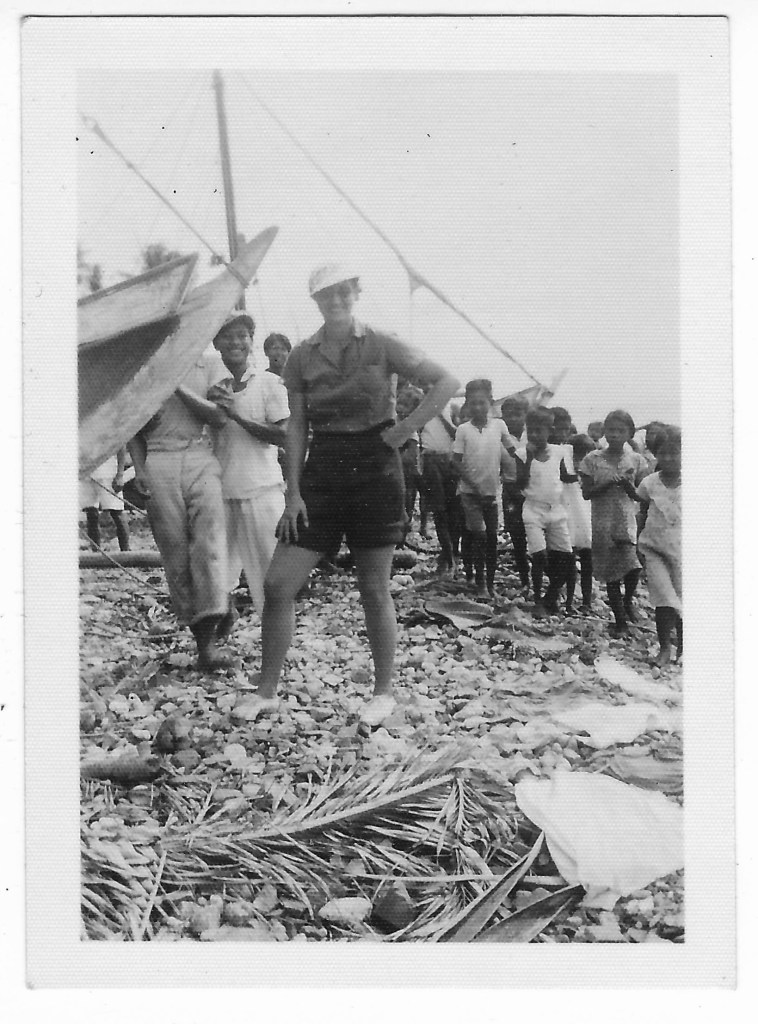
Helen Skinner, Philipines, 1938

27. India, Part II: Awe at the Taj Mahal: The Letter Home, Jan 1938

With ten days of shore leave at hand, Helen embarked on a complicated, multi-day side trip inland — traveling over 1,200km each way — via boat and train. She reflected upon it all quite colorfully in both the after-the-trip letter and the day-to-day journal. So much color in fact, it will take two posts.

First, the shorter after-the-trip summary…

The After-the-Trip Letter

(I mentioned in the last post about the unfortunate state of things for many in India at the time. That state of things is reflected in her observations below.)

The ship went into dry-dock in Calcutta, and while hundreds of coolies swarmed over the boat day and night, riveting, hammering, scouring, repairing, and refurbishing, the passengers had ten days "on their own”. 

Three of us, Lysol bottle in hand, braved the so-called perils of travel by train.

“You must travel 1st class, and you MUST take a bearer (servant)", everyone said, so we went 2nd class, without bearers -- you have to take your own bedding on Indian railroads...we rented bedding rolls from American Express for one rupee ($.38) a day...the natives steal everything on the train that is not securely fastened, so the comforts thereof are negligible, if not non-existent.

We found the trains unbelievably dirty, the sleeping accommodations thin (the berths were 2 in. thick, and the mattress...well, to be generous, maybe one-half inch...these came with the roll of bedding), the beggars persistent, the station platforms crowded with squatting Indians surrounded by their luggage, and innumerable peddlers who urged us in all the dialects of Hindustan to buy knives, bangles, brassware, guavas, betel nut (one walks the streets of India mentally holding in one's skirts, for chewing betel nut is the national pastime, and you never can tell from where he sits how far the chewer is going to spit the bright red juice whose spots give India's pavements a perpetually gory aspect). 

We wouldn't have missed the experience, and we learned to bargain, and to accept only good rupees (about half the currency is counterfeit, and you have to “ring" every coin before you take it, or they will "take" you…) and how to get off a train without tipping six porters and their uncles and their cousins and their aunts. 

Side note: She was warned! By ‘everyone’! But see… up there she says she wouldn’t have missed it.

Oh, and ‘we’ in his passage of the letter is not about Shag, but instead about her two female traveling companions on this side trip. They are both fellow civilian passengers from the boat. Which two right now I cannot recall, but they will appear in the next post in some detail.

And lastly, a public service announcement: The betel nut, like many consumables that are fun and/or frowned upon, can be addictive and harmful to the health.

In Benares we sat in wicker chairs and were rowed up the Holy Ganges River past the spectacle that is the sacred city of the Hindu (for a Hindu to die in Benares is to assure his salvation, and they come in countless thousands, pilgrims of every age, to bathe in the holy river -- pardon me while I hold my nose). It is the bath, the laundry, the medicine, the chapel, the lavatory and the crematory AND the drinking water! UGH! 

Side note: Here is a video of what she might have experienced, taken in 1937. I found some photos that aren’t all Benares, but there are great photos from India in the 1930s.

Let's escape to Agra. I'd heard so much about the Taj Mahal that I expected to be disappointed, but that evening has a page all its own in my book of memories. The setting sun shed a rosy glow on the white marble as we saw it first...then it was almost dark inside the mausoleum when we entered, and I had a momentary feeling of stepping into the past...a voice called 'Allah, Allah, Allah', and ages later the echo came back hollowly. By candle-light we examined the exquisitely carved marble screen surrounding the sarcophagi, and the wall panels inlaid with lapis-lazuli, carnelian, jade, jasper, in delicately wrought patterns. 

Side note: The Taj Mahal was built in 1631 (!) in honor of the emperor’s favorite wife. I don’t know when I thought it was built, but that is older than I expected.

And did she just know the names of those inlaid rocks and how to spell them? As a child in Colorado, I used to go to a rock and mineral shop almost weekly with my mother — each for our own reasons — and I’ve never heard of lapis-lazuli or carnelian.

Our companion, a young Indian professor of Physics from Ahmedabad, lighted our way with a dim pocket torch up a circular staircase to the top of a minaret. We had not long to wait for the moon to cross the river. It touched the marble with a caress, softening the lines until the Taj looked like a rare old ivory carved by a master craftsman. 

In Delhi we saw acres of marble buildings inlaid with semi-precious stones, built by the Mogul Emperors five hundred years ago.

Our eyes stood out on stems and our chins rested on our chests. It was so gorgeous we lost the power to react to it. 

Side note: We’ll talk more about this young professor in the next post, but for context, at some point her little group ends up in First Class on the train and there she meets a young professor who is headed to the same place they’re going. And the four of them then travel to the Taj Mahal together.

Another side note: The bit about the phrase, ‘Our eyes stood out on stems…’ evokes old cartoons, no? And it’s fitting. The art and architectures that humans build for their myriad gods are some of the most eyes-on-stems and chin-on-chest inducing of any, even for non-believers.

“Our eyes stood out on stems and our chins rested on our chests. It was so gorgeous we lost the power to react to it.”

The trip back to Calcutta is a volume in itself, so don't get me started on our compartment mates with their 14 suitcases, the garden flowers, the lunch hamper, the tepees, tennis rackets, basket of vegetables, raincoats, birdcage and catch terrier. 

Side note: Tepees?